
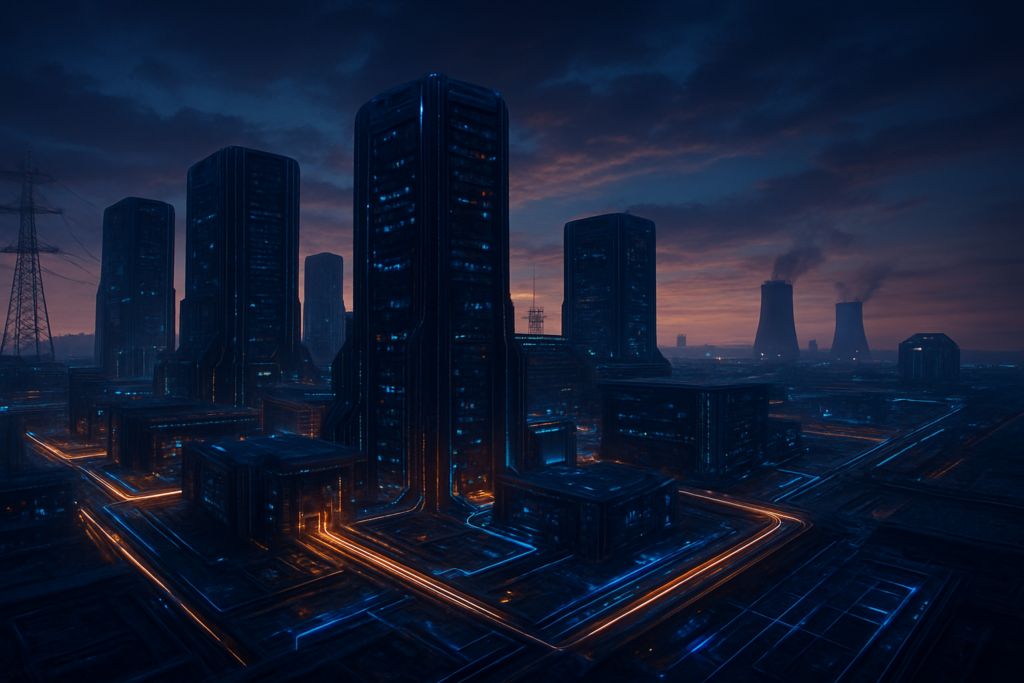
In a move that has fundamentally rewritten the economics of the silicon age, OpenAI, SoftBank Group Corp. (TYO: 9984), and Oracle Corp. (NYSE: ORCL) have solidified their alliance under "Project Stargate"—a breathtaking $500 billion infrastructure initiative designed to build the world’s first 10-gigawatt "AI factory." As of late January 2026, the venture has transitioned from a series of ambitious blueprints into the largest industrial undertaking in human history. This massive infrastructure play represents a strategic bet that the path to artificial super-intelligence (ASI) is no longer a matter of algorithmic refinement alone, but one of raw, unprecedented physical scale.
The significance of Project Stargate cannot be overstated; it is a "Manhattan Project" for the era of intelligence. By combining OpenAI’s frontier models with SoftBank’s massive capital reserves and Oracle’s distributed cloud expertise, the trio is bypassing traditional data center constraints to build a global compute fabric. With an initial $100 billion already deployed and sites breaking ground from the plains of Texas to the fjords of Norway, Stargate is intended to provide the sheer "compute-force" necessary to train GPT-6 and the subsequent models that experts believe will cross the threshold into autonomous reasoning and scientific discovery.
The Engineering of an AI Titan: 10 Gigawatts and Custom Silicon
Technically, Project Stargate is less a single building and more a distributed network of "Giga-clusters" designed to function as a singular, unified supercomputer. The flagship site in Abilene, Texas, alone is slated for a 1.2-gigawatt capacity, featuring ten massive 500,000-square-foot facilities. To achieve the 10-gigawatt target—a power load equivalent to ten large nuclear reactors—the project has pioneered new frontiers in power density. These facilities utilize NVIDIA Corp. (NASDAQ: NVDA) Blackwell GB200 racks, with a rapid transition planned for the "Vera Rubin" architecture by late 2026. Each rack consumes upwards of 130 kW, necessitating a total abandonment of traditional air cooling in favor of advanced closed-loop liquid cooling systems provided by specialized partners like LiquidStack.
This infrastructure is not merely a graveyard for standard GPUs. While NVIDIA remains a cornerstone partner, OpenAI has aggressively diversified its compute supply to mitigate bottlenecks. Recent reports confirm a $10 billion agreement with Cerebras Systems and deep co-development projects with Broadcom Inc. (NASDAQ: AVGO) and Advanced Micro Devices, Inc. (NASDAQ: AMD) to integrate up to 6 gigawatts of custom Instinct-series accelerators. This multi-vendor strategy ensures that Stargate remains resilient against supply chain shocks, while Oracle’s (NYSE: ORCL) Cloud Infrastructure (OCI) provides the orchestration layer, allowing these disparate hardware blocks to communicate with the near-zero latency required for massive-scale model parallelization.
Market Shocks: The Rise of the Infrastructure Super-Alliance
The formation of Stargate LLC has sent shockwaves through the technology sector, particularly concerning the long-standing partnership between OpenAI and Microsoft Corp. (NASDAQ: MSFT). While Microsoft remains a vital collaborator, the $500 billion Stargate venture marks a clear pivot toward a multi-cloud, multi-benefactor future for Sam Altman’s firm. For SoftBank (TYO: 9984), the project represents a triumphant return to the center of the tech universe; Masayoshi Son, serving as Chairman of Stargate LLC, is leveraging his ownership of Arm Holdings plc (NASDAQ: ARM) to ensure that vertical integration—from chip architecture to the power grid—remains within the venture's control.
Oracle (NYSE: ORCL) has arguably seen the most significant strategic uplift. By positioning itself as the "Infrastructure Architect" for Stargate, Oracle has leapfrogged competitors in the high-performance computing (HPC) space. Larry Ellison has championed the project as the ultimate validation of Oracle’s distributed cloud vision, recently revealing that the company has secured permits for three small modular reactors (SMRs) to provide dedicated carbon-free power to Stargate nodes. This move has forced rivals like Google (NASDAQ: GOOGL) and Amazon (NASDAQ: AMZN) to accelerate their own nuclear-integrated data center plans, effectively turning the AI race into an energy-acquisition race.
Sovereignty, Energy, and the New Global Compute Order
Beyond the balance sheets, Project Stargate carries immense geopolitical and societal weight. The sheer energy requirement—10 gigawatts—has sparked a national conversation regarding the stability of the U.S. electrical grid. Critics argue that the project’s demand could outpace domestic energy production, potentially driving up costs for consumers. However, the venture’s proponents, including leadership from Abu Dhabi’s MGX, argue that Stargate is a national security imperative. By anchoring the bulk of this compute within the United States and its closest allies, OpenAI and its partners aim to ensure that the "intelligence transition" is governed by democratic values.
The project also marks a milestone in the "OpenAI for Countries" initiative. Stargate is expanding into sovereign nodes, such as a 1-gigawatt cluster in the UAE and a 230-megawatt hydropowered site in Narvik, Norway. This suggests a future where compute capacity is treated as a strategic national reserve, much like oil or grain. The comparison to the Manhattan Project is apt; Stargate is an admission that the first entity to achieve super-intelligence will likely be the one that can harness the most electricity and the most silicon simultaneously, effectively turning industrial capacity into cognitive power.
The Horizon: GPT-7 and the Era of Scientific Discovery
In the near term, the immediate application for this 10-gigawatt factory is the training of GPT-6 and GPT-7. These models are expected to move beyond text and image generation into "world-model" simulations, where AI can conduct millions of virtual scientific experiments in seconds. Larry Ellison has already hinted at a "Healthcare Stargate" initiative, which aims to use the massive compute fabric to design personalized mRNA cancer vaccines and simulate complex protein folding at a scale previously thought impossible. The goal is to reduce the time for drug discovery from years to under 48 hours.
However, the path forward is not without significant hurdles. As of January 2026, the project is navigating a global shortage of high-voltage transformers and ongoing regulatory scrutiny regarding SoftBank’s (TYO: 9984) attempts to acquire more domestic data center operators like Switch. Furthermore, the integration of small modular reactors (SMRs) remains a multi-year regulatory challenge. Experts predict that the next 18 months will be defined by "the battle for the grid," as Stargate LLC attempts to secure the interconnections necessary to bring its full 10-gigawatt vision online before the decade's end.
A New Chapter in AI History
Project Stargate represents the definitive end of the "laptop-era" of AI and the beginning of the "industrial-scale" era. The $500 billion commitment from OpenAI, SoftBank (TYO: 9984), and Oracle (NYSE: ORCL) is a testament to the belief that artificial general intelligence is no longer a "if," but a "when," provided the infrastructure can support it. By fusing the world’s most advanced software with the world’s most ambitious physical build-out, the partners are attempting to build the engine that will drive the next century of human progress.
In the coming months, the industry will be watching closely for the completion of the "Lighthouse" campus in Wisconsin and the first successful deployments of custom OpenAI-designed silicon within the Stargate fabric. If successful, this 10-gigawatt AI factory will not just be a data center, but the foundational infrastructure for a new form of civilization—one powered by super-intelligence and sustained by the largest investment in technology ever recorded.
This content is intended for informational purposes only and represents analysis of current AI developments.
TokenRing AI delivers enterprise-grade solutions for multi-agent AI workflow orchestration, AI-powered development tools, and seamless remote collaboration platforms. For more information, visit https://www.tokenring.ai/.