
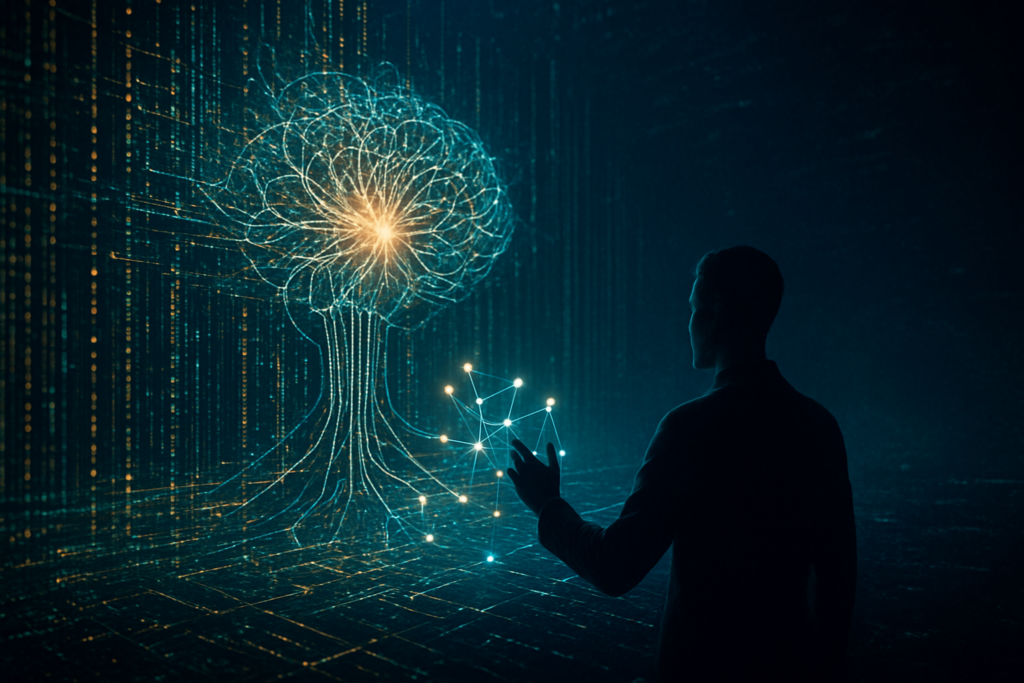
In a watershed moment for the artificial intelligence industry, Anthropic CEO Dario Amodei recently confirmed that the "vast majority"—estimated at over 90%—of the code for new Claude models and features is now authored autonomously by AI agents. Speaking at a series of industry briefings in early 2026, Amodei revealed that the internal development cycle at Anthropic has undergone a "phase transition," shifting from human-centric programming to a model where AI acts as the primary developer while humans transition into the roles of high-level architects and security auditors.
This announcement marks a definitive shift in the "AI building AI" narrative. While the industry has long speculated about recursive self-improvement, Anthropic's disclosure provides the first concrete evidence that a leading AI lab has integrated autonomous coding at such a massive scale. The move has sent shockwaves through the tech sector, signaling that the speed of AI development is no longer limited by human typing speed or engineering headcount, but by compute availability and the refinement of agentic workflows.
The Engine of Autonomy: Claude Code and Agentic Loops
The technical foundation for this milestone lies in a suite of internal tools that Anthropic has refined over the past year, most notably Claude Code. This agentic command-line interface (CLI) allows the model to interact directly with codebases, performing multi-file refactors, executing terminal commands, and fixing its own bugs through iterative testing loops. Amodei noted that the current flagship model, Claude Opus 4.5, achieved an unprecedented 80.9% on the SWE-bench Verified benchmark—a rigorous test of an AI’s ability to solve real-world software engineering issues—enabling it to handle tasks that were considered impossible for machines just 18 months ago.
Crucially, this capability is supported by Anthropic’s "Computer Use" feature, which allows Claude to interact with standard desktop environments just as a human developer would. By viewing screens, moving cursors, and typing into IDEs, the AI can navigate complex legacy systems that lack modern APIs. This differs from previous "autocomplete" tools like GitHub Copilot; instead of suggesting the next line of code, Claude now plans the entire architecture of a feature, writes the implementation, runs the test suite, and submits a pull request for human review.
Initial reactions from the AI research community have been polarized. While some herald this as the dawn of the "10x Engineer" era, others express concern over the "review bottleneck." Researchers at top universities have pointed out that as AI writes more code, the burden of finding subtle, high-level logical errors shifts entirely to humans, who may struggle to keep pace with the sheer volume of output. "We are moving from a world of writing to a world of auditing," noted one senior researcher. "The challenge is that auditing code you didn't write is often harder than writing it yourself from scratch."
Market Disruption: The Race to the Self-Correction Loop
The revelation that Anthropic is operating at a 90% automation rate has placed immense pressure on its rivals. While Microsoft (NASDAQ: MSFT) and GitHub have pioneered AI-assisted coding, they have generally reported lower internal automation figures, with Microsoft recently citing a 30-40% range for AI-generated code in their repositories. Meanwhile, Alphabet Inc. (NASDAQ: GOOGL), an investor in Anthropic, has seen its own Google Research teams push Gemini 3 Pro to automate roughly 30% of their new code, leveraging its massive 2-million-token context window to analyze entire enterprise systems at once.
Meta Platforms, Inc. (NASDAQ: META) has taken a different strategic path, with CEO Mark Zuckerberg setting a goal for AI to function as "mid-level software engineers" by the end of 2026. However, Anthropic’s aggressive internal adoption gives it a potential speed advantage. The company recently demonstrated this by launching "Cowork," a new autonomous agent for non-technical users, which was reportedly built from scratch in just 10 days using their internal AI-driven pipeline. This "speed-to-market" advantage could redefine how startups compete with established tech giants, as the cost and time required to launch sophisticated software products continue to plummet.
Strategic advantages are also shifting toward companies that control the "Vibe Coding" interface—the high-level design layer where humans interact with the AI. Salesforce (NYSE: CRM), which hosted Amodei during his initial 2025 predictions, is already integrating these agentic capabilities into its platform, suggesting that the future of enterprise software is not about "tools" but about "autonomous departments" that write their own custom logic on the fly.
The Broader Landscape: Efficiency vs. Skill Atrophy
Beyond the immediate productivity gains, the shift toward 90% AI-written code raises profound questions about the future of the software engineering profession. The emergence of the "Vibe Coder"—a term used to describe developers who focus on high-level design and "vibes" rather than syntax—represents a radical departure from 50 years of computer science tradition. This fits into a broader trend where AI is moving from a co-pilot to a primary agent, but it brings significant risks.
Security remains a primary concern. Cybersecurity experts warned in early 2026 that AI-generated code could introduce vulnerabilities at a scale never seen before. While AI is excellent at following patterns, it can also propagate subtle security flaws across thousands of files in seconds. Furthermore, there is the growing worry of "skill atrophy" among junior developers. If AI writes 90% of the code, the entry-level "grunt work" that typically trains the next generation of architects is disappearing, potentially creating a leadership vacuum in the decade to come.
Comparisons are being made to the "calculus vs. calculator" debates of the past, but the stakes here are significantly higher. This is a recursive loop: AI is writing the code for the next version of AI. If the "training data" for the next model is primarily code written by the previous model, the industry faces the risk of "model collapse" or the reinforcement of existing biases if the human "Architect-Supervisors" are not hyper-vigilant.
The Road to Claude 5: Agent Constellations
Looking ahead, the focus is now squarely on the upcoming Claude 5 model, rumored for release in late Q1 or early Q2 2026. Industry leaks suggest that Claude 5 will move away from being a single chatbot and instead function as an "Agent Constellation"—a swarm of specialized sub-agents that can collaborate on massive software projects simultaneously. These agents will reportedly be capable of self-correcting not just their code, but their own underlying logic, bringing the industry one step closer to Artificial General Intelligence (AGI).
The next major challenge for Anthropic and its competitors will be the "last 10%" of coding. While AI can handle the majority of standard logic, the most complex edge cases and hardware-software integrations still require human intuition. Experts predict that the next two years will see a battle for "Verifiable AI," where models are not just asked to write code, but to provide mathematical proof that the code is secure and performs exactly as intended.
A New Chapter in Human-AI Collaboration
Dario Amodei’s confirmation that AI is now the primary author of Anthropic’s codebase marks a definitive "before and after" moment in the history of technology. It is a testament to how quickly the "recursive self-improvement" loop has closed. In less than three years, we have moved from AI that could barely write a Python script to AI that is architecting the very systems that will replace it.
The key takeaway is that the role of the human has not vanished, but has been elevated to a level of unprecedented leverage. One engineer can now do the work of a fifty-person team, provided they have the architectural vision to guide the machine. As we watch the developments of the coming months, the industry will be focused on one question: as the AI continues to write its own future, how much control will the "Architect-Supervisors" truly retain?
This content is intended for informational purposes only and represents analysis of current AI developments.
TokenRing AI delivers enterprise-grade solutions for multi-agent AI workflow orchestration, AI-powered development tools, and seamless remote collaboration platforms.
For more information, visit https://www.tokenring.ai/.