
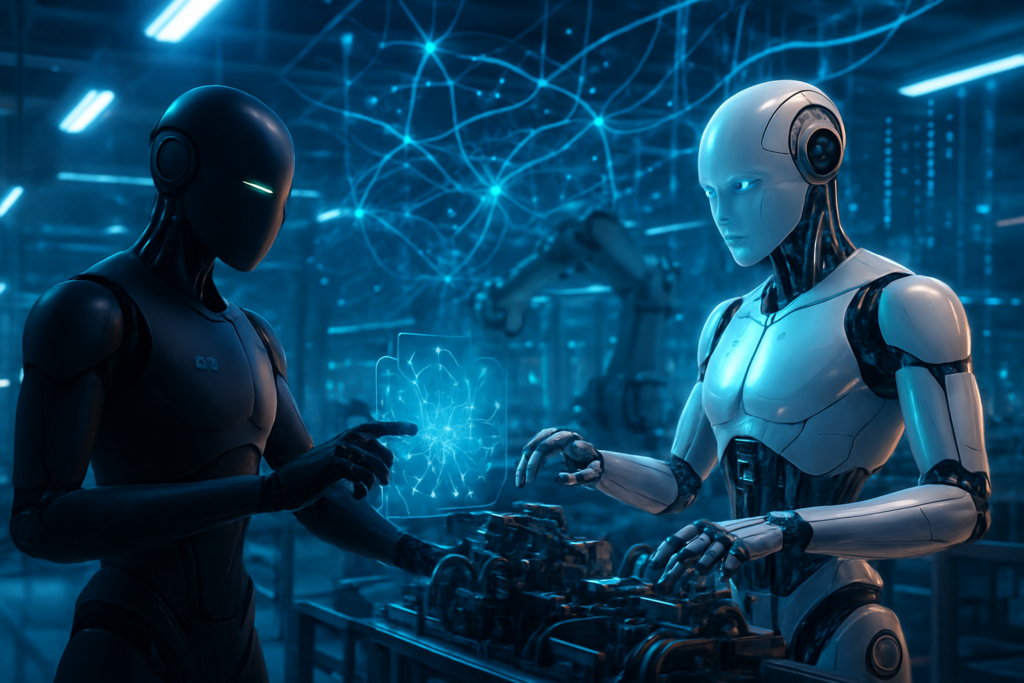
As 2025 draws to a close, the landscape of artificial intelligence has shifted from the digital screens of chatbots to the physical reality of autonomous humanoids. The final quarter of the year has been defined by a strategic "great decoupling," most notably led by Figure AI, which has moved away from its foundational partnership with OpenAI to develop its own proprietary "Helix" AI architecture. This shift signals a new era of vertical integration where the world’s leading robotics firms are no longer content with general-purpose models, opting instead for "embodied AI" systems built specifically for the nuances of physical labor.
This transition comes as Tesla (NASDAQ: TSLA) accelerates its own Optimus program, transitioning from prototype demonstrations to active factory deployment. With Figure AI proving the commercial viability of humanoids through its landmark partnership with BMW (ETR: BMW), the industry has moved past the "can they walk?" phase and into the "how many can they build?" phase. The competition between Figure’s specialized industrial focus and Tesla’s vision of a mass-market generalist is now the central drama of the tech sector, promising to redefine the global labor market in the coming decade.
The Rise of Helix and the 22-DoF Breakthrough
The technical frontier of robotics in late 2025 is defined by two major advancements: Figure’s "Helix" Vision-Language-Action (VLA) model and Tesla’s revolutionary 22-Degree-of-Freedom (DoF) hand design. Figure’s decision to move in-house was driven by the need for a "System 1/System 2" architecture. While OpenAI’s models provided excellent high-level reasoning (System 2), they struggled with the 200Hz low-latency reactive control (System 1) required for a robot to catch a falling object or adjust its grip on a vibrating power tool. Figure’s new Helix model bridges this gap, allowing the Figure 03 robot to process visual data and tactile feedback simultaneously, enabling it to handle objects as delicate as a 3-gram paperclip with its new sensor-laden fingertips.
Tesla has countered this with the unveiling of the Optimus Gen 3, which features a hand assembly that nearly doubles the dexterity of previous versions. By moving from 11 to 22 degrees of freedom, including a "third knuckle" and lateral finger movement, Optimus can now perform tasks previously thought impossible for non-humans, such as threading a needle or playing a piano with nuanced "touch." Powering this is the Tesla AI5 chip, which runs end-to-end neural networks trained on the Dojo Supercomputer. Unlike earlier iterations that relied on heuristic coding for balance, the 2025 Optimus operates entirely on vision-to-torque mapping, meaning it "learns" how to walk and grasp by watching human demonstrations, a process Tesla claims allows the robot to master up to 100 new tasks per day.
Strategic Sovereignty: Why Figure AI Left OpenAI
The decision by Figure AI to terminate its collaboration with OpenAI in February 2025 sent shockwaves through the industry. For Figure, the move was about "strategic sovereignty." CEO Brett Adcock argued that for a humanoid to be truly autonomous, its "brain" cannot be a modular add-on; it must be purpose-built for its specific limb lengths, motor torques, and sensor placements. This "Apple-like" approach to vertical integration has allowed Figure to optimize its hardware and software in tandem, leading to the Figure 03’s impressive 20-kilogram payload capacity and five-hour runtime.
For the broader market, this split highlights a growing rift between pure-play AI labs and robotics companies. As tech giants like Microsoft (NASDAQ: MSFT) and Nvidia (NASDAQ: NVDA) continue to pour billions into the sector, the value is increasingly shifting toward companies that own the entire stack. Figure’s successful deployment at the BMW Group Plant Spartanburg has served as the ultimate proof of concept. In a 2025 performance report, BMW confirmed that a fleet of Figure robots successfully integrated into an active assembly line, contributing to the production of over 30,000 BMW X3 vehicles. By performing high-repetition tasks like sheet metal insertion, Figure has moved from a "cool demo" to a critical component of the automotive supply chain.
Embodied AI and the New Industrial Revolution
The significance of these developments extends far beyond the factory floor. We are witnessing the birth of "Embodied AI," a trend where artificial intelligence is finally breaking out of the "GPT-box" and interacting with the three-dimensional world. This represents a milestone comparable to the introduction of the assembly line or the personal computer. While previous AI breakthroughs focused on automating cognitive tasks—writing code, generating images, or analyzing data—Figure and Tesla are targeting the "Dull, Dirty, and Dangerous" jobs that form the backbone of the physical economy.
However, this rapid advancement brings significant concerns regarding labor displacement and safety. As Tesla breaks ground on its Giga Texas Optimus facility—designed to produce 10 million units annually—the question of what happens to millions of human manufacturing workers becomes urgent. Industry experts note that while these robots are currently filling labor shortages in specialized sectors like BMW’s Spartanburg plant, their falling cost (with Musk targeting a $20,000 price point) will eventually make them more economical than human labor in almost every manual field. The transition to a "post-labor" economy is no longer a sci-fi trope; it is a live policy debate in the halls of power as 2025 concludes.
The Road to 2026: Mass Production and Consumer Pilot Programs
Looking ahead to 2026, the focus will shift from technical milestones to manufacturing scale. Figure AI is currently ramping up its "BotQ" facility in California, which aims to produce 12,000 units per year using a "robots building robots" assembly line. The near-term goal is to expand the BMW partnership into other automotive giants and logistics hubs. Experts predict that Figure will focus on "Humanoid-as-a-Service" (HaaS) models, allowing companies to lease robot fleets rather than buying them outright, lowering the barrier to entry for smaller manufacturers.
Tesla, meanwhile, is preparing for a pilot production run of the Optimus Gen 3 in early 2026. While Elon Musk’s timelines are famously optimistic, the presence of over 1,000 Optimus units already working within Tesla’s own factories suggests that the "dogfooding" phase is nearing completion. The next frontier for Tesla is "unconstrained environments"—moving the robot out of the structured factory and into the messy, unpredictable world of retail and home assistance. Challenges remain, particularly in battery density and "common sense" reasoning in home settings, but the trajectory suggests that the first consumer-facing "home bots" could begin pilot testing by the end of next year.
Closing the Loop on the Humanoid Race
The progress made in 2025 marks a definitive turning point in human history. Figure AI’s pivot to in-house AI and its industrial success with BMW have proven that humanoids are a viable solution for today’s manufacturing challenges. Simultaneously, Tesla’s massive scaling efforts and hardware refinements have turned the "Tesla Bot" from a meme into a multi-trillion-dollar valuation driver. The "Great Decoupling" of 2025 has shown that the most successful robotics companies will be those that treat AI and hardware as a single, inseparable organism.
As we move into 2026, the industry will be watching for the first "fleet learning" breakthroughs, where a discovery made by one robot in a Spartanburg factory is instantly uploaded and "taught" to thousands of others worldwide via the cloud. The era of the humanoid is no longer "coming"—it is here. Whether through Figure’s precision-engineered industrial workers or Tesla’s mass-produced generalists, the way we build, move, and live is about to be fundamentally transformed.
This content is intended for informational purposes only and represents analysis of current AI developments.
TokenRing AI delivers enterprise-grade solutions for multi-agent AI workflow orchestration, AI-powered development tools, and seamless remote collaboration platforms. For more information, visit https://www.tokenring.ai/.