
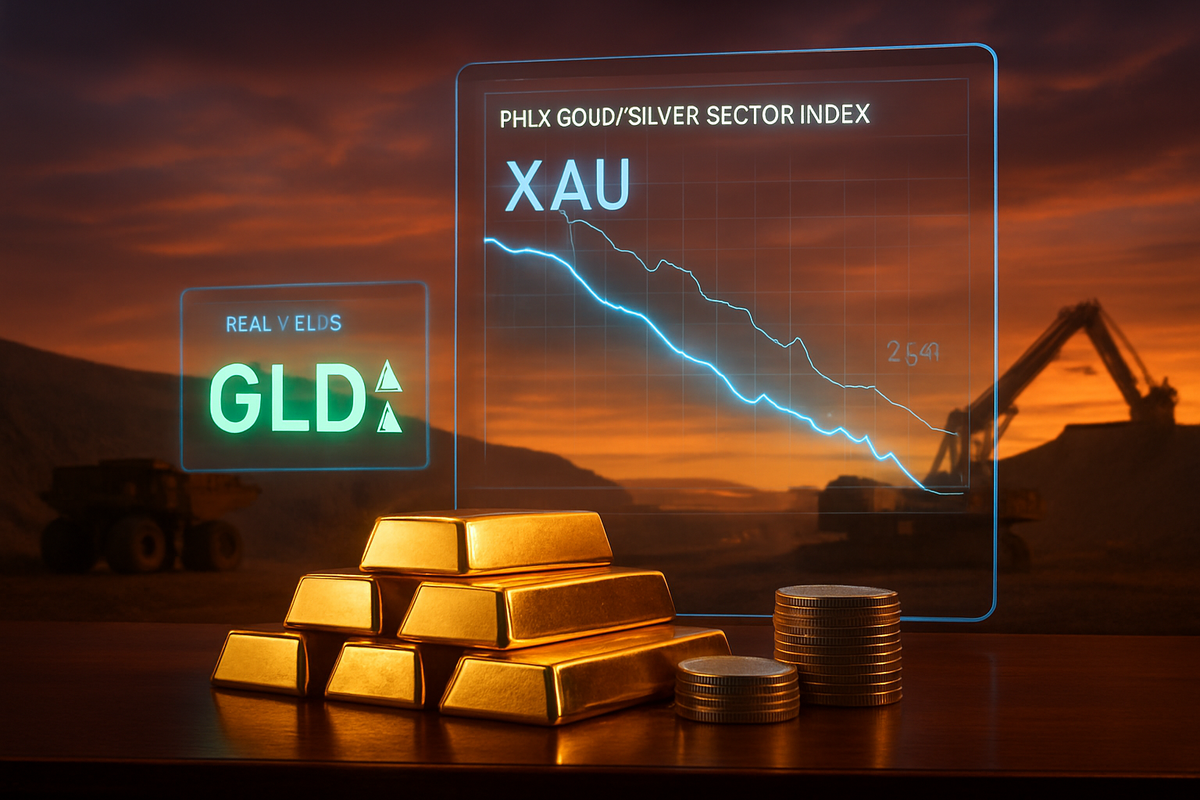
The precious metals sector has staged a remarkable rally in early March 2026, as the PHLX Gold/Silver Sector Index (XAU) tests historic highs amid a massive influx of institutional capital. Driven by a significant decline in inflation-adjusted "real" yields, investors have aggressively rotated into gold-backed assets, resulting in over $1.2 billion in net inflows into the SPDR Gold Shares (NYSE Arca: GLD) over the past five trading sessions alone. This surge reflects a growing consensus that gold has entered a new fundamental regime, decoupling from traditional bearish correlations.
While broader equity markets have been roiled by geopolitical instability and shifting central bank leadership, the gold and silver mining sector has emerged as a primary beneficiary. The decline in the 10-year Treasury Inflation-Protected Securities (TIPS) yield to 2.08% has effectively lowered the opportunity cost of holding non-yielding assets, providing a robust fundamental tailwind. As spot gold hovers near the $5,000 per ounce milestone, the mining industry is experiencing what analysts are calling the "Era of Super-Margins," characterized by record profitability and aggressive balance sheet deleveraging.
The current momentum in the precious metals space is the culmination of a volatile but upwardly biased start to 2026. After a brief technical correction in late February, the XAU index rebounded sharply to reach 433.38 by March 4, 2026. This move was supported by a five-day buying streak in the ETF market, most notably within the GLD fund, which saw its total Assets Under Management swell to approximately $181 billion. This $1.2 billion injection of capital signals a major shift from retail speculation to institutional "safe haven" positioning as global risks mount.
The timeline leading to this surge was catalyzed by a dramatic shift in the rates market. Real yields, which stood as high as 2.36% in mid-January, began a steady descent as the market repriced inflation expectations and growth forecasts. By falling to 2.08%, these yields removed nearly $150 of "theoretical pressure" from the price of gold per ounce. This technical relief coincided with the nomination of Kevin Warsh as the next Federal Reserve Chair, which initially sparked fears of aggressive hawkishness but has since been reinterpreted by traders as a signal for a more structured normalization of the central bank's balance sheet.
Key stakeholders, including major hedge funds and sovereign wealth funds, appear to be front-running a potential 2026 interest rate cut cycle. Market reactions have been swift; while the U.S. Dollar Index (DXY) remains relatively stable near 103.0, the "real yield" catalyst has allowed gold to outperform almost every other asset class year-to-date. In the silver market, the VanEck Gold Miners ETF (NYSE Arca: GDX) and individual silver producers have seen even higher beta returns, as the secondary metal often amplifies the moves seen in bullion during periods of intense capital inflow.
The primary winners in this environment are the "Tier 1" miners who possess the scale to capitalize on soaring bullion prices while maintaining disciplined cost structures. Newmont Corporation (NYSE: NEM) remains a dominant force, with shares trading near $118.52. Despite a planned production trough in 2026 aimed at optimizing long-term mine sequencing, Newmont is generating massive free cash flow, as its all-in sustaining costs (AISC) remain anchored far below the current spot price. Similarly, Barrick Gold (NYSE: GOLD) has seen its valuation climb to $63.30, bolstered by its dual-exposure to gold and copper, the latter of which is also benefiting from supply constraints.
Agnico Eagle Mines (NYSE: AEM) is another standout, recognized for its operational consistency in low-risk jurisdictions. As real yields decline, companies with high dividend yields and strong buyback programs become increasingly attractive compared to fixed-income alternatives. For these firms, the 2.08% yield environment is a "Goldilocks" scenario: low enough to drive gold prices higher, but indicative of an economy that is not yet in a full-blown recession, allowing for continued industrial demand for byproduct metals like copper and silver.
Conversely, the "losers" in this shift are primarily found in the high-growth tech sectors and regional banking, where the rotation of capital toward hard assets has drained liquidity. Companies with high debt-to-equity ratios that relied on falling nominal rates are finding themselves squeezed as the market prioritizes "intrinsic value" over "growth-at-any-price." Furthermore, small-cap explorers that lack current production may struggle to attract capital as investors prefer the immediate cash-flow generation of established producers like Freeport-McMoRan (NYSE: FCX), which is currently leveraging record copper prices alongside its gold output.
The wider significance of this rally lies in the fundamental decoupling of gold from its historical mirrors. Historically, high real yields were the "gold killer," yet at 2.08%, gold is trading at levels that would have been unthinkable a decade ago. This suggests that the market is placing a higher premium on "geopolitical insurance" and "currency debasement protection" than on traditional yield differentials. The closure of the Strait of Hormuz during recent Middle Eastern conflicts—dubbed "Operation Roaring Lion"—has introduced a permanent supply-side risk premium that is now baked into the sector's valuation.
This trend mirrors the inflationary cycles of the 1970s but with a modern twist: the presence of massive, liquid ETFs like GLD allows for institutional-grade moves to happen in days rather than months. The $1.2 billion inflow is a drop in the bucket of global liquidity, but its concentration in a single week suggests a "tipping point" in investor sentiment. Regulatory scrutiny of central bank gold purchases, which have hit record levels in early 2026, also points to a broader systemic shift where nations are diversifying away from the dollar-dominated reserve system.
The precedent for this move can be traced back to the late 2023 and 2024 cycles, but the 2026 iteration is defined by "Super-Margins." With gold at $5,000 and AISC for major miners averaging $1,500, the industry is seeing 70% profit margins. This level of profitability is attracting a new class of ESG-conscious and value-oriented investors who previously shunned the mining sector due to its historical capital mismanagement. The industry's shift toward "value over volume" is a significant policy evolution that is likely to persist even if gold prices stabilize.
Looking ahead, the short-term trajectory of the XAU index will largely depend on the Federal Reserve’s June policy meeting. If the Fed confirms the market’s pricing of a rate cut, real yields could slip further toward the 1.80% level, potentially sending gold toward the $5,500 mark. Miners will likely use this windfall to accelerate "green mining" initiatives and automate operations, which are necessary strategic pivots to combat rising labor costs. Barrick Gold’s anticipated "NewCo" IPO—a spin-off of its non-core assets—could serve as a major catalyst for a sector-wide revaluation in the second half of 2026.
However, challenges remain. Any sudden hawkish pivot from the incoming Fed Chair Kevin Warsh could spark a "flash crash" in the sector, as seen during the January sell-off. Furthermore, if silver prices continue to show extreme volatility—with intraday swings of up to 9%—it may deter more conservative institutional participants. Investors should expect a period of consolidation as the XAU index tests its 430 support level; a successful hold here would provide the technical foundation for a run toward 500 by year-end.
The early March surge in the precious metals sector marks a definitive moment for the 2026 market. The combination of $1.2 billion in GLD inflows and the stabilization of real yields at 2.08% has created a powerful tailwind that is difficult for even the most skeptical bears to ignore. With the XAU index delivering a YTD return of 37%, the mining sector is no longer a peripheral "hedge" but a core performance driver for diversified portfolios.
Moving forward, the market appears to be transitioning from a fear-based rally to one grounded in the reality of massive corporate cash flows. Investors should watch for the sustainability of these ETF inflows and any further compression in TIPS yields. While geopolitical tensions provided the initial spark, the fundamental realignment of the mining industry’s margins is what will likely provide the lasting impact. As we move deeper into 2026, the "gold standard" of investing may once again become a literal reality for those positioned in the XAU and its constituent giants.
This content is intended for informational purposes only and is not financial advice.