
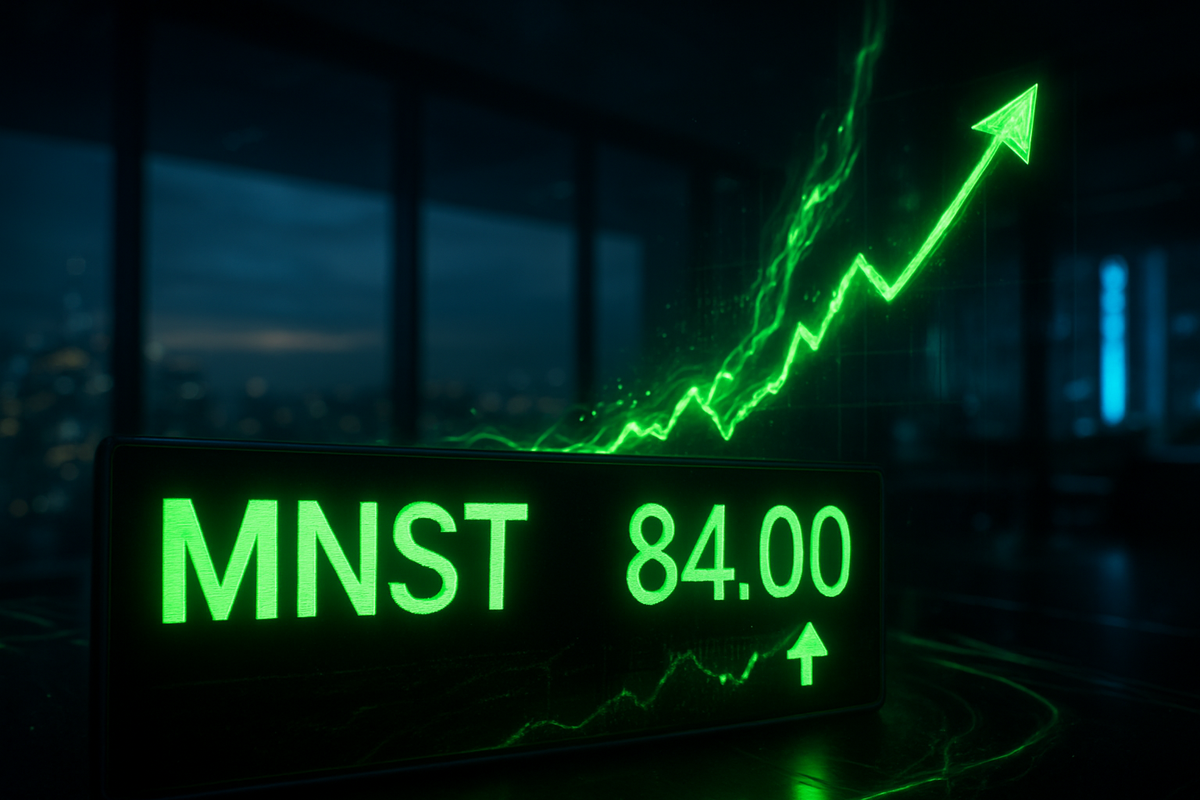
As the closing bell approaches on February 26, 2026, all eyes on Wall Street are fixed on Monster Beverage Corporation (NASDAQ: MNST). The energy drink titan is set to report its fourth-quarter and full-year 2025 earnings after the market close today, and the stakes have rarely been higher. Trading near its 52-week high of $84.00, the stock has become a focal point for investors seeking to determine if the company’s aggressive "margin recovery" strategy has fully taken hold in an increasingly crowded beverage landscape.
CEO Hilton Schlosberg is expected to host the conference call this afternoon, steering the narrative for a company that has spent the last eighteen months navigating a complex web of inflationary pressures and shifting consumer preferences. With the stock price sitting on a 64% recovery from its cyclical lows, today’s report is not just a financial update; it is a litmus test for Monster’s ability to defend its crown against high-growth challengers and maintain its premium valuation in a maturing market.
The Margin Recovery Story and the Path to $84
The story of Monster Beverage in 2025 has been defined by a relentless focus on profitability. Following a period of compressed margins in 2022 and 2023—driven by skyrocketing aluminum costs and logistical bottlenecks—the company pivoted toward a disciplined fiscal strategy. Throughout 2025, Monster implemented a series of pricing actions, including a notable 5% price hike in late 2024, which bolstered its gross profit margins from roughly 53.2% to an estimated 56.5% by the end of the third quarter. Analysts are eager to see if this trajectory continued into the final months of the year.
The stock’s ascent to the $84.00 level has been supported by a chorus of optimistic analyst revisions. Earlier this month, HSBC issued a major upgrade, raising its price target for MNST from $82.00 to $98.00, citing confidence in the company’s international growth and the resilience of its "Ultra" zero-sugar line. Similarly, JP Morgan (NYSE: JPM) analyst Andrea Teixeira adjusted her firm’s price target upward to $79.00, reflecting a broader market acknowledgment that Monster’s supply chain optimizations and product mix are finally yielding the expected "margin-first" results.
This pre-earnings momentum has been further fueled by Monster’s strategic diversification. Under the leadership of Hilton Schlosberg, who took a more prominent role following Rodney Sacks’ transition to Chairman, the company has leaned heavily into international markets to offset a slight cooling in domestic convenience store foot traffic. The "Strategic Brands" segment, including affordable options like Predator in emerging markets, has become a key pillar of the growth thesis, providing a buffer against the volatility of the North American consumer.
The technical setup for today's announcement is particularly noteworthy. At a forward price-to-earnings (P/E) ratio of approximately 38.9x, Monster is trading at a significant premium compared to its historical averages. This valuation implies that the market has already "priced in" a near-perfect execution of the margin recovery plan. Consequently, any slight miss in revenue or a conservative outlook for 2026 could trigger a volatile reaction, despite the stock's impressive run-up leading into the call.
Winners and Losers in the Energy Arms Race
The primary challenger in the energy drink space remains Celsius Holdings, Inc. (NASDAQ: CELH), which has seen its market share surge to approximately 20% by late 2025. Celsius has successfully capitalized on the "clean energy" trend, appealing to a fitness-oriented demographic that had previously moved away from traditional energy drinks. While Monster remains the dominant player with nearly 39% of the U.S. market, the rapid ascent of Celsius—further bolstered by its integration of the Alani Nu acquisition—has forced Monster to innovate more aggressively in its "Ultra" and "Reign" categories.
For The Coca-Cola Company (NYSE: KO), a major stakeholder and distribution partner for Monster, the earnings results carry significant weight. A strong performance from Monster bolsters Coca-Cola’s "emerging categories" portfolio and validates their long-standing partnership. Conversely, PepsiCo, Inc. (NASDAQ: PEP) stands as a competitor through its distribution deal and investment in Celsius. The "Energy Wars" of 2026 are no longer just about the liquid in the can; they are about the logistical dominance of the two largest bottling systems in the world.
If Monster reports a beat-and-raise quarter, it could signal a broader recovery for the consumer staples sector, which has faced headwinds from "GLP-1" weight-loss drug adoption concerns earlier in the decade. Companies like Keurig Dr Pepper (NASDAQ: KDP) may also see sympathetic price action as investors look for confirmation that beverage volumes are stabilizing. However, the biggest "loser" in a strong Monster report would likely be the narrative that the "legacy" energy drink market is in a terminal decline, proving instead that brand loyalty and international scale remain potent competitive moats.
Industry Trends and the Global Shift
The energy drink sector is currently navigating a period of intense transformation. We are seeing a "barbell" effect in consumer behavior: on one end, a demand for premium, health-conscious ingredients (the Celsius effect), and on the other, a need for value-driven, affordable energy in inflation-sensitive markets (the Predator effect). Monster Beverage’s ability to play in both of these spaces simultaneously is a testament to its scale, but it also creates operational complexity that smaller, more focused competitors do not have to manage.
This event also highlights a broader shift toward international expansion as the U.S. market reaches a state of relative saturation. Analysts are paying close attention to Monster's performance in Southeast Asia and Latin America, where per-capita energy drink consumption still lags far behind North American levels. The regulatory landscape is also shifting, with increased scrutiny on caffeine content and labeling in European markets, requiring giants like Monster to be more agile in their formulation and marketing strategies than ever before.
Historically, Monster has been a pioneer in the "lifestyle" branding approach, a strategy that has since been mimicked by dozens of competitors. The current market environment echoes the "Cola Wars" of the 1980s, where two or three dominant players fought for every inch of shelf space. Today, the battle has moved beyond the "black-and-green" can to include alcohol-infused energy drinks and "functional" beverages, complicating the competitive set and forcing companies to decide whether they are "energy companies" or broader "beverage platforms."
What Lies Ahead for the Energy Giant
Looking beyond today’s Q4 report, the next six to twelve months will be critical for Monster’s long-term valuation. A key question is whether the company can maintain its 56%+ gross margins if aluminum prices or energy costs experience another spike in 2026. Strategic pivots toward more sustainable packaging and a deeper foray into the alcoholic beverage space through its "The Beast Unleashed" and "Nasty Beast" lines will be essential to sustain the high-single-digit revenue growth that investors have come to expect.
In the short term, the market will be listening for updates on the integration of recent smaller acquisitions and the status of the company’s share buyback program. With over $2 billion in cash and zero long-term debt, Monster remains one of the most financially robust players in the S&P 500. This "fortress balance sheet" gives Hilton Schlosberg the optionality to either pursue a major acquisition to blunt the growth of Celsius or to return significant capital to shareholders if organic growth slows.
The most likely scenario for the remainder of 2026 is a period of "consoldiation and defense." Monster must protect its core "Green Monster" franchise while continuing to peel away market share from smaller "third-tier" brands. If the company can successfully navigate the Celsius challenge while continuing its international expansion, the $98.00 price target set by HSBC may not just be a possibility—it may be the new floor for a company that has consistently defied gravity for two decades.
Closing Thoughts for Investors
The Q4 2025 earnings call represents a pivotal moment for Monster Beverage. While the stock's run to $84.00 has been spectacular, it leaves little room for error. The "margin recovery" story is largely written into the stock price, meaning the focus tonight will shift toward future guidance and the ability to find new pockets of growth in an increasingly mature global market.
Moving forward, investors should watch for any signs of "pricing fatigue" among consumers and monitor the market share gap between Monster and Celsius. The energy drink category remains one of the most vibrant segments of the consumer staples world, and Monster Beverage remains its most significant bellwether. As Hilton Schlosberg takes the podium later today, he will be speaking not just to analysts, but to a market that is hungry for proof that the energy giant still has the fuel to reach new heights.
This content is intended for informational purposes only and is not financial advice.