

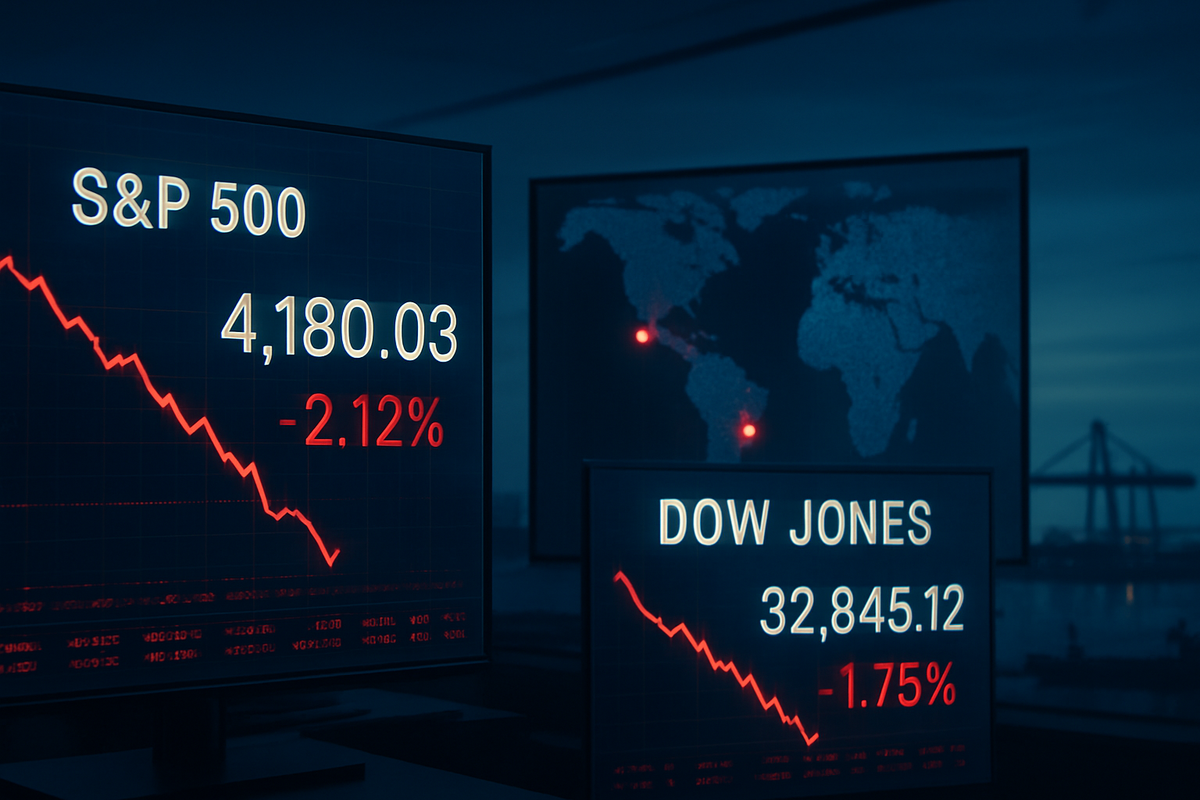
The opening week of 2026 has proven to be a volatile wake-up call for investors, as the initial euphoria that pushed the S&P 500 and Dow Jones Industrial Average to record highs on New Year’s Day has rapidly evaporated. By the close of trading on January 7, both indices retreated significantly from their peaks, driven by a dramatic escalation in geopolitical tensions and a murky economic landscape shaped by the aftermath of the longest government shutdown in U.S. history. The cautious tone on Wall Street reflects a growing realization that the "Goldilocks" scenario of 2025—steady growth and cooling inflation—is being tested by aggressive new foreign policy and trade measures.
Market participants are currently grappling with a "risk-off" environment where the optimism surrounding artificial intelligence and corporate earnings is being weighed against the unpredictability of military interventions and trade wars. As the S&P 500 (INDEXSP:.INX) and the Dow Jones Industrial Average (INDEXDJX:.DJI) pull back, analysts are warning that the resilience of the bull market will depend heavily on the Federal Reserve's response to sticky inflation and the global reaction to the newly unveiled "Donroe Doctrine."
The Caracas Catalyst and the Donroe Doctrine
The primary driver of this week’s market retreat was the sudden execution of "Operation Absolute Resolve" on January 3, 2026. In a high-stakes military raid, U.S. special forces captured Venezuelan President Nicolás Maduro and his wife, Cilia Flores, in Caracas. While the administration framed the move as a liberation and an opportunity to bring 30 to 50 million barrels of sanctioned oil to U.S. markets, the immediate effect was a spike in global energy uncertainty. The move was followed by the formal announcement of the "Donroe Doctrine," a policy framework that reasserts U.S. dominance over the Western Hemisphere and warns China, Russia, and Iran to cease all regional influence.
This aggressive shift in foreign policy triggered an immediate backlash from Beijing. China responded by imposing strict export controls on "dual-use" civilian-military technology to Japan and other U.S. allies, further straining a tech supply chain that was already fragile. The timeline of these events—occurring just as the market opened for the new year—shattered the expectation of a quiet January. Investors who had priced in a period of geopolitical stability were forced to quickly re-evaluate the risk premiums on multinational corporations with heavy exposure to Asian manufacturing and South American resources.
The market's anxiety is further compounded by the "data gap" left by the 43-day federal government shutdown that paralyzed Washington in late 2025. As government agencies began releasing a backlog of economic reports this week, the results have been contradictory. While the ADP National Employment Report showed modest private-sector hiring, the JOLTS report indicated a sharp decline in job openings, leading to fears that the labor market may be cooling faster than previously estimated. This confusion has left institutional giants like Morgan Stanley (NYSE: MS) and JPMorgan Chase & Co. (NYSE: JPM) divided on whether the economy is heading toward a soft landing or a tariff-induced slowdown.
Winners and Losers in a Volatile Landscape
The energy sector has become the epicenter of market volatility following the events in Venezuela. Initially, large-cap players like Chevron Corporation (NYSE: CVX) and BP p.l.c. (NYSE: BP) saw their stock prices swing wildly as traders weighed the potential for an oversupply of Venezuelan oil against the risks of regional instability. While lower oil prices could benefit the broader economy, the prospect of a state-led disruption in global energy flows has made energy stocks a difficult bet for short-term traders.
Conversely, the semiconductor industry has shown surprising resilience. Despite the trade tensions with China, NVIDIA Corporation (NASDAQ: NVDA) and Broadcom Inc. (NASDAQ: AVGO) have provided a floor for the Nasdaq, supported by continued massive capital expenditure in AI infrastructure. However, software companies and consumer-facing tech firms have struggled, as the "Liberation Day" tariffs—including a 10% baseline tariff on all imports—begin to squeeze profit margins. Automobile manufacturers such as Ford Motor Company (NYSE: F) have been particularly hard-hit by the 25% tariff on all imported cars and parts, leading to a sharp sell-off in the industrial sector.
The "rotation trade" has become the strategy of choice for many fund managers. As mega-cap tech valuations face pressure from rising 10-year Treasury yields, which are grinding toward 4.35%, investors are seeking refuge in healthcare and financials. The Goldman Sachs Group, Inc. (NYSE: GS) has noted that while the "AI tech super-cycle" remains intact, the immediate focus has shifted toward value-oriented stocks that can withstand the inflationary pressures of the new tariff regime.
Broader Significance and Historical Precedents
The current market pullback is more than just a technical correction; it represents a fundamental shift in the global economic order. The "Donroe Doctrine" marks a return to a more interventionist U.S. foreign policy that hasn't been seen in decades, drawing comparisons to the early 20th-century "Big Stick" diplomacy. This shift is occurring at a time when the global economy is already fragmented, and the move to isolate the Western Hemisphere from Eastern influence could lead to a permanent decoupling of trade blocks.
Historically, markets have struggled during periods of significant policy shifts and data uncertainty. The 43-day government shutdown of 2025 has created a "fog of war" for the Federal Reserve. Fed Chair Jerome Powell's recent "wait and see" approach reflects the difficulty of setting interest rate policy when the underlying data—such as inflation hovering stubbornly between 3% and 4%—is being distorted by tariff impacts and post-shutdown anomalies. This level of uncertainty is reminiscent of the stagflationary periods of the 1970s, where geopolitical shocks and domestic policy changes combined to create a challenging environment for traditional equities.
Furthermore, the "Liberation Day" tariffs represent one of the most significant shifts in U.S. trade policy since the Smoot-Hawley Tariff Act. By implementing reciprocal tariffs as high as 50% on countries with large trade deficits, the administration is betting on a resurgence of domestic manufacturing. However, the short-term reality for the market is increased costs for consumers and a potential drag on global GDP growth, which is forcing a re-evaluation of corporate earnings forecasts for the remainder of 2026.
The Path Forward: What Comes Next?
In the short term, all eyes are on the Federal Reserve’s January meeting. The market is currently split, with some analysts at Morgan Stanley (NYSE: MS) predicting a 25-basis-point cut to support a softening labor market, while others at Goldman Sachs (NYSE: GS) expect a pause until March to ensure inflation doesn't reignite under the new tariff regime. Any signal from the Fed that they are willing to look past the "tariff-induced" inflation to support growth could spark a relief rally in the S&P 500.
Long-term, the evolution of the situation in Venezuela will be critical. If the U.S. can successfully stabilize the region and integrate its oil reserves into the global market, it could provide a significant disinflationary tailwind. However, if the "Donroe Doctrine" leads to a protracted proxy conflict with China or Russia in South America, the "geopolitical risk premium" will remain a permanent fixture of stock valuations. Investors should also watch for a potential strategic pivot by tech companies as they attempt to move supply chains entirely out of the "Donroe-excluded" zones to avoid retaliatory export controls.
Closing Thoughts for Investors
The retreat from record highs in early 2026 serves as a reminder that the market does not move in a straight line, especially when faced with systemic shifts in trade and foreign policy. The key takeaway for investors is the importance of diversification and a focus on companies with strong pricing power that can navigate a high-tariff environment. While the AI revolution continues to provide a long-term growth narrative, the immediate path is fraught with geopolitical landmines and economic data gaps.
Moving forward, the market will likely remain in a state of heightened sensitivity. Investors should closely monitor the 10-year Treasury yield and the upcoming earnings season for signs of how the "Liberation Day" tariffs are impacting corporate bottom lines. While the start of 2026 has been characterized by a cautious tone, the underlying strength of the U.S. consumer and the continued advancement of technology suggest that the bull market may not be over, but it is certainly entering a more disciplined and selective phase.
This content is intended for informational purposes only and is not financial advice.