

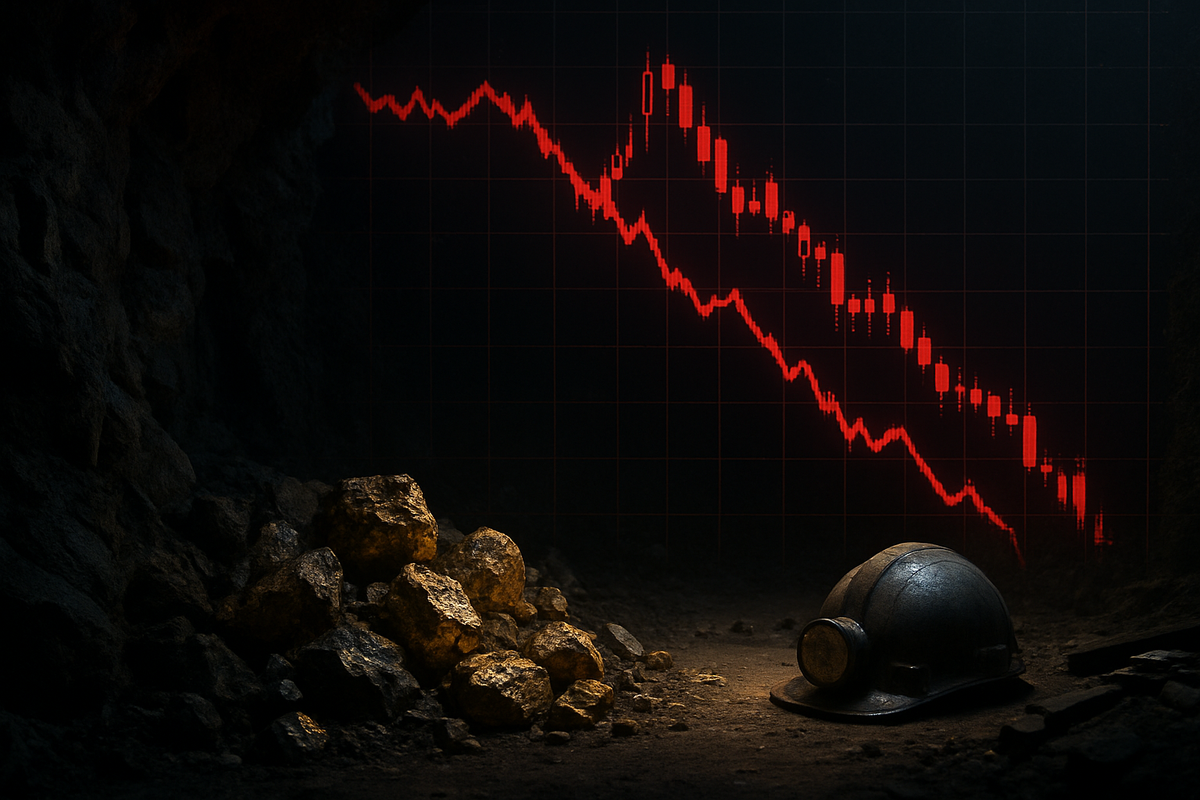
The historic rally that defined the commodities market in 2025 has hit a significant roadblock in the opening week of 2026. After a year that saw gold and silver shatter all-time records, a sharp technical correction is currently rippling through the financial markets. As of January 7, 2026, precious metals are retreating from their peaks, sending shockwaves through the valuations of major mining companies and creating a stark divergence within the broader materials sector.
The immediate implications are profound for institutional and retail investors alike. While the long-term structural bull case for "hard assets" remains intact, the sudden evaporation of momentum has triggered a massive sell-off in leveraged mining equities. This downturn is not merely a reflection of the metals' prices but a complex interplay of regulatory shifts, profit-taking, and a strategic rebalancing of global commodity indices that has caught many market participants off guard.
The January Correction: A Perfect Storm for Gold and Silver
The current downturn marks a dramatic shift from the euphoria of late 2025, when gold (XAU) peaked at a staggering $4,550 per ounce and silver (XAG) tested the $84 mark. The retreat began in earnest during the final days of December and has accelerated into the first week of 2026. Gold has pulled back toward the $4,200–$4,300 range, while silver is struggling to maintain support between $70 and $80. This "cooling-off" period was catalyzed by a "perfect storm" of technical and fundamental factors.
Key among these was the CME Group’s decision in late December to hike margin requirements for gold and silver contracts. Silver margins, in particular, rose by approximately 13.6% to $25,000 per contract, forcing highly leveraged traders to liquidate positions. This was compounded by the annual rebalancing of the Bloomberg Commodity Index (BCOM) in early January. The index, which had seen gold’s weighting swell to over 20% due to its massive 2025 gains, was forced to cap the metal at 15%. This regulatory requirement necessitated the programmatic sale of roughly 2.4 million ounces of gold in a single week, creating a liquidity vacuum that exacerbated the price drop.
Furthermore, the "Strong Dollar" policy signals from the current administration and resilient U.S. employment data—with jobless claims hitting a low of 199,000—have led some analysts to question the necessity of the aggressive interest rate cuts previously priced into the market. While the Federal Reserve is still expected to ease policy in 2026, the prospect of a "higher-for-longer" real interest rate environment has provided a temporary headwind for non-yielding assets like precious metals.
Winners and Losers: Mining Giants Face a Leverage Trap
The impact on mining stocks has been disproportionate to the fall in the underlying metals. Because mining equities typically offer 2x to 3x leverage on metal prices, the 5% drop in gold has translated into a 25% to 30% rout for major producers. Newmont (NYSE: NEM) and Agnico Eagle Mines (NYSE: AEM), the titans of the gold sector, have seen their share prices tumble as investors rush to lock in the massive gains accumulated over the past twelve months. Barrick Gold (NYSE: B), which recently changed its ticker to reflect its growing copper footprint, has also faced selling pressure, though its diversified portfolio has offered a slight cushion compared to pure-play gold miners.
In the silver space, the volatility has been even more pronounced. First Majestic Silver (NYSE: AG) and Pan American Silver (NYSE: PAAS) have seen double-digit percentage declines in early January trading. However, not all players in the sector are suffering equally. "Streaming" and royalty companies like Wheaton Precious Metals (NYSE: WPM) and Franco-Nevada (NYSE: FNV) have shown greater resilience. Their business models, which avoid the direct operational and inflationary risks of mining, have made them a preferred "safe haven" within the materials sector for those looking to maintain exposure to metals without the volatility of traditional miners.
Conversely, the broader materials sector, represented by the Materials Select Sector SPDR Fund (NYSE: XLB), has remained surprisingly stable. This is largely due to the strength of industrial metals. While gold and silver are correcting, Freeport-McMoRan (NYSE: FCX) has seen its valuation climb as copper prices hit record highs above $13,000 per tonne. This divergence highlights a critical market shift: investors are rotating out of "monetary" metals (gold/silver) and into "industrial" materials (copper/lithium) that are essential for the ongoing energy transition and infrastructure build-outs.
Wider Significance: De-Dollarization vs. Technical Exhaustion
The current volatility in precious metals fits into a broader global trend of "de-dollarization" and the search for "real assets" in an era of high sovereign debt. Despite the January pullback, central banks are expected to remain net purchasers of gold, with estimates suggesting they will add another 750 tonnes to their reserves in 2026. This structural demand provides a "floor" for the market that did not exist in previous cycles, such as the post-2011 bear market.
Historically, corrections of this magnitude are common after the kind of parabolic move seen in 2025. Analysts point to the gold rally of 1979-1980 as a precedent; while the peaks were followed by sharp drops, the underlying inflationary and geopolitical drivers remained for years. Today, the ripple effects are being felt most acutely in the junior mining sector, where capital raises have suddenly become more difficult, potentially leading to a wave of consolidations and M&A activity later in the year as larger firms use their record-high cash reserves to acquire distressed assets.
The regulatory implications are also coming into focus. The CME margin hikes and index rebalancing have renewed calls for more transparent commodity trading rules. Some market advocates argue that the forced selling triggered by index caps creates artificial volatility that harms long-term investors. As the materials sector becomes an increasingly large part of the global equity market, these technical mechanics will likely face greater scrutiny from the SEC and other global regulators.
What Comes Next: A Generational Entry Point?
Looking ahead, the short-term outlook remains cautious as the market searches for a definitive bottom. Most analysts expect the consolidation to continue through the end of the first quarter of 2026. However, the long-term forecasts from major financial institutions remain aggressively bullish. J.P. Morgan (NYSE: JPM) recently maintained its target of $5,055 per ounce by the end of 2026, while Goldman Sachs (NYSE: GS) projects a mid-year recovery to $4,900.
The strategic pivot for mining companies will involve a renewed focus on "All-In Sustaining Costs" (AISC). Even with gold at $4,200, most major miners are enjoying record-high profit margins, as their average costs remain near $1,600 per ounce. If these companies can demonstrate disciplined capital allocation—returning cash to shareholders through dividends and buybacks rather than chasing overvalued acquisitions—they may see a rapid "re-rating" once the metal prices stabilize.
The primary challenge for the sector will be navigating the "Strong Dollar" narrative. If the U.S. economy continues to outperform global peers, the dollar could remain elevated, acting as a persistent drag on dollar-denominated commodities. However, any sign of economic cooling or a more dovish pivot from the Federal Reserve would likely serve as the "coiled spring" that launches the next leg of the bull market.
Summary and Investor Outlook
The early 2026 downturn in precious metals is a classic "technical reset" following a period of historic exuberance. While the 30% rout in mining stocks has been painful for latecomers to the rally, it has also cleared out much of the speculative froth that had built up in the sector. The fundamental drivers—central bank buying, geopolitical instability, and a structural supply deficit in silver—remain firmly in place.
Moving forward, the market will likely be characterized by increased selectivity. Investors should move away from the "buy everything" approach of 2025 and focus on high-quality producers with low cost-bases and strong balance sheets. The divergence between precious and industrial metals suggests that a diversified materials portfolio is now more essential than ever.
In the coming months, all eyes will be on the Federal Reserve’s interest rate path and the monthly central bank gold purchase reports. If gold can hold the $4,000 level and silver remains above $65, the current correction will likely be remembered as a brief pause in a multi-year bull run. For now, the materials sector remains the "canary in the coal mine" for global economic sentiment, signaling that while the path to higher prices is rarely a straight line, the era of "hard assets" is far from over.
This content is intended for informational purposes only and is not financial advice.