

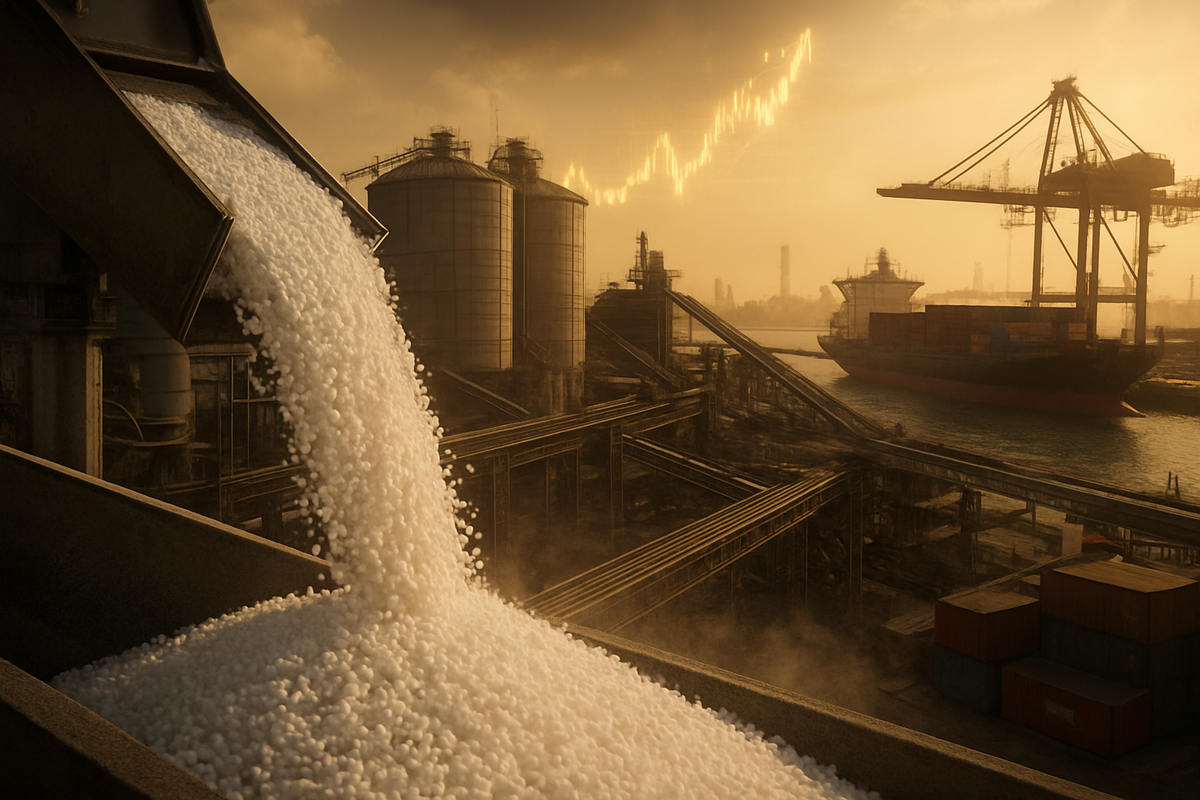
The global fertilizer market witnessed a sharp reversal of trends in the final month of 2025, as urea prices in China surged by 4.6% during December. This rally, which effectively halted a multi-month price decline, was primarily catalyzed by a massive import tender from India and mounting speculation regarding the relaxation of Chinese export quotas. As of early January 2026, the ripple effects of this price spike are being felt across the agricultural sector, signaling a potentially volatile start to the new year for global food production costs.
The immediate implications of this surge are twofold: it has provided a much-needed floor for international nitrogen prices while simultaneously raising concerns for farmers in the Northern Hemisphere preparing for the spring planting season. With India aggressively securing supplies to meet record-breaking domestic consumption, the traditional balance of the urea trade is being tested, forcing a realignment of supply chains that had only recently begun to stabilize after years of geopolitical disruption.
The December Rally: A Confluence of Demand and Speculation
The 4.6% climb in Chinese urea prices was not a result of domestic scarcity, but rather a reaction to international procurement signals. On December 17, 2025, National Fertilizers Limited (NSE: NFL), a key Indian state-owned enterprise, issued a global tender for 1.5 million metric tonnes (MMT) of urea. This followed a massive 2.5 MMT tender from Indian Potash Limited (IPL) in November. The sheer scale of Indian demand—projected to hit a record 6 million tonnes in December alone—sent a clear signal to the market that the world’s largest importer was in a "buying race" to secure its winter crop requirements.
In China, the news triggered a rapid transmission from the futures market to spot prices. Although the Chinese government maintained its "dynamic guidance" policy—essentially a set of export restrictions designed to ensure domestic food security—the market began pricing in the possibility of a policy pivot. Producers in key hubs such as Shandong and Henan adjusted their ex-factory prices upward, with the national average rising from approximately 1,702 CNY/ton at the start of December to 1,732 CNY/ton by year-end. This psychological shift was bolstered by the fact that international prices in the Middle East were climbing into the high $410s per ton (FOB), creating a lucrative arbitrage opportunity that many expected Chinese officials would eventually allow exporters to capture.
The timeline of the surge was punctuated by a mid-month "dogfight" among traders who scrambled to secure volumes ahead of the February 20, 2026, shipment deadline set by the Indian tender. This demand surge occurred despite China’s robust daily production levels, which remained near 200,000 tons. The divergence between high domestic supply and rising prices highlights the significant role that international tender activity now plays in dictating local market dynamics in a post-pandemic trade environment.
Winners and Losers in the Nitrogen Market
The primary beneficiaries of this price surge are the large-scale nitrogen producers with the flexibility to pivot between domestic and international markets. CF Industries (NYSE: CF), the world’s largest nitrogen fertilizer producer, stands to gain as the rising Chinese floor price effectively lifts the global price ceiling. Similarly, Nutrien Ltd (NYSE: NTR) is well-positioned to capitalize on the tightening global supply, particularly as it leverages its diversified production base to fill gaps left by restricted Chinese exports.
Within China, companies like Sinofert Holdings (HKG: 0297) and Hualu-Hengsheng (600426.SS) have seen their margins improve as the ex-factory price of urea rose faster than the cost of coal feedstock. China XLX Fertiliser (HKG: 1866), known for its high-efficiency production, is also a significant winner, as its lower cost structure allows it to capture a higher percentage of the price increase as pure profit. Conversely, in India, while Chambal Fertilisers (NSE: CHAMBLFERT) and Rashtriya Chemicals & Fertilizers (NSE: RCF) benefit from the strategic importance of their domestic production, the high cost of imports remains a fiscal burden for the Indian government, which heavily subsidizes fertilizer to protect its farming population.
The "losers" in this scenario are undoubtedly the end-users: the farmers. As urea is a critical nitrogen source for staple crops like corn, wheat, and rice, the 4.6% rise in China—coupled with similar gains globally—directly inflates the cost of agricultural inputs. This pressure is particularly acute for large-scale agribusinesses such as Archer-Daniels-Midland (NYSE: ADM) and Bunge Global SA (NYSE: BG), which may face compressed margins if they cannot fully pass on the increased costs of raw materials to consumers in a market already wary of food inflation.
Broader Significance and the Geopolitical Shift
This event is more than a simple price fluctuation; it represents a fundamental shift in the global fertilizer landscape. The December surge fits into a broader trend of "resource nationalism," where major producers like China prioritize domestic stability over export profits. This has forced a structural change in the supply chain, moving away from a just-in-time model toward a more strategic, inventory-heavy approach. The Indian tender’s impact on Chinese prices underscores how interconnected these markets remain, even when formal trade barriers are in place.
Furthermore, the timing of the surge coincided with the implementation of the EU’s Carbon Border Adjustment Mechanism (CBAM) on January 1, 2026. The CBAM has added an estimated 10–15% to the cost of urea entering Europe, creating a bifurcated market where European prices are decoupling from the rest of the world. This regulatory shift, combined with recent geopolitical disruptions—such as the US-led military enforcement operation in Venezuela on January 3, 2026, which halted loading at major urea facilities—has created a "perfect storm" of supply constraints.
Historically, urea prices have been closely tied to natural gas costs, but the current rally is being driven by policy and procurement strategies. We are seeing a precedent where state-led buying (India) and state-led restriction (China) are more powerful market movers than the underlying commodity costs. This suggests that the fertilizer market is becoming increasingly politicized, with food security becoming a central pillar of national security for the world’s most populous nations.
Future Outlook: Navigating a Tightened Market
In the short term, the market will be laser-focused on whether China releases more export quotas in the first quarter of 2026. If the "winter storage" targets are met and domestic prices stabilize, Beijing may allow a controlled volume of urea to flow to India to satisfy the December tender requirements. However, any further geopolitical instability in the Middle East or South America could quickly send prices back toward the record highs seen in 2022.
Long-term, the industry is likely to see a strategic pivot toward "green" and "blue" ammonia and urea. Companies like Yara International (OSE: YARA) are already investing heavily in low-carbon fertilizer production to bypass the costs associated with the EU's CBAM. For investors, the challenge will be identifying which companies can successfully navigate this transition while maintaining profitability in a high-cost environment. The Russia-India joint venture, recently established to bypass traditional trade routes, also suggests that new bilateral trade blocs are forming, which could permanently alter the flow of global agricultural inputs.
Conclusion: A New Era of Volatility
The 4.6% surge in Chinese urea prices in December 2025 serves as a stark reminder of the fragility of the global food supply chain. Driven by aggressive Indian procurement and the shadow of Chinese export limits, the rally has set a bullish tone for the fertilizer sector heading into 2026. While producers are currently enjoying improved margins, the long-term sustainability of these price levels remains a concern for global food security and agricultural stability.
Moving forward, the market is no longer just a reflection of supply and demand; it is a complex theater of geopolitical maneuvering and regulatory shifts. Investors should keep a close eye on Chinese export policy updates, the status of the Venezuelan supply disruptions, and the ongoing impact of carbon pricing in Europe. As we enter the 2026 planting season, the ability of the market to re-allocate supply will be the ultimate test of its resilience.
This content is intended for informational purposes only and is not financial advice.