
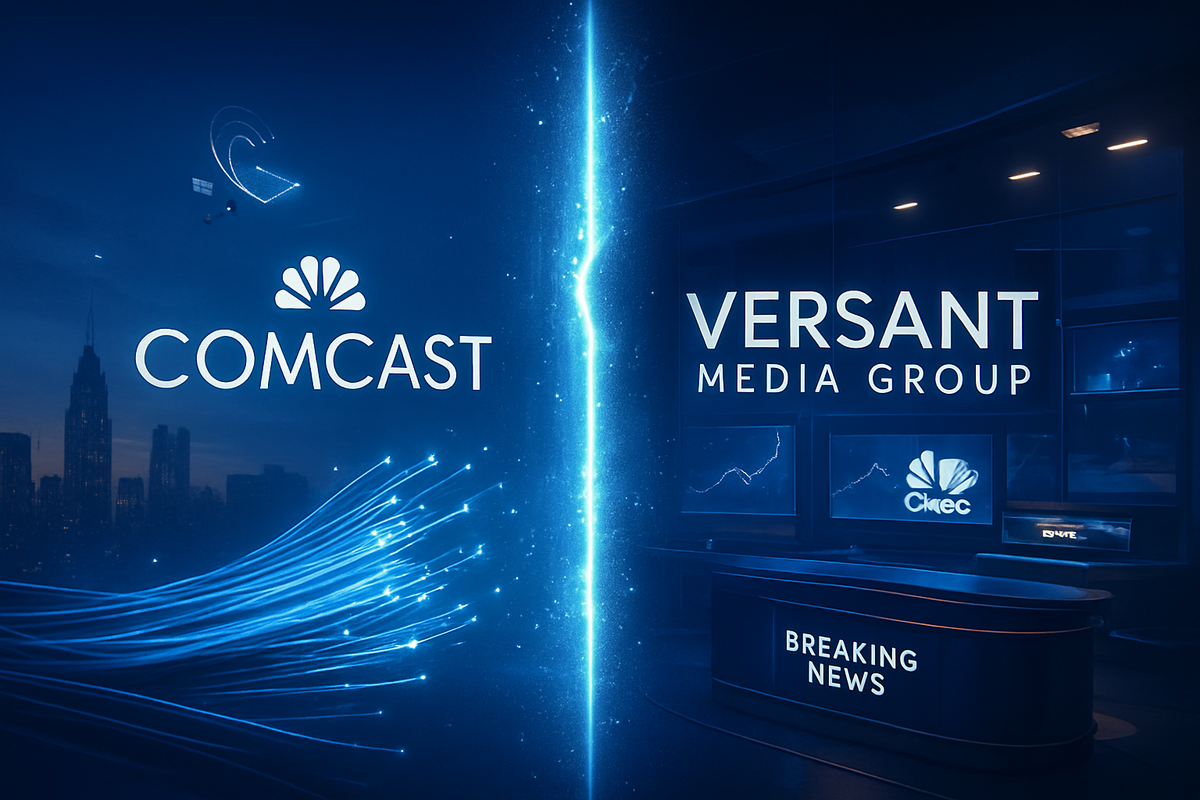
In a move that signals the definitive end of the traditional media conglomerate era, Comcast (NASDAQ: CMCSA) officially finalized the spinoff of its storied cable television portfolio into a new, independent entity: Versant Media Group (NASDAQ: VSNT). The separation, which became effective at the start of the new year, marks a radical pivot for Comcast as it sheds the weight of legacy linear networks to double down on its high-growth connectivity, theme parks, and streaming divisions.
The immediate implications are stark. As of the market open on January 5, 2026, Versant Media Group began trading as a "pure-play" cable giant, immediately becoming a litmus test for the public market's appetite for legacy television assets. While Comcast shares saw a modest lift of 1.3% as investors cheered the "de-risking" of the parent company, Versant faced a rocky debut, with its stock sliding over 14% in early trading. This divergence highlights a growing rift in the financial sector: a preference for the infrastructure of the future over the content delivery systems of the past.
A New Identity for Legacy Giants: The Birth of Versant
The road to Versant Media Group began in late 2024, when Comcast leadership first signaled a strategic review of its cable assets. The official separation, executed as a tax-free pro-rata distribution, saw Comcast shareholders receive one share of Versant for every 25 shares of Comcast held as of the December 16, 2025, record date. The newly formed company launched with a formidable, albeit challenged, portfolio including CNBC, USA Network, E!, Syfy, Golf Channel, and Oxygen. Notably, the high-profile news network MSNBC underwent a significant rebranding just prior to the split, emerging as MS NOW—a move designed to decouple the opinion-heavy network from the "NBC News" brand retained by Comcast.
The leadership of Versant is a "who's who" of NBCUniversal veterans. Mark Lazarus, formerly the Chairman of NBCUniversal Media Group, has stepped in as CEO, joined by Anand Kini as CFO and COO. This team inherited a company that, while burdened by the industry-wide trend of cord-cutting, remains a cash-flow engine, generating approximately $7 billion in annual revenue. To facilitate the split, Versant secured $3 billion in senior debt, using $2.25 billion of those proceeds to provide a one-time cash "parting gift" to Comcast, leaving the new entity with a lean but leveraged balance sheet.
Initial market reactions have been a mix of skepticism and opportunistic interest. While the 14% drop in Versant’s share price on day one reflects fears that linear TV is a "melting ice cube," some institutional investors see the company as an undervalued cash cow. The strategic rebranding of MSNBC to MS NOW is particularly telling; by shedding the iconic peacock logo and moving to independent studios, the network is positioning itself for a digital-first future, free from the editorial constraints of its former broadcast parent.
Winners and Losers in the Media Divorce
The primary winner in this transaction appears to be Comcast (NASDAQ: CMCSA). By offloading the "conglomerate discount" that has long suppressed its stock price, the company has cleared the decks to compete more aggressively in the 5G and broadband arenas. With billions in fresh cash and a narrowed focus, Comcast is now widely expected to pursue aggressive M&A, with rumors already circulating about a potential bid for the studio assets of Warner Bros. Discovery (NASDAQ: WBD).
Conversely, Versant Media Group (NASDAQ: VSNT) faces an uphill battle. As a standalone entity, it lacks the "bundling leverage" it once enjoyed as part of the Comcast-NBCUniversal umbrella. Without the shield of a massive parent company, Versant must now negotiate carriage deals with cable providers on its own merits. However, the company’s "pure-play" status makes it an incredibly attractive acquisition target for tech giants like Amazon (NASDAQ: AMZN) or Apple (NASDAQ: AAPL), who may see the live news and sports components of CNBC and the Golf Channel as the perfect "missing piece" for their respective streaming platforms.
Other industry players are feeling the heat. Paramount Global (NASDAQ: PARA), now under the Skydance banner, is positioning itself as a consolidator, potentially looking to snap up the very assets Comcast just discarded to achieve "distribution heft." Meanwhile, Disney (NYSE: DIS) remains the ultimate outlier; CEO Bob Iger continues to maintain that keeping linear and streaming assets under one roof is a competitive advantage, a stance that is increasingly being questioned by activist investors in light of Comcast’s successful separation.
A Blueprint for the Industry’s Future
The Comcast-Versant split is more than just a corporate restructuring; it is a blueprint for the survival of legacy media. For years, the industry has struggled to balance the declining but profitable linear business with the high-cost, high-growth world of streaming. By spinning off Versant, Comcast has essentially provided a "tax-free exit ramp" for other conglomerates. Warner Bros. Discovery is already following suit, with plans to separate its own "Global Networks" from its studio and Max streaming service, a move that has already triggered a hostile takeover bid from Paramount.
This event also signals a shift in regulatory and policy implications. As media companies fragment, the traditional "Big Media" monopolies are dissolving, potentially easing the path for future consolidation among the smaller, spun-off entities. Historically, this mirrors the "Baby Bells" era of telecommunications, where a massive entity was broken up only to see the pieces eventually consolidate into a few dominant players. Versant may be the first of many "Media Babies" to hit the market in the coming 24 months.
Furthermore, the rebranding of MSNBC to MS NOW highlights a broader trend of "brand insulation." In an increasingly polarized political climate, broadcast networks are finding it necessary to distance their "neutral" news brands (like NBC News) from their "opinion" brands. This separation allows MS NOW to lean into its identity-driven commentary without risking the journalistic reputation—or the advertising relationships—of its former parent.
The Road Ahead: Survival of the Leanest
In the short term, Versant Media Group must prove to Wall Street that it can manage its debt while simultaneously investing in the digital transformation of its core brands. The "MS NOW" experiment will be the first major test; if the network can successfully migrate its audience to a subscription-based digital model, it could provide a roadmap for CNBC and USA Network to follow. Market analysts expect Versant to be a highly active participant in the "secondary market" for content, potentially licensing its vast library to third-party streamers to bolster its bottom line.
For Comcast, the focus shifts entirely to the "Connectivity and Platforms" segment. With the distraction of the cable networks gone, the market will be watching closely to see how the company utilizes its massive free cash flow. A major strategic pivot into international broadband or a transformative acquisition in the gaming sector are both on the table. The goal is clear: transform Comcast from a 20th-century media company into a 21st-century technology and infrastructure powerhouse.
Final Takeaways: A Market in Transition
The official launch of Versant Media Group marks the end of an era and the beginning of a more fragmented, specialized media economy. The key takeaway for investors is that the "conglomerate model" is officially broken. Value is no longer found in owning every link in the chain, but in owning the right links. Comcast has chosen to own the pipes and the premium "flywheel" assets, while Versant has been left to extract the remaining value from the linear television model.
Moving forward, the market will likely see a wave of similar spinoffs as the "ice cube" of linear TV continues to melt. Investors should watch the "carriage renewal" cycles for Versant over the next 18 months; these will be the true indicators of the company’s longevity. While the initial stock drop for VSNT was painful, the company’s high cash flow and "pure-play" status make it a high-risk, high-reward play for those betting on a final consolidation of the cable industry. For Comcast, the path is now clear: the "de-risking" is complete, and the race for connectivity dominance has truly begun.
This content is intended for informational purposes only and is not financial advice.