

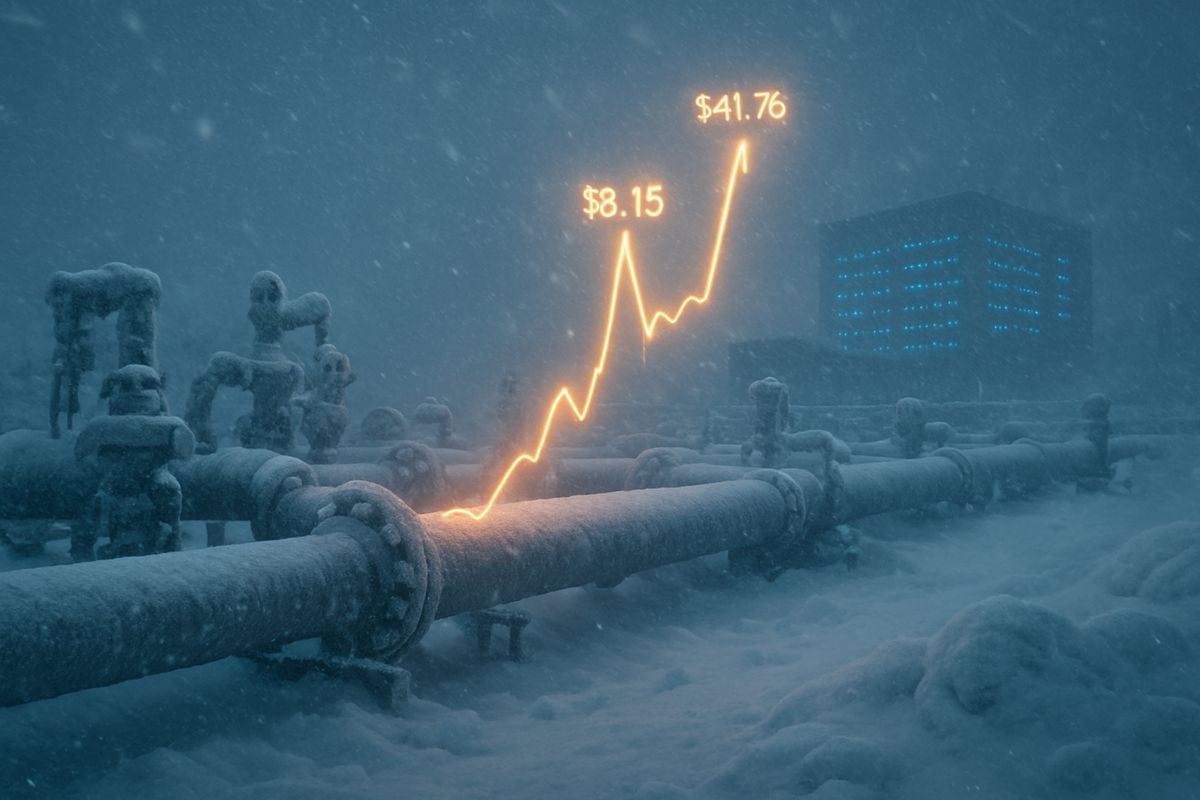
The final week of January 2026 has etched itself into the annals of energy market history as a brutal Arctic front, dubbed "Winter Storm Fern," paralyzed much of the United States. This extreme weather event transformed the natural gas market into a theater of unprecedented volatility, where supply-demand balances tightened to a breaking point. National benchmarks saw staggering gains, but it was the regional "dislocations"—pockets of the country where fuel simply could not reach the furnaces—that saw prices skyrocket to levels rarely seen outside of a catastrophic crisis.
As temperatures plunged from the Pacific Northwest to the Texas Gulf Coast, the energy infrastructure faced its most significant test since the 2021 freeze. The immediate implications were felt across the financial spectrum: spot prices at the Henry Hub benchmark surged past the critical $8.15/MMBtu threshold early in the week before peaking at even more astronomical levels, while regional hubs saw localized pricing explode. For the public, these spikes signal a looming "utility bill shock" that will likely ripple through the economy for months to come, challenging the resilience of a grid increasingly dependent on gas-fired generation.
The Anatomy of a Freeze: 16 Bcf/d Lost to the Cold
The crisis began in earnest during the third week of January as a polar vortex split, sending a deep freeze deep into the heart of the Permian Basin and the Appalachian shale plays. By January 25, 2026, the industry was grappling with massive "freeze-offs"—a phenomenon where water and other liquids in the gas stream freeze at the wellhead, physically blocking the flow of fuel. Industry data confirmed that production losses hit a staggering 16 to 17 billion cubic feet per day (Bcf/d). This sudden removal of nearly 15% of the total U.S. gas supply occurred precisely as heating demand reached a seasonal peak, creating a perfect storm for price escalation.
The timeline of the surge was rapid. At the start of the week, Henry Hub spot prices were hovering in a relatively stable range near $3.50/MMBtu. However, as the production data began to reflect the severity of the freeze-offs, the benchmark surged past $8.15/MMBtu in a matter of hours. The situation was even more dire at regional delivery points. In Southern California, the Northern Ventura hub saw prices hit an eye-watering $41.76/MMBtu, as pipeline constraints made it nearly impossible to bring in supplementary supply from the Rockies or the Permian. Meanwhile, in the Northeast, hubs like Algonquin Citygate reported trades as high as $50/MMBtu as the regional grid struggled to keep up with both residential heating and power generation needs.
Key players, including the Federal Energy Regulatory Commission (FERC) and the North American Electric Reliability Corporation (NERC), were forced into emergency monitoring as grid operators issued "energy emergency alerts." Initial market reactions were frantic; traders who were caught short on physical delivery scrambled to cover positions, fueling a feedback loop of rising prices. While the prices eased slightly toward the end of the week as the storm began to subside, the damage to the supply chain was already done, leaving storage levels significantly depleted.
Market Winners and Losers: Infrastructure Resilience as a Competitive Moat
In the wake of the volatility, the divide between energy companies with weatherized infrastructure and those without became a chasm. EQT Corporation (NYSE: EQT), the nation's largest natural gas producer, emerged as a notable winner. With its heavy footprint in the Appalachian Basin and sophisticated midstream integration, EQT was able to maintain much of its flow and capture the massive regional price premiums in the Northeast. Similarly, Antero Resources (NYSE: AR) benefited from its strategic transport capacity, allowing it to move gas from the wellhead to the highest-priced markets, insulating its balance sheet from the worst of the production outages.
Conversely, companies with heavy exposure to the Permian Basin faced significant operational hurdles. ConocoPhillips (NYSE: COP) and Chevron (NYSE: CVX) reported temporary production shut-ins as the Texas freeze impacted gathering systems. While these diversified giants can weather the short-term volume loss, the "freeze-off" event highlighted the ongoing vulnerability of southern infrastructure to extreme cold. In the midstream sector, Kinder Morgan (NYSE: KMI) and Williams Companies (NYSE: WMB) proved to be critical linchpins. Williams' Transco pipeline system, which serves the Eastern Seaboard, became the most valuable piece of real estate in the energy world, though the company had to navigate complex "underperformance" notices as gas nominations from producers were slashed.
The utilities sector, however, faces a much grimmer reality. Duke Energy (NYSE: DUK) and Exelon (NYSE: EXC) had to purchase supplemental fuel at the peak of the price spike to keep the lights on and the heaters running. While these companies are generally allowed to pass fuel costs on to consumers, the "regulatory lag" and the sheer magnitude of the January costs mean they will likely face intense scrutiny from public utility commissions. For investors, the takeaway is clear: the 2026 storm has rewarded those with "optionality"—the ability to move gas to where it is most needed—while punishing those tied to static, unweatherized supply chains.
A New Demand Floor: The AI Data Center Factor
The volatility of 2026 isn't just a repeat of historical weather events; it marks the emergence of a new, "inelastic" demand floor: the AI data center. Unlike previous years, where high prices might prompt industrial users to curtail production, the massive computing clusters operated by big tech firms in Virginia and Texas cannot simply be turned off. This "must-run" demand for electricity, much of which is served by natural gas-fired turbines, prevented prices from softening even as the initial panic of the storm subsided. This event serves as a warning that the energy transition's reliance on gas as a "bridge fuel" is being strained by the digital economy's insatiable hunger for power.
Furthermore, the temporary halt in LNG exports from facilities like those operated by Cheniere Energy (NYSE: LNG) illustrates a growing tension between domestic energy security and global export ambitions. During the height of the freeze, feed gas was diverted from export terminals to satisfy domestic heating needs. This shift has broader geopolitical implications, as European and Asian buyers—already sensitive to U.S. supply reliability—watched the American domestic market teeter on the edge. The ripple effects will likely lead to calls for more stringent federal oversight of gas storage and export priorities.
From a regulatory perspective, the $41.76/MMBtu price at Northern Ventura will almost certainly trigger a new round of investigations into market manipulation and infrastructure bottlenecks. Critics of the current system point out that despite the lessons of 2021, the 16 Bcf/d production loss suggests that weatherization mandates have either been insufficient or poorly enforced. This event fits into a broader trend of "grid fragility," where the push for decarbonization and the retirement of coal and nuclear plants have left the system with a thinner margin for error during extreme weather events.
What Comes Next: Storage Depletion and Strategic Pivots
In the short term, the market will be laser-focused on the weekly storage reports from the Energy Information Administration (EIA). The massive drawdowns required to survive Winter Storm Fern have left U.S. inventories well below the five-year average. This "deficit" means that even if the rest of the winter is mild, natural gas prices are likely to maintain a higher baseline through the spring as utilities race to refill storage tanks. For producers, this provides a lucrative opportunity to lock in higher futures prices for the 2026-2027 season.
Longer term, we expect to see a strategic pivot in capital expenditure. Companies like Expand Energy (NASDAQ: EXE)—the newly formed powerhouse from the Chesapeake and Southwestern merger—are likely to accelerate investments in "winterization 2.0." This includes everything from heated wellhead enclosures to more robust chemical injection systems to prevent hydrate formation. Additionally, the midstream sector may see a surge in "brownfield" expansion projects aimed at de-bottlenecking regional hubs like Northern Ventura to prevent future $40 price spikes.
The January 2026 crisis also opens the door for alternative energy storage solutions, such as utility-scale batteries and hydrogen, which can provide a buffer during gas supply interruptions. However, these technologies are years away from the scale needed to replace the role of natural gas during a 16 Bcf/d supply shock. Investors should prepare for a period of "structural volatility," where weather events have an outsized impact on the market due to the combination of tight supply and inelastic demand from both the residential and tech sectors.
The Bottom Line: Lessons from the 2026 Arctic Surge
The January 2026 natural gas price spike serves as a sobering reminder that the "Old Economy" infrastructure of pipes and wellheads still dictates the reality of the "New Economy" of AI and cloud computing. The surge to over $8.15 at Henry Hub and the extreme regional peaks are symptoms of a system that is being pushed to its limits by climate volatility and shifting demand profiles. The loss of 16 Bcf/d of production during the peak of the storm was a systemic failure that underscores the need for continued investment in infrastructure resilience.
Moving forward, the market is no longer just looking at "supply and demand" in a vacuum; it is looking at "deliverability." For investors, the winners will be the companies that own the "toll roads" and the flexible production assets that can thrive when the mercury drops. Watch for upcoming quarterly earnings reports from the major producers and midstream players mentioned, as the true financial windfall—or shortfall—from this storm will become clear in their realized price data and hedging losses.
The lasting impact of Winter Storm Fern will likely be a renewed debate over energy policy. As the public reacts to the spike in their heating bills, the pressure on lawmakers to balance export growth with domestic price stability will reach a fever pitch. In the months ahead, keep a close eye on storage injection rates and any new regulatory filings regarding grid reliability; they will be the best indicators of whether the market has truly learned the lessons of the 2026 freeze or if it remains vulnerable to the next Arctic blast.
This content is intended for informational purposes only and is not financial advice