
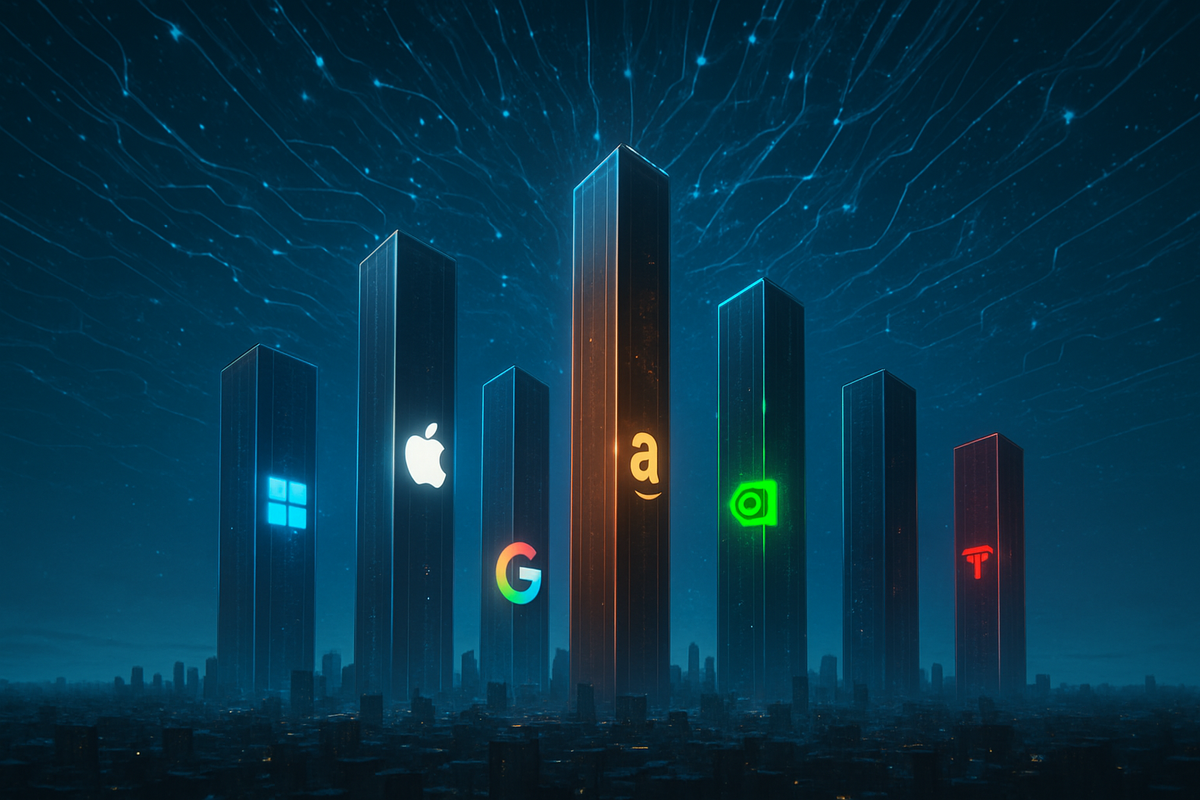
As the January 2026 earnings season reaches its fever pitch, the "Magnificent Seven" group of technology titans continues to exert an unprecedented stranglehold on the U.S. equity markets. Accounting for a staggering 35% of the total S&P 500 market capitalization, these seven companies—Apple, Microsoft, Alphabet, Amazon, Nvidia, Meta, and Tesla—have transformed from a high-growth tech cohort into the primary engine of the global economy. With a collective market value of approximately $21.5 trillion, their financial health is no longer just a barometer for the tech sector, but the single most significant factor in the stability of individual retirement accounts and institutional portfolios alike.
The immediate implications of this concentration are becoming clear as the 2026 fiscal year begins. While the broader "S&P 493" struggles to find its footing amidst shifting interest rate expectations and geopolitical uncertainty, the Magnificent Seven are projected to deliver earnings-per-share (EPS) growth of 18% to 23% this year. This widening "profit gap" between the tech elite and the rest of the market has forced a re-evaluation of diversification strategies, as investors grapple with the reality that the performance of the entire domestic market is now tethered to the capital expenditure cycles and AI monetization efforts of a handful of companies in Silicon Valley and Redmond.
The Reality of AI Monetization
The current dominance of the Magnificent Seven is the culmination of a three-year "AI Arms Race" that began in late 2022. By early 2026, the market has transitioned from a period of pure speculative hype into a "reality phase," where investors are demanding tangible returns on massive infrastructure investments. On January 28, 2026, several key members of the group reported quarterly results that highlighted this divide. Microsoft Corp. (NASDAQ: MSFT) reported a record revenue of $80.3 billion, but its stock remained sensitive to a "capacity crunch" in its Azure cloud division, where demand for AI compute continues to outstrip the company’s ability to build data centers fast enough. Simultaneously, Tesla Inc. (NASDAQ: TSLA) reported narrowing margins to 5.8% as it faced stiff competition from Chinese manufacturers, though its energy storage division saw record growth.
The timeline leading to this concentration began in earnest in 2024 and 2025, as Nvidia Corp. (NASDAQ: NVDA) solidified its role as the sole provider of the "shovels" for the AI gold rush. The launch of the Blackwell chip architecture in 2025 created a supply-chain bottleneck that defined the previous four quarters, leading to what CEO Jensen Huang described as "insane" demand. Meanwhile, Meta Platforms Inc. (NASDAQ: META) shocked the market in late 2025 by announcing even larger capital expenditures for 2026, signaling that the cost of staying relevant in the AI age is rising exponentially. These events have left institutional investors and the Federal Reserve closely watching the group’s high forward P/E ratio of 28.3x, which sits at a significant premium to the rest of the market.
Market reactions to the January 28 reports have been polarized. While the share prices of Alphabet Inc. (NASDAQ: GOOGL) and Amazon.com Inc. (NASDAQ: AMZN) have seen early 2026 gains of 4% to 5% due to strong cloud momentum and the reception of Alphabet’s Gemini 3 AI model, the "Lag-6" (the group excluding Nvidia) has shown signs of growth deceleration. This divergence suggests that while the group is dominant in aggregate, internal competition is intensifying as they pivot toward "agentic" AI—autonomous software agents that can perform complex tasks without human intervention—which is seen as the next major growth frontier after generative chatbots.
Winners, Losers, and the Liquidity Vacuum
The clear winners in this concentrated environment are the mega-cap tech giants themselves, particularly those with strong vertical integration. Nvidia Corp. continues to benefit from its near-monopoly on high-end GPUs, though it faces emerging geopolitical risks following reports of chip smuggling to restricted markets. Alphabet and Microsoft also stand as primary winners, as their early bets on quantum computing and agentic AI begin to pay off. Alphabet's recent announcement of its "Willow" quantum chip achieving verifiable quantum advantage has positioned it at the forefront of the next technological frontier, potentially disrupting cryptography and material science in ways the market is only beginning to price in.
Conversely, the "losers" in this scenario are often the small-to-mid-cap companies within the Russell 2000 and the bottom 400 of the S&P 500. These companies are facing a "liquidity vacuum" where capital is sucked into the Magnificent Seven, leaving smaller players with higher borrowing costs and less access to the specialized hardware needed to compete in an AI-driven economy. Furthermore, traditional consumer-facing companies are finding their margins squeezed by the advertising dominance of Meta and Alphabet, which have used AI to optimize their ad platforms to a degree that makes traditional marketing less effective and more expensive for smaller competitors.
For the Magnificent Seven, the risk is no longer just competition, but "weight." As they occupy 35% of the index, any single earnings miss can trigger a systemic market correction. Apple Inc. (NASDAQ: AAPL) is currently navigating this high-stakes environment by shifting its manufacturing focus. To mitigate risks from rising U.S. tariffs and a softening Chinese consumer market, Tim Cook has accelerated the pivot to India-based production while leaning heavily on the iPhone 17 Pro Max cycle. Apple’s ability to maintain its premium pricing power in a fragmented global economy will determine whether it remains a market leader or becomes a victim of its own massive scale.
A Historical Precedent with Modern Stakes
The dominance of the Magnificent Seven fits into a broader historical trend of market concentration, but with a technological intensity not seen since the Nifty Fifty era of the early 1970s or the Dot-com bubble. Unlike the year 2000, however, these companies are highly profitable and generate massive cash flows, which they use to fund their own research and development, effectively creating a "moat" that is nearly impossible for startups to cross. This has significant ripple effects on the venture capital ecosystem, where "exits" are increasingly dependent on being acquired by one of these seven giants, leading to further consolidation and potential anti-trust scrutiny.
Regulatory and policy implications are perhaps the most significant tailwinds or headwinds for this group in 2026. Global regulators in the EU and the U.S. are increasingly focused on the data monopolies and compute advantages held by these companies. The "DeepSeek controversy" of late 2025—involving the suspected smuggling of Blackwell chips to China—has already triggered a new wave of export controls that could limit Nvidia’s total addressable market. Additionally, as AI begins to displace labor in sectors like customer service and coding, the Magnificent Seven may face "social license" challenges, with potential legislative efforts to tax AI-driven automation.
Compared to historical precedents like the dominance of the oil and rail barons, the tech titans of 2026 control the "digital infrastructure" of the modern world. This power dynamic has led to a situation where these companies are acting more like sovereign entities than traditional corporations, engaging in direct diplomacy with foreign governments to secure energy for their data centers and access to access to resources. This "corporate statecraft" represents a fundamental shift in the global order, where the strategic decisions of a CEO in Redmond or Cupertino can have as much impact on national security as the decisions of a head of state.
The Path to 2027: Capex Cliffs and Agentic AI
Looking ahead to the remainder of 2026 and into 2027, the primary challenge for the Magnificent Seven will be the "Capex Cliff." The group is currently spending over $200 billion annually on AI infrastructure. If the promised productivity gains and revenue from "agentic" AI do not materialize by the end of 2026, a significant valuation reset could occur. Strategic pivots are already underway; Microsoft is moving away from simple chatbots toward integrated AI agents in its Office 365 suite, while Amazon is leveraging its custom "Trainium" chips to reduce its reliance on Nvidia, signaling a move toward more internal cost control.
Potential scenarios for the next 18 months range from a "Golden Age" of AI-driven productivity to a "Stagnation Scenario" where the high cost of compute prevents smaller enterprises from adopting the technology, limiting the total market size for the Mag 7's products. Market opportunities may emerge in the energy sector, as the massive power requirements for AI data centers lead companies like Microsoft and Amazon to invest directly in nuclear power and renewable energy grids. This could lead to a new wave of "Tech-Utility" hybrids that dominate both the digital and physical worlds.
Conclusion: Watching the Titans
The takeaway for investors in early 2026 is one of cautious concentration. The Magnificent Seven have proven to be resilient, high-margin machines that are effectively the only game in town for significant profit growth. However, the sheer size of these companies—occupying over a third of the market—means that the risks are now systemic rather than idiosyncratic. The "Magnificent Seven" era has redefined the U.S. equity market into a barbell shape: a massive, high-tech engine at one end, and a struggling, traditional economy at the other.
As we move through the first quarter of 2026, the key metrics to watch will be the "Capex-to-Revenue" ratios of Meta and Microsoft, the success of the iPhone 17 cycle in India, and Nvidia’s ability to navigate the increasingly complex web of global trade restrictions. While these companies have the resources to outlast almost any economic storm, their current valuations leave very little room for error. Investors should remain mindful that in a market this concentrated, the greatest risk is often the very thing that drove the greatest rewards: the belief that these seven companies are invincible.
This content is intended for informational purposes only and is not financial advice