

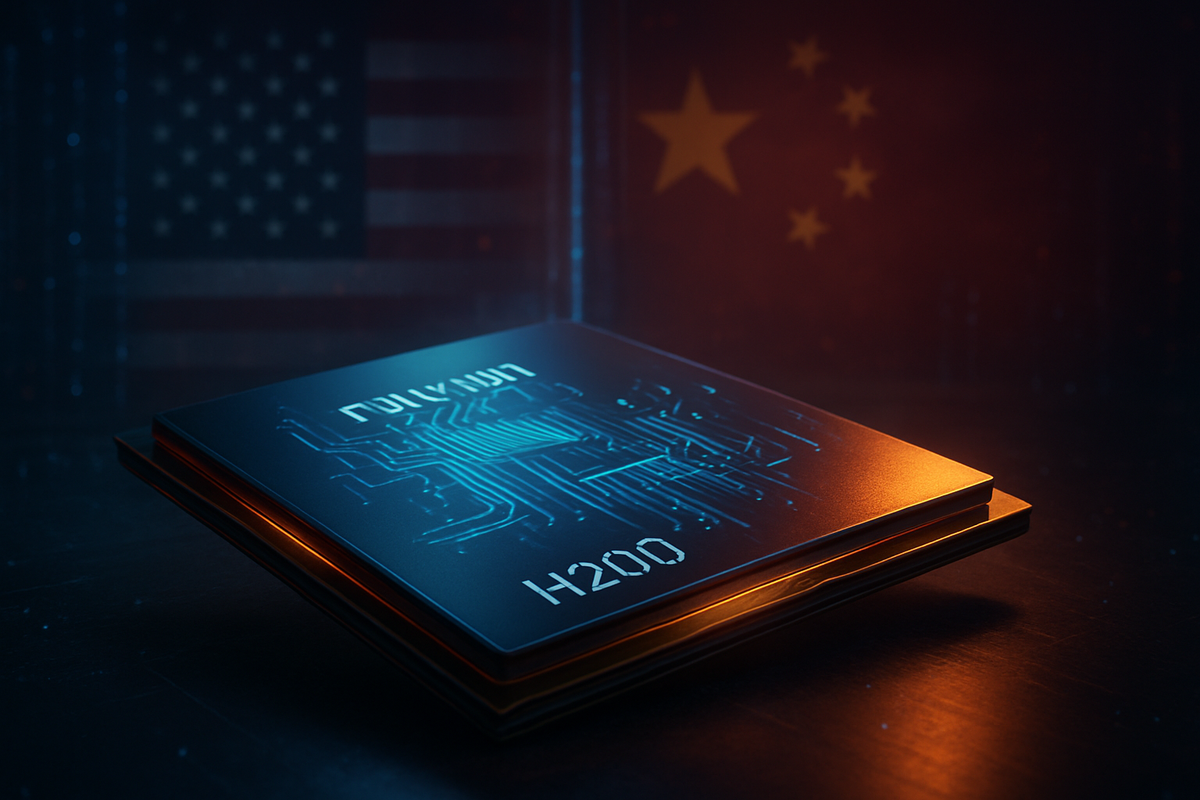
In a landmark shift for global semiconductor trade, the Trump administration has officially granted Nvidia (NASDAQ: NVDA) and Advanced Micro Devices (NASDAQ: AMD) permission to export high-end H200 AI chips to China. The decision, finalized on January 16, 2026, marks the end of a long-standing blanket ban on top-tier silicon, replacing it with a "managed access" framework designed to capture revenue for the U.S. Treasury while maintaining a technical leash on Chinese AI development.
The immediate reaction from Wall Street was one of cautious skepticism rather than celebration. Despite the opening of a multi-billion dollar revenue stream, Nvidia’s stock experienced a 1.4% dip on the day of the announcement, closing at $183.14. Investors expressed concern over the "Trump Surcharge"—a mandatory 25% federal fee on every unit sold—and a series of logistically complex security requirements that could erode margins and delay deliveries.
The Path to 'Managed Access': A Timeline of the Shift
The road to this policy shift began in late 2025, driven by intense industry lobbying and a changing geopolitical strategy that favors "taxable dependency" over total decoupling. The process accelerated on December 8, 2025, when President Trump signaled via social media that the administration would allow Nvidia to sell to "approved customers" in exchange for a direct revenue share. This culminated in a January 13, 2026, rule change by the Department of Commerce’s Bureau of Industry and Security (BIS), which shifted the licensing policy from a "presumption of denial" to a "case-by-case review."
The finalized framework, signed into effect on January 14, 2026, introduces the most rigorous export conditions in history. Every H200 shipment destined for China must now undergo "U.S. Routing," meaning chips manufactured in Taiwan must detour to a third-party laboratory in the United States for physical verification before reaching the end customer. Furthermore, the administration imposed the "50% Rule," which dictates that Nvidia cannot export more than half the volume of chips it sells domestically in the United States, ensuring American firms maintain priority access to the best hardware.
Technically, the approval is limited to chips with a Total Processing Performance (TPP) score below 21,000. While the Nvidia H200 (TPP ~15,832) qualifies, the more advanced Blackwell and upcoming Rubin architectures remain strictly prohibited. The regulatory burden is further complicated by strict Know Your Customer (KYC) requirements, forcing exporters to certify that buyers have no ties to the People's Liberation Army (PLA) or Chinese intelligence agencies.
Winners and Losers in the New Silicon Landscape
Nvidia (NASDAQ: NVDA) stands as the most prominent winner in terms of market access, regaining its footing in a territory that once accounted for a quarter of its revenue. However, the victory is pyrrhic; the 25% surcharge and logistical detours add significant overhead. Advanced Micro Devices (NASDAQ: AMD) is also a beneficiary, as its MI325X chip was included in the same licensing framework, allowing the company to challenge Nvidia’s dominance in the Chinese cloud sector for the first time in years.
On the other side of the Pacific, the impact is mixed. Chinese tech giants like Alibaba (NYSE: BABA) and Tencent (HKG: 0700) finally have legal access to the H200, which is essential for training the next generation of large language models. However, they now face drastically higher costs and the constant threat of "unsafe" labels from their own government. Beijing’s initial reaction has been frosty, with reports of Chinese customs agents stalling shipments in retaliation for the mandatory U.S. laboratory verification.
Domestic Chinese chip manufacturers like Huawei may find themselves in a difficult position. While the government-preferred Ascend 910C remains the domestic standard, it struggles to match the H200’s efficiency and the deep software ecosystem of Nvidia’s CUDA. Furthermore, many Chinese AI startups that flourished under the ban—positioning themselves as "import substitutes"—saw their funding dry up overnight as superior American silicon returned to the market.
A New Era of Taxable Dependency
This policy shift represents a fundamental departure from previous administrations' focus on "decoupling." By allowing exports but taxing them heavily, the Trump administration is treating AI chips as a strategic commodity similar to oil. This "taxable dependency" model aims to keep China reliant on American architectures while simultaneously funding U.S. industrial policy through the 25% surcharge.
The ripple effects are expected to be felt across the entire global supply chain. Competitors in South Korea and Japan are already watching closely to see if similar "surcharges" will be applied to their exports. Historically, this mirrors the high-tariff era of the late 19th century, but with a modern, high-tech twist: the tariff isn't just a barrier to entry; it’s a tool for persistent oversight and data collection via the mandatory routing labs.
The Road Ahead: Logistical Hurdles and Strategic Pivots
In the short term, the market will focus on whether Nvidia can pass the 25% surcharge on to its Chinese customers or if it will be forced to absorb the costs. The logistical bottleneck created by the U.S.-based verification labs is the most immediate operational challenge. Industry analysts estimate these detours could add three to five weeks to lead times, potentially causing a backlog that lasts well into the second half of 2026.
Longer-term, the administration’s strategy may force a pivot in how AI companies design their hardware. We may see the emergence of "China-specific" SKUs that are physically designed to pass U.S. laboratory inspections more quickly. However, if Beijing decides to implement a full-scale boycott of "Surcharge Chips," the newly opened market could close just as quickly as it opened, leaving Nvidia and AMD with specialized inventory and no buyers.
Final Assessment for Investors
The approval of H200 exports to China is a double-edged sword that provides a revenue floor for the semiconductor industry but introduces unprecedented geopolitical and fiscal friction. The 1.4% dip in Nvidia’s stock is a clear signal that the market views this "opening" as a complex regulatory challenge rather than a simple sales win. The "managed access" model is a live experiment in high-tech diplomacy, and its success depends entirely on whether the U.S. Treasury can collect its fees without breaking the supply chain.
Investors should closely monitor Chinese customs data and Nvidia’s next quarterly earnings report for signs of margin compression. The key indicator of success will not be the volume of chips shipped, but the ability of these companies to navigate the "Trump Surcharge" without triggering a total retaliatory ban from Beijing. As we move deeper into 2026, the semiconductor market remains the primary battlefield for global influence, with the H200 serving as the newest and most expensive pawn.
This content is intended for informational purposes only and is not financial advice.