

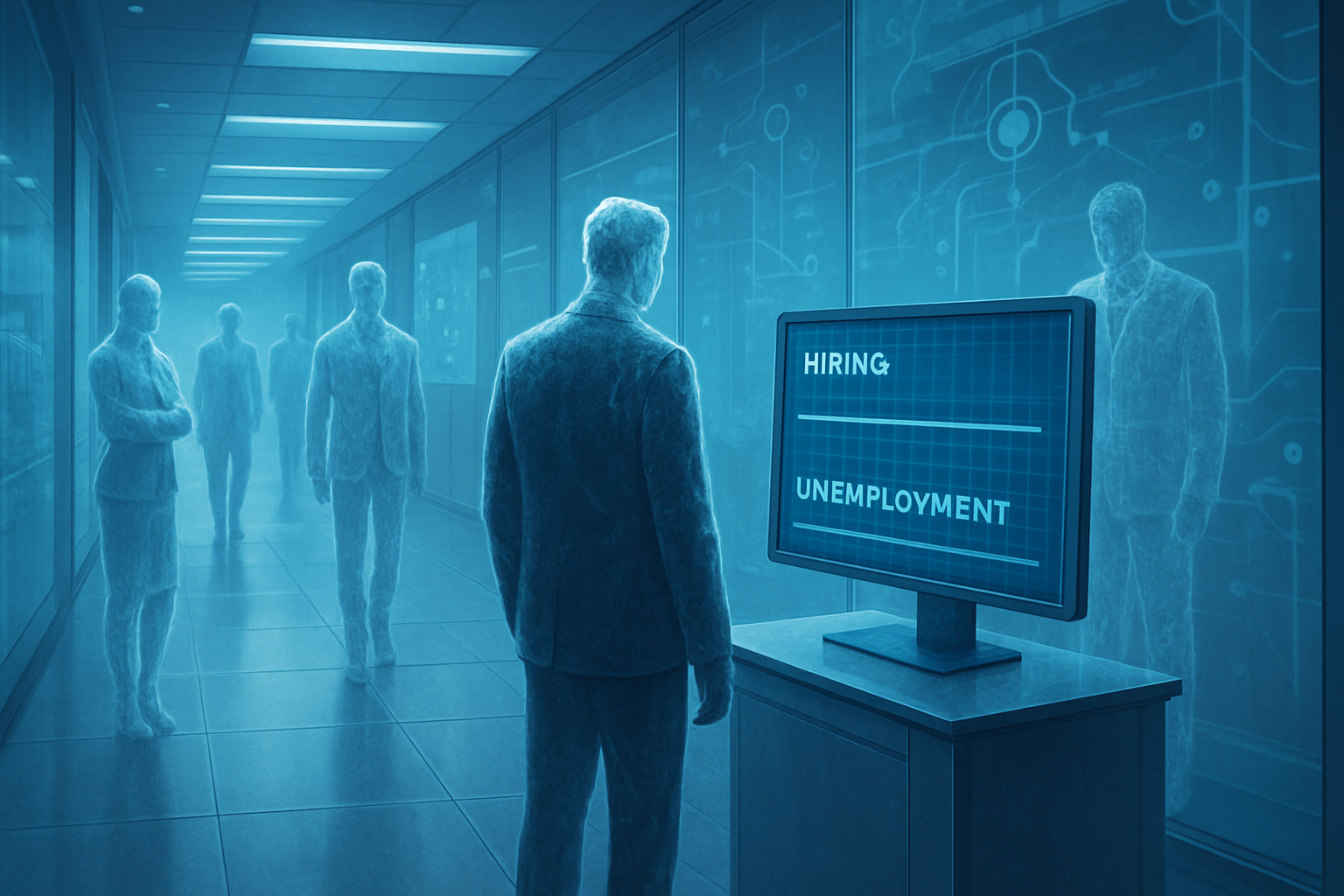
The United States labor market has transitioned into a state of "strategic hibernation," marked by a "no hiring, no firing" equilibrium that has left economists and investors recalibrating their expectations for the year ahead. Following the release of the December 2025 jobs report, it is clear that the frenetic churn of the post-pandemic era has been replaced by a "Big Stay." Companies, wary of high borrowing costs and geopolitical uncertainty, are clutching their existing talent while showing extreme reluctance to expand their payrolls.
This period of stasis presents a unique challenge for the Federal Reserve. While the lack of aggressive hiring suggests a cooling economy, the absence of mass layoffs and persistent wage stability complicates the path toward further interest rate cuts in 2026. For the American worker, the "Great Resignation" has officially given way to the "Great Lockdown," where job security is high but upward mobility and external opportunities have largely evaporated.
A December Chill: Inside the 'Frozen' Jobs Report
The December 2025 employment data, released on January 9, 2026, served as a definitive confirmation of this trend. The U.S. economy added a meager 50,000 jobs during the final month of the year, falling short of the modest consensus estimate of 65,000. This brought the total job gains for 2025 to a mere 584,000—a staggering 71% decline from the 2 million jobs added in 2024. Despite this sluggish growth, the unemployment rate actually ticked down to 4.4% from a revised 4.5% in November, though analysts at J.P. Morgan (NYSE: JPM) pointed out that this was largely due to a shrinking labor force and reduced participation rather than a surge in employment.
The most telling metrics, however, were found in the turnover data. The voluntary quit rate remained stuck at 1.8%, its lowest level in over a decade, excluding the brief shock of the 2020 pandemic. Simultaneously, layoffs remained at a historical floor of 1.1%, as firms opted to "hoard" their current workforce rather than risk losing institutional knowledge in an uncertain environment. This "low-hire, low-fire" environment was exacerbated by a brief but disruptive federal government shutdown in late 2025, which caused the public sector to shed 136,000 jobs over the course of the year and rattled corporate confidence.
Federal Reserve officials, led by Chair Jerome Powell, have responded to the data with characteristic caution. After a 25-basis-point cut in December 2025 that brought the federal funds rate to a range of 3.5%–3.75%, the "stasis" has led the central bank to signal a potential pause for the upcoming January 2026 meeting. The consensus among policymakers is shifting toward a "higher-for-longer" stance, with many now expecting only one additional rate cut for the entirety of 2026.
Corporate Winners and Losers in the Stasis Economy
The "Big Stay" is creating a stark divide between industries that rely on labor turnover and those that can leverage efficiency and automation. The recruitment and staffing sector has been the most visible casualty. Companies like ManpowerGroup (NYSE: MAN) and Robert Half (NYSE: RHI) have seen their stock prices underperform as the "churn" that fuels their business models has all but vanished. With fewer people quitting and fewer companies posting new roles, the demand for third-party talent acquisition has reached its lowest point since the 2008 financial crisis.
Conversely, large-cap retail and tech giants are using this period of low turnover to aggressively optimize their internal structures. Walmart (NYSE: WMT) has seen its stock reach record highs by implementing a global corporate headcount freeze while simultaneously leveraging AI to manage its vast supply chain. By focusing on productivity gains rather than headcount expansion, Walmart has managed to preserve margins even as consumer spending growth moderates. Similarly, Amazon (NASDAQ: AMZN) has continued to "remix" its workforce, cutting corporate roles while accelerating its plan to integrate specialized robotics across its logistics network.
In the technology sector, the focus has shifted entirely to "AI-first" headcount policies. Microsoft (NASDAQ: MSFT) and IBM (NYSE: IBM) have reported their lowest voluntary attrition rates in decades. IBM, in particular, has capitalized on this by retraining existing staff for AI-centric roles rather than hiring externally, a strategy that has kept costs low. Shopify (NYSE: SHOP) has taken this a step further, reportedly requiring department heads to provide a "technological justification" for any new human hire over an automated solution.
The Rise of Productivity-Driven Growth
This shift into labor market stasis is not merely a cyclical downturn; it represents a broader structural change in how American corporations operate. After years of labor shortages and wage spikes, the 2025 "Great Stay" reflects a strategic pivot toward efficiency. The integration of Generative AI is finally beginning to show up in productivity data, allowing companies to maintain output levels with flat or declining headcounts. This mirrors the early 2010s "jobless recovery," but with the added layer of sophisticated automation that may permanently lower the "natural" rate of hiring.
The wider significance of this trend also extends to the regulatory and policy landscape. With immigration numbers cooling and the labor force aging, the "no-firing" part of the equation is a defensive move by CEOs who fear that if they let workers go now, they may never be able to hire them back when the economy accelerates. This has created a "golden handcuffs" effect, where workers remain in roles they dislike for the sake of stability, while employers keep workers they don't strictly need for the sake of future-proofing.
Historically, such periods of low turnover often precede a significant shift in the economic cycle. The current environment bears some resemblance to the late 1990s "productivity miracle," where technological gains allowed for low unemployment and low inflation simultaneously. However, the high-interest-rate environment of 2026 provides a much different backdrop, as the cost of capital remains a significant drag on expansionary investment.
Scenarios for 2026: Soft Landing or Long Stagnation?
As we look toward the remainder of 2026, the primary question for the market is whether this stasis is a prelude to a "soft landing" or a precursor to long-term economic stagnation. In the short term, the Federal Reserve is likely to remain in a "wait-and-see" mode. If the labor market stays frozen, inflation should continue to drift toward the 2% target, potentially allowing for a more dovish pivot in the second half of the year. However, if the "no-hiring" trend eventually gives way to "increased-firing" as margins compress, the Fed may be forced to act more aggressively to prevent a recession.
A major strategic pivot for many companies will involve "internal talent marketplaces." Instead of looking outside for new skills, expect firms to double down on upskilling programs. The market opportunity here lies in enterprise software and EdTech platforms that facilitate this internal mobility. On the other hand, the primary challenge remains consumer sentiment; if workers feel "trapped" in their jobs, discretionary spending may suffer, impacting luxury and travel sectors later in the year.
Navigating the 'Golden Handcuffs' Era
The U.S. labor market at the start of 2026 is a study in contradictions. It is stable yet stagnant, secure yet stifling. The December jobs report has provided the Fed with the cover it needs to keep interest rates restrictive for longer, as the "low-fire" environment prevents a true economic emergency. For investors, the key takeaways are clear: growth will now be driven by efficiency and AI integration rather than sheer scale and payroll expansion.
Moving forward, the market will be closely watching the "Quits" data in the monthly JOLTS reports. A rise in quits would signal that workers are finding better opportunities, potentially reigniting the labor engine. Until then, the "Big Stay" remains the dominant economic narrative. Investors should favor high-margin companies that have demonstrated they can grow earnings without growing headcount, as the era of easy hiring remains a distant memory.
This content is intended for informational purposes only and is not financial advice