
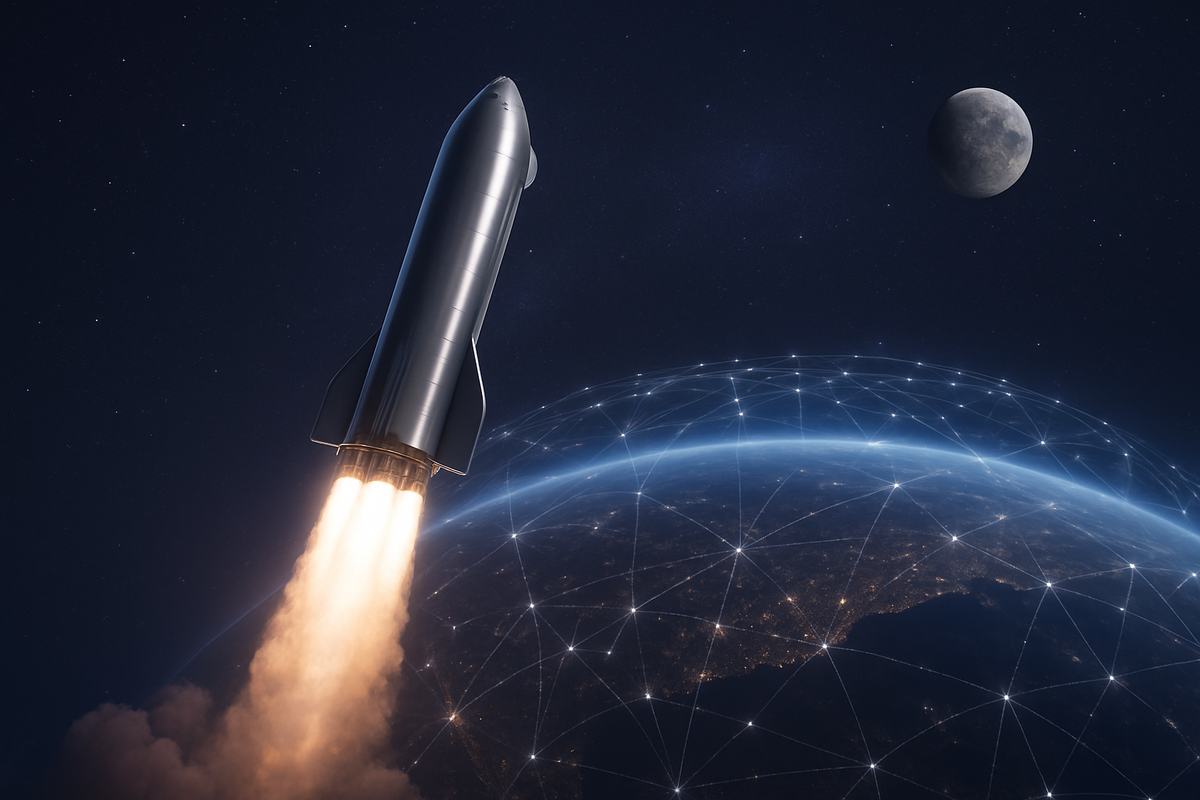
SpaceX, the ambitious aerospace manufacturer and space transport services company, continues its relentless push to redefine humanity's presence in space. As of December 2025, the company is at a pivotal juncture, marked by the rapid iterative development of its Starship program and the expansive global reach of its Starlink satellite internet constellation. These advancements are not merely technological feats but herald significant shifts in global connectivity, space exploration, and the competitive landscape of the aerospace industry, with immediate implications for both public and private entities.
The immediate impact of SpaceX's current trajectory is multifaceted. The accelerating pace of Starship's flight tests and the imminent debut of its Version 3 design signal a determined march towards deep-space missions and heavy-lift capabilities crucial for lunar and Martian ambitions. Concurrently, Starlink's aggressive deployment, particularly with the successful rollout of its Direct to Cell (D2C) service across over 100 countries, is democratizing internet access and establishing a formidable revenue stream that underpins the company's grander aspirations. This dual-pronged strategy is not only solidifying SpaceX's market dominance but also exerting considerable pressure on traditional aerospace contractors and telecommunications giants alike, compelling them to innovate or risk being outpaced in the rapidly evolving space economy.
Unpacking SpaceX's Latest Milestones and Strategic Shifts
SpaceX's year has been defined by a series of high-profile developments across its core initiatives. The Starship program, central to CEO Elon Musk's vision of making humanity multi-planetary, has seen a flurry of activity. As of October 13, 2025, Starship completed its 11th flight test, marking the final planned flight for the Starship Version 2 design. The 10th flight, on August 26, 2025, achieved critical successes, including a Super Heavy booster splashdown test and the Starship upper stage deploying Starlink mass simulators and re-lighting an engine in orbit. The focus is now firmly on Starship Version 3 (V3), described as a "massive upgrade," with its maiden flight targeted for early 2026. This next iteration is designed to be capable enough for initial Mars missions, with the next Super Heavy booster stack expected in December 2025 at Starbase.
Infrastructure expansion is also a key component of Starship's future. The U.S. Air Force has approved a new Starship launch pad at Launch Complex 37 (SLC-37) at Cape Canaveral, Florida, with construction already underway. This will be Starship's third dedicated launch site in Florida, aiming for "airport-like efficiency" to support diverse missions, including national security and NASA's Artemis program. However, the Human Landing System (HLS) for NASA's Artemis program, which relies on Starship, has faced delays. The uncrewed HLS lunar landing test, initially expected in 2025, is now slated for 2026, pushing the Artemis III crewed mission to no earlier than September 2026 or even mid-2027. This delay prompted NASA's Acting Administrator to reopen the lander competition to include Blue Origin, citing concerns over on-orbit cryogenic propellant transfer. Despite this, SpaceX responded by releasing a simplified lunar lander design. Mars mission timelines have also been revised, with an uncrewed Starship mission to Mars now realistically targeted for 2028, and a crewed flight likely in 2030, a slight adjustment from Musk's earlier, more aggressive projections.
Meanwhile, the Starlink constellation continues its rapid global expansion. On December 2 and 4, 2025, SpaceX launched a combined 57 Starlink satellites from Cape Canaveral and Vandenberg, respectively. In 2025 alone, Florida hosted 67 Starlink missions, deploying 1,724 satellites, bringing the total in orbit to over 9,528. A groundbreaking development is the public availability of Starlink's Direct to Cell (D2C) service. SMS texting via D2C became available in the U.S. (through partnerships with T-Mobile (NASDAQ: TMUS), AT&T (NYSE: T), and Verizon (NYSE: VZ)) and New Zealand (One NZ) in July 2025. By August 2025, D2C was operational in over 100 countries, with voice, data, and Internet of Things (IoT) services expected to follow. SpaceX further bolstered its D2C capabilities by acquiring AWS-4 and H-block licenses from EchoStar (NASDAQ: SATS) in September 2025, aiming for greater spectrum ownership. The first-generation D2C constellation, comprising over 600 satellites, is now reportedly the largest 4G coverage provider globally.
SpaceX's workhorse Falcon rocket family continues to set industry benchmarks. As of December 4, 2025, the Falcon 9 family has completed 584 launches with an impressive 581 full mission successes. The company achieved a record 150 Falcon 9 launches in 2025, with one booster (B1071) completing its 30th flight, and a collective 540 successful booster landings. The U.S. Space Force awarded SpaceX two substantial National Security Space Launch (NSSL) Phase 3 Lane 1 contracts, totaling $733.6 million, for launches between 2025 and 2026. SpaceX was also designated the primary provider for NSSL Phase 3 Lane 2 contracts, anticipated to receive 28 missions from fiscal years 2025 to 2029, largely utilizing its cost-effective Falcon Heavy. Furthermore, NASA modified its NLS II contract with SpaceX in March 2025 to include the Starship launch vehicle, providing enhanced options for launching high-priority scientific and exploration satellites. In January 2025, SpaceX also launched two robotic lunar landers, Blue Ghost (developed by Firefly Aerospace) and Resilience, on a Falcon 9, underscoring its role in commercial lunar exploration.
Market Movers: Winners and Losers in the New Space Race
SpaceX's relentless innovation and aggressive market strategies are creating clear winners and losers across various sectors. In the launch services market, SpaceX (privately held) continues to exert immense pressure on competitors. Its record-breaking reusability and high launch cadence, particularly with the Falcon family, drive down costs significantly, making it challenging for companies relying on expendable rockets to compete on price. United Launch Alliance (ULA), a joint venture between Boeing (NYSE: BA) and Lockheed Martin (NYSE: LMT), is a prime example. While ULA is developing its Vulcan Centaur rocket to compete, SpaceX's established track record and lower costs, especially for national security missions, mean ULA faces an uphill battle to retain market share. The recent NSSL Phase 3 awards, where SpaceX secured the majority of missions and was designated the primary provider for Lane 2, highlight this shift.
In the burgeoning lunar exploration sector, the competition for NASA's Human Landing System (HLS) contract is heating up. While SpaceX's Starship HLS was initially the sole provider, delays in its development have led NASA to reopen the competition, bringing Blue Origin (privately held, founded by Jeff Bezos) back into the fold. This creates a potential win for Blue Origin, which could secure a significant portion of the HLS contract, diversifying NASA's options and fostering a more competitive environment. For SpaceX, it means a more stringent development pathway and the possibility of sharing a crucial revenue stream. Companies involved in commercial lunar missions, such as Firefly Aerospace (privately held), which saw its Blue Ghost lander launched by SpaceX, stand to benefit from the increased accessibility and lower costs of lunar transportation, fostering a new ecosystem of lunar services and science.
The telecommunications sector is experiencing a seismic shift due to Starlink's Direct to Cell (D2C) service. Traditional mobile network operators like T-Mobile (NASDAQ: TMUS), AT&T (NYSE: T), and Verizon (NYSE: VZ) in the U.S., and One NZ in New Zealand, are partnering with Starlink to extend their coverage, particularly in rural and remote areas. This represents a significant opportunity for these carriers to expand their customer base and offer enhanced services without building extensive new ground infrastructure. However, it also signifies a potential long-term threat if Starlink's D2C becomes a direct competitor for ubiquitous mobile service. Furthermore, companies like EchoStar (NASDAQ: SATS), which recently sold AWS-4 and H-block licenses to SpaceX, are strategically aligning themselves with the new space-based connectivity paradigm, though the sale also indicates a shift in spectrum control towards SpaceX. The rural broadband market, where Starlink is set to provide service to over 470,000 U.S. locations through a federal program, also presents both opportunities and challenges. While Starlink stands to gain significant subsidies, concerns about its ability to consistently meet fiber-equivalent performance standards could open doors for traditional fiber-optic providers or other satellite internet competitors to challenge its dominance in this specific niche.
Broader Implications and Industry Transformation
SpaceX's current trajectory is not merely about individual successes; it's a powerful catalyst reshaping the entire space industry and beyond. The most significant broader implication is the radical reduction in the cost of accessing space. SpaceX's relentless pursuit of reusability, now perfected with the Falcon 9 and increasingly applied to Starship, has fundamentally altered the economic equation of space launches. This forces competitors, both established giants and new entrants, to either adopt similar cost-saving strategies or find niche markets where cost is less of a factor. This trend democratizes space, making it accessible for a wider array of commercial, scientific, and national security missions, fostering innovation across the board from satellite manufacturing to in-orbit services.
The expansion of Starlink, particularly its Direct to Cell capabilities, has profound implications for global connectivity and digital inclusion. By providing internet access to underserved and remote regions, Starlink is bridging the digital divide on an unprecedented scale. This has ripple effects on economies, education, and disaster relief efforts worldwide. For traditional telecommunications companies, Starlink represents both a potential partner and a formidable competitor, accelerating the need for innovation in terrestrial networks and potentially driving down prices for consumers. The acquisition of additional spectrum from companies like EchoStar highlights SpaceX's ambition to control more of the end-to-end service, potentially leading to a more vertically integrated connectivity provider. This also raises regulatory implications, particularly concerning spectrum allocation, orbital debris, and fair competition in various national markets, as governments grapple with the rapid deployment of mega-constellations.
The delays in the Artemis Human Landing System (HLS) program and the reopening of competition to Blue Origin underscore the inherent challenges and complexities of deep-space exploration. While SpaceX's Starship is revolutionary, the scale of its development and the novel technologies required, such as on-orbit cryogenic propellant transfer, present significant engineering hurdles. This situation highlights the importance of redundancy and competition in critical national programs, ensuring that ambitious timelines are balanced with robust technical solutions. Historically, space programs have often faced delays, from the Apollo missions to the Space Shuttle, demonstrating that cutting-edge endeavors rarely proceed without unforeseen obstacles. SpaceX's push for Mars, even with revised timelines, fits into a broader trend of renewed interest in deep-space exploration, with nations and private entities vying for leadership in establishing a human presence beyond Earth orbit, potentially leading to new international collaborations or rivalries.
The Road Ahead: Navigating Future Frontiers
Looking ahead, SpaceX faces a dynamic landscape filled with both immense opportunities and significant challenges. In the short term, the successful maiden flight and subsequent rapid iteration of Starship Version 3 will be paramount. A consistent and reliable launch cadence for Starship is critical not only for NASA's Artemis program but also for SpaceX's internal goals of deploying next-generation Starlink satellites and eventually launching crewed missions to Mars. The ongoing construction and operationalization of new Starship launch infrastructure at Cape Canaveral will be a key enabler for achieving higher flight rates, aiming for that "airport-like efficiency." Addressing the technical hurdles of on-orbit cryogenic propellant transfer remains a top priority, as it is fundamental for long-duration deep-space missions and lunar landings.
In the long term, the strategic pivots will revolve around scaling Starship production and operations, expanding Starlink's Direct to Cell services to include full voice and data capabilities, and securing further lucrative government and commercial contracts. The competition for NASA's HLS program will continue to be a significant area to watch, as will the broader landscape of national security space launches, where SpaceX aims to be the dominant provider. Market opportunities will emerge from the increasing demand for heavy-lift capabilities for large satellite constellations, space station modules, and deep-space probes. Furthermore, Starlink's global reach could unlock entirely new markets for connectivity, particularly in areas previously deemed economically unviable for traditional infrastructure.
However, challenges persist. Regulatory scrutiny over orbital debris, spectrum usage, and market dominance will likely intensify as SpaceX's operations expand. Competitors will not stand still; companies like Blue Origin, ULA, and emerging players in Europe and Asia will continue to develop their own next-generation launch vehicles and satellite services. The sheer capital expenditure required for Starship's development and Starlink's continued deployment is enormous, making sustained profitability and effective capital management crucial. Potential scenarios range from SpaceX achieving its Mars colonization goals within the next two decades, solidifying its position as the preeminent space company, to facing unforeseen technical setbacks or regulatory hurdles that slow its progress. Investors should closely monitor Starship's flight test success rate, Starlink subscriber growth and profitability, and the outcome of key government contracts.
Concluding Thoughts: A New Era of Space Dominance
SpaceX's current trajectory, marked by the rapid advancement of Starship and the global proliferation of Starlink, signifies a profound and lasting impact on the financial markets and the broader space industry. The company's innovative approach to reusability and its ambitious long-term vision are not just disrupting existing paradigms but are actively forging new ones. The immediate future will see continued intense development in the Starship program, with the Version 3 design poised to unlock unprecedented capabilities for heavy-lift and deep-space missions. Simultaneously, Starlink's Direct to Cell service is set to revolutionize global connectivity, creating both opportunities and competitive pressures for telecommunications companies worldwide.
As the market moves forward, the key takeaways from SpaceX's recent activities are clear: cost-effectiveness and rapid iteration are paramount for success in the new space race. SpaceX's ability to drive down launch costs and increase access to space is a game-changer, forcing all players to adapt. Investors should recognize the dual nature of SpaceX's strategy: Starlink provides a robust, growing revenue stream to fund the capital-intensive Starship program, which promises future, potentially transformative, returns. The competitive landscape will remain fierce, with traditional aerospace giants and new space ventures vying for market share in launch, satellite services, and lunar exploration.
Ultimately, SpaceX is not just a company; it's a driving force behind a new era of space exploration and utilization. Its actions in the coming months, particularly concerning Starship's flight test cadence, Starlink's expansion into full D2C services, and the outcomes of critical government contracts, will be crucial indicators for the future direction of the entire sector. Investors should watch for continued technological breakthroughs, regulatory developments, and the strategic responses of competitors, as these will define the opportunities and risks in this rapidly evolving and high-stakes market.
This content is intended for informational purposes only and is not financial advice