
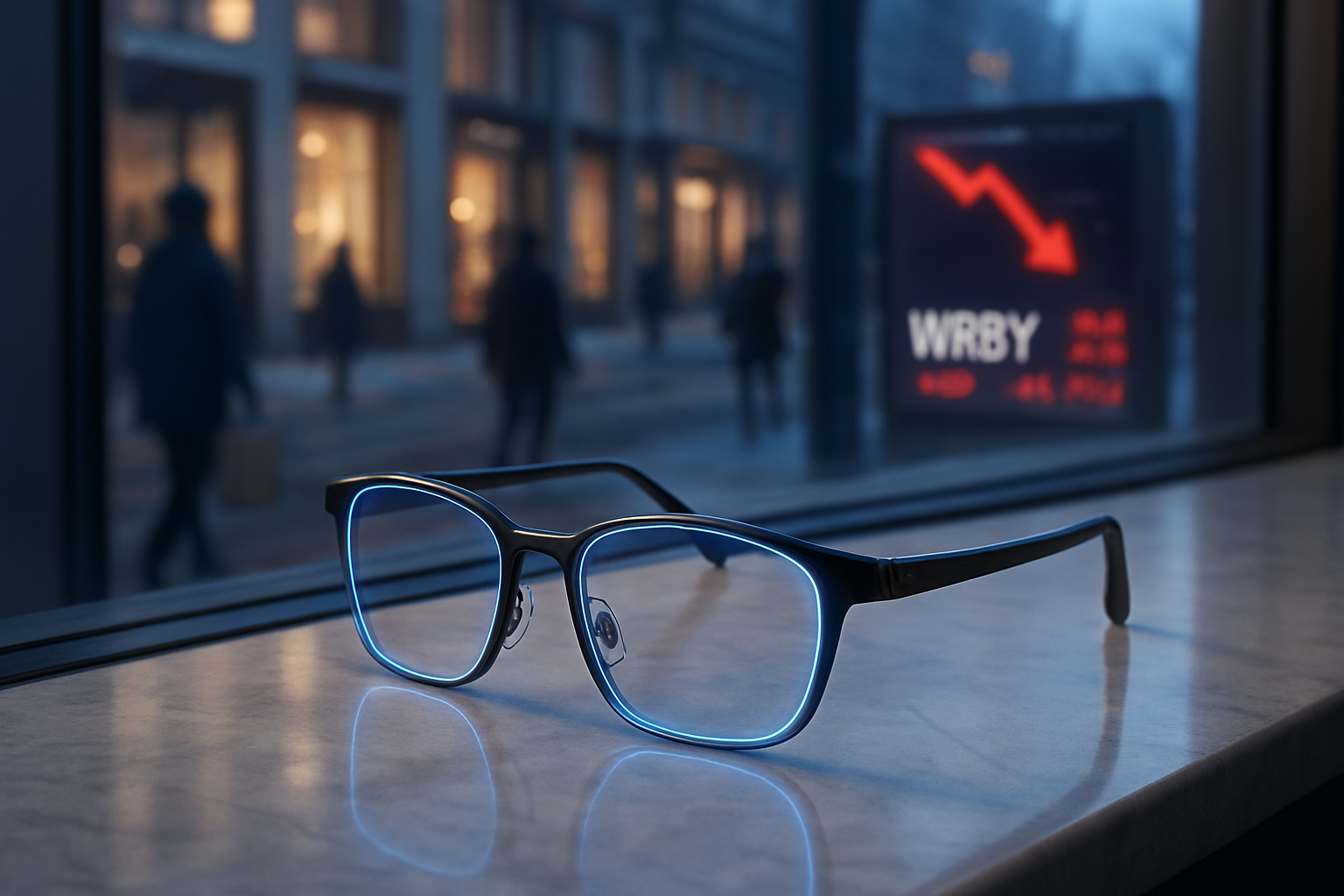
The final trading days of 2025 have proven turbulent for Warby Parker Inc. (NYSE: WRBY), as the eyewear disruptor saw its stock price slide sharply following a surprise pre-announcement of disappointing holiday sales. Despite a mid-December surge driven by a high-profile technology partnership, the company’s shares are now lagging behind the broader market indices, which have largely maintained their gains in a year defined by artificial intelligence and a resilient, albeit cautious, consumer base.
The recent downturn underscores the persistent challenges facing the retail sector as the year draws to a close. While the National Retail Federation (NRF) reported that total U.S. holiday spending topped the $1 trillion mark for the first time in history, the growth rate has slowed significantly. For Warby Parker, the combination of a "highly promotional" environment and a dip in online conversion rates has forced a late-year reckoning for investors who had hoped the brand’s expansion into medical services and high-tech wearables would insulate it from macroeconomic headwinds.
A December to Forget: The Timeline of the Slide
The volatility for Warby Parker began in earnest during the final week of the year. On December 26, 2025, the stock plummeted approximately 8.2% on high-volume institutional selling. This sharp decline was triggered by a management update that revised Q4 2025 guidance downward, citing a weaker-than-expected performance during the critical "Cyber Week" and the subsequent December shopping period. The stock, which had reached a monthly high of $30.23 just weeks prior, fell into a trading range between $23.40 and $24.20 by December 30.
This year-end slide stands in stark contrast to the optimism seen in early December. On December 4, Warby Parker announced a landmark partnership with Google (NASDAQ: GOOGL) to develop AI-powered smart glasses. The project, dubbed the "Third Act" of the company’s evolution, promised to integrate Google’s Gemini AI and Android XR platform into Warby’s signature frames by 2026. The news initially sent shares soaring as analysts from firms like Piper Sandler raised price targets, briefly making WRBY a darling of the "retail-meets-tech" narrative.
However, the excitement over future technology could not mask the immediate operational hurdles revealed in the company’s Q3 2025 earnings report and subsequent updates. While revenue for the third quarter grew 15.2% year-over-year to $221.7 million, it fell short of the $224.5 million consensus. More concerning to the street was the miss on earnings per share (EPS), which came in at $0.05 against an expected $0.08. As the reality of a "cautious" consumer set in, the market's focus shifted from 2026 AI dreams to the 2025 bottom line.
Winners and Losers in the Eyewear Tug-of-War
In the current environment, the eyewear market has become increasingly bifurcated, creating clear winners and losers. On the winning side are ultra-low-cost digital competitors like Zenni Optical, which have captured price-sensitive consumers trading down from premium brands. As inflation and a late-year federal government shutdown eroded discretionary income in late 2025, Zenni’s $7 frame offerings became an attractive alternative to Warby Parker’s $95-and-up pricing model.
Conversely, legacy giants like EssilorLuxottica (OTC: ESLOY) continue to leverage their massive scale and ownership of managed vision care providers to maintain a dominant 28% share of the U.S. market. While Warby Parker has successfully expanded its physical footprint to over 313 stores, it still lacks the vertical integration and insurance-network dominance of the industry's largest player. National Vision Holdings (NASDAQ: EYE) has also faced pressure, suggesting that the "middle-market" of the optical industry—where Warby Parker increasingly sits—is currently the most vulnerable to shifting consumer habits.
Google emerges as a strategic winner regardless of Warby Parker's short-term stock performance. By partnering with a brand known for design and consumer trust, Google secures a viable hardware platform for its AI ecosystem, avoiding the "Glass" pitfalls of a decade ago. For Warby Parker, the partnership is a long-term win, but in the immediate term, the company is losing the battle for the "value" consumer who is currently prioritizing essentials over stylish new frames.
Broader Industry Trends and Macroeconomic Pressures
The struggles at Warby Parker are a microcosm of the broader U.S. retail landscape in late 2025. The sector is currently grappling with "cautious strength"—a phenomenon where total spending remains high, but consumers are extremely selective, waiting for deep discounts before pulling the trigger. This has led to a "highly promotional" environment where gross margins are sacrificed to maintain sales volume. For Warby Parker, gross margins dipped slightly to 54.1% in late 2025, pressured by both these promotions and ongoing tariffs on imported lenses and frames.
Furthermore, the late-year federal government shutdown in December 2025 created a localized but significant ripple effect. The resulting dip in consumer confidence delayed discretionary purchases during the final two weeks of the year, a period when many consumers typically use their remaining Flexible Spending Account (FSA) and Health Savings Account (HSA) dollars on eyewear. Historically, the end-of-year "FSA rush" has been a reliable tailwind for the optical industry; in 2025, that tailwind became a light breeze.
This event mirrors the retail environment of late 2022, when high inflation first began to decouple brand loyalty from consumer spending. However, the 2025 version includes a new layer of complexity: the "AI premium." Investors are now rewarding companies that can prove tech integration, but they are simultaneously punishing those that fail to meet traditional retail metrics. Warby Parker is caught in the middle of this transition, attempting to pivot from a direct-to-consumer (DTC) darling to a tech-enabled healthcare provider.
The Road Ahead: 2026 and the "Third Act"
Looking into 2026, Warby Parker is entering a critical "transition phase." The primary catalyst for a stock recovery will be the successful execution of its AI glasses launch. If the company can demonstrate that its partnership with Google translates into a high-margin, recurring revenue stream—perhaps through AI-subscription features integrated into the eyewear—it may regain its status as a high-growth innovator. Short-term, however, the company must stabilize its online conversion rates, which have lagged as consumers return to physical shopping.
Strategic pivots may also include a deeper push into medical services. With over 313 stores, Warby Parker is increasingly acting as a primary eye-care provider rather than just a frame shop. Expanding its eye exam capacity and deepening its integration with major vision insurance carriers will be essential to mitigating the volatility of discretionary frame sales. Market opportunities remain in the "holistic vision" space, where the company can leverage data from its digital apps and physical exams to create a more "sticky" customer relationship.
The potential scenarios for 2026 range from a robust recovery driven by tech-enthusiast adoption of smart glasses to a continued stagnation if the retail environment remains promotional. Investors should watch for the company’s official Q4 2025 earnings call in early 2026, which will provide the first clear look at the margin impact of the holiday season and updated timelines for the Google collaboration.
Investor Takeaway and Market Wrap-Up
Warby Parker’s year-end slide serves as a reminder that even the most innovative brands are not immune to the gravity of macroeconomic trends. While the long-term narrative surrounding AI-powered eyewear is compelling, the current reality of a cautious consumer and a promotional retail environment has taken the wind out of the stock's sails. The 8.2% drop in late December reflects a market that is currently prioritizing immediate profitability and sales consistency over future technological potential.
Moving forward, the key for investors will be monitoring the "FSA catch-up" in early 2026 and the company's ability to maintain its Adjusted EBITDA margins, which showed resilience at 11.6% in the third quarter. Warby Parker remains a leader in the digital transformation of the optical industry, but its path to market outperformance now requires proving that it can grow its traditional retail base while simultaneously building the "Third Act" of its business.
In the coming months, keep a close eye on the specifics of the Google partnership and any shifts in the promotional landscape. If Warby Parker can weather the current retail storm and successfully bridge the gap between fashion and high-tech utility, the current slide may eventually be viewed as a buying opportunity in a transformative company. For now, however, caution remains the watchword for the eyewear innovator.
This content is intended for informational purposes only and is not financial advice.