
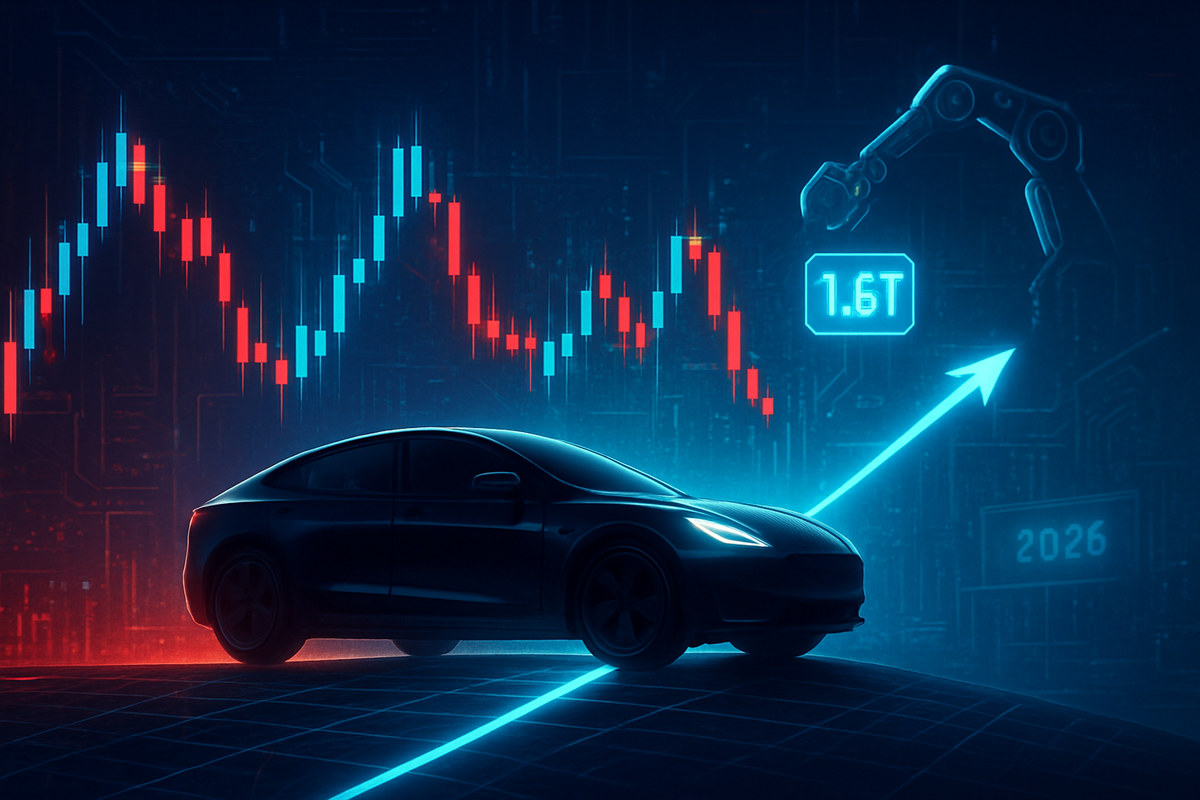
As the sun sets on 2025, Tesla (NASDAQ: TSLA) finds itself in an unprecedented position. On this December 30, the company’s stock is trading near $459.64, having recently retreated from an all-time intraday high of $498.83 reached just eight days ago. This valuation surge, which pushed the company’s market cap back above the $1.5 trillion mark, comes at a time when the company’s core business—selling electric vehicles—is facing its most significant contraction in history.
The immediate implication for investors is a total decoupling of Tesla’s valuation from its manufacturing output. While the broader market remains jittery due to the final stages of "The Great Rebalancing"—a year-end phenomenon where institutional funds trim over-concentrated winners—Tesla has emerged as the definitive "barometer" for high-growth tech. The market is no longer pricing Tesla as a car company; it is pricing it as an AI and robotics venture, even as the fundamentals of its automotive division show signs of fatigue.
A Tale of Two Realities: Record Highs Amidst Delivery Slumps
The final weeks of 2025 have been a whirlwind for Tesla shareholders. After a tumultuous start to the year that saw shares slide over 30% in the first quarter, the stock staged a massive recovery in the second half. This rally peaked on December 22, driven by optimism surrounding the rollout of Full Self-Driving (FSD) version 14. However, the celebration was short-lived. By December 30, the stock entered a period of "mechanical de-risking," as investors locked in profits ahead of the new year.
This price action stands in stark contrast to the company’s manufacturing data. Tesla recently released its company-compiled consensus for Q4 2025, forecasting roughly 422,850 deliveries—a sharp 15% decline compared to the same period in 2024. For the full year, Tesla is projected to deliver 1.64 million vehicles, marking its second consecutive year of declining sales. The timeline of this slump can be traced back to the expiration of federal EV tax credits earlier this year and a saturated market in North America, which has forced the company to rely on its AI narrative to maintain investor confidence.
The Winners and Losers of the EV Shift
The primary beneficiary of Tesla’s cooling delivery numbers has been BYD (OTC: BYDDY). In 2025, the Chinese titan officially surpassed Tesla as the world’s top battery-electric vehicle (BEV) seller, delivering over 2 million units. BYD’s vertical integration and the introduction of ultra-fast charging systems have allowed it to capture the value-conscious segment that Tesla’s aging Model 3 and Model Y lineup is struggling to retain.
In the domestic market, Rivian (NASDAQ: RIVN) has emerged as a resilient competitor, recently securing a $6.6 billion Department of Energy loan to accelerate its Georgia manufacturing plant. Meanwhile, Lucid (NASDAQ: LCID) has seen a prestige boost with the launch of its Gravity SUV, though it continues to struggle with high quarterly losses and a slow production ramp. While Tesla "wins" in the valuation game, these competitors are successfully chipping away at its once-impenetrable market share, creating a fragmented landscape where Tesla is no longer the default choice for every EV buyer.
The AI Pivot and the Regulatory Landscape
The wider significance of Tesla’s 2025 performance lies in its transition into an "AI-first" entity. The stock’s massive P/E ratio, which currently hovers near 300, is pinned almost entirely on the successful commercialization of the Cybercab and the Optimus humanoid robot. This shift mirrors historical precedents like Amazon’s transition from a bookstore to a cloud computing giant, but the stakes are significantly higher given the regulatory and technical hurdles of autonomous driving.
Broader industry trends suggest a cooling of the initial EV fever, replaced by a focus on "intelligent" mobility. The Federal Reserve’s decision to cut interest rates to the 3.50%–3.75% range in late 2025 provided some relief for auto loans, but it was not the silver bullet many hoped for. Furthermore, the loss of federal subsidies has forced all manufacturers to rethink their pricing strategies. Tesla’s ability to navigate these shifts depends on whether its FSD v14 software—currently receiving mixed reviews for urban "panic braking"—can finally reach the "unsupervised" milestone promised for years.
The Road to 2026: Hardware Hurdles and Strategic Pivots
Looking ahead to 2026, Tesla faces a critical "show me" period. The company has slated the official production of the steering-wheel-free Cybercab for April 2026, yet prototypes spotted in Austin as recently as last week still featured manual controls. This suggests that the transition to a purely autonomous fleet may be more gradual than the market has priced in. Additionally, the delay of the AI5 (formerly HW5) chip until mid-2027 means the next generation of Tesla vehicles will have to rely on older hardware, potentially capping the ceiling of their autonomous capabilities.
Investors should expect a strategic pivot toward "Robotaxi-as-a-Service" (RaaS) as Tesla attempts to monetize its existing fleet through software subscriptions. The challenge will be maintaining the $1.6 trillion valuation if delivery numbers continue to stagnate. If FSD v14 fails to achieve widespread consumer trust by mid-2026, the stock could face a significant "valuation reset" as the reality of being a high-margin software company clashes with the physics of being a low-growth hardware manufacturer.
Final Assessment: What to Watch in the New Year
Tesla enters 2026 as a paradox: a company with a declining core business but a soaring market valuation. The key takeaway for the year-end is that the market has fully embraced Elon Musk’s vision of Tesla as a robotics firm. However, the margin for error has never been thinner. The "Santa Claus rally" of December 2025 has provided a cushion, but the underlying volatility suggests that any further delays in the Cybercab or AI5 chip could trigger a sharp correction.
In the coming months, investors must keep a close eye on the Q4 earnings call in January and the initial feedback from the wider rollout of FSD v14.2.2.2. The battle for EV supremacy may have been lost to BYD in terms of volume, but the battle for the future of autonomy is just beginning. Whether Tesla can turn its AI dreams into GAAP-compliant profits will be the defining story of 2026.
This content is intended for informational purposes only and is not financial advice.