
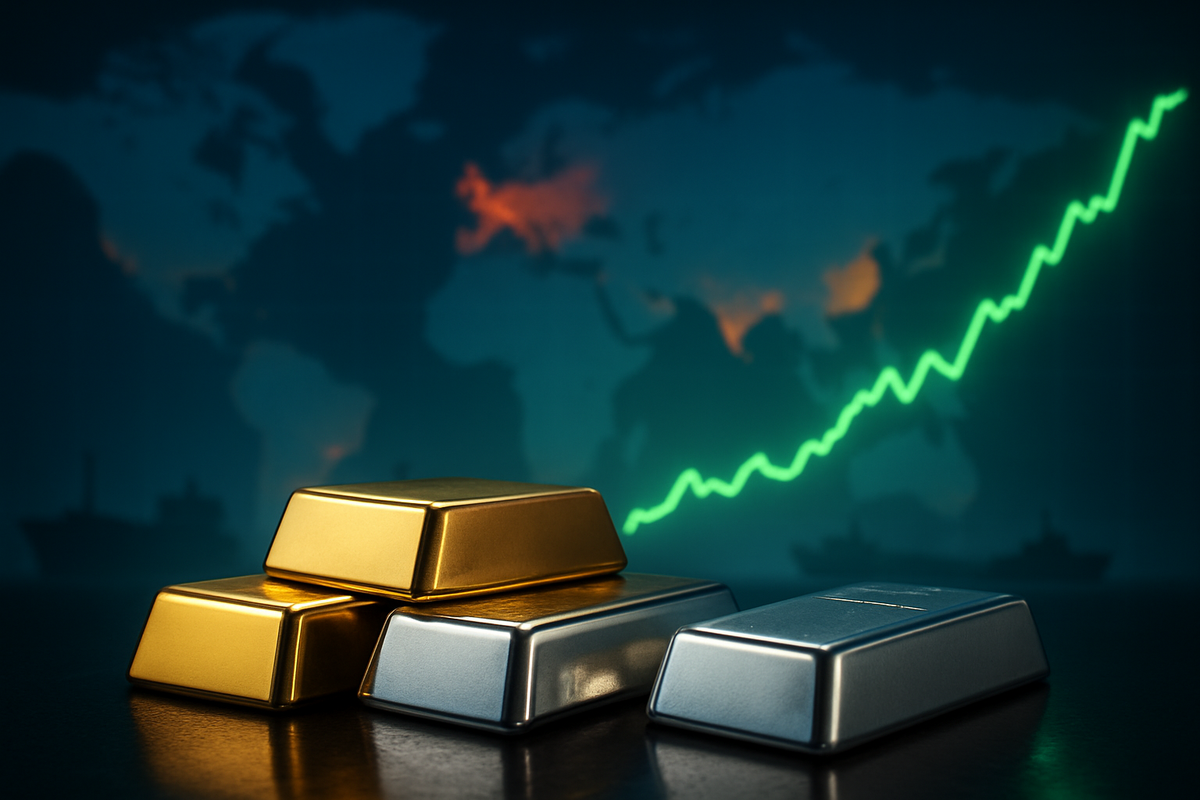
In a dramatic conclusion to an already historic year for precious metals, gold and silver prices staged a powerful "V-shaped" recovery on December 30, 2025. Following a sharp sell-off that rattled markets just twenty-four hours earlier, silver prices surged by more than 7%, reclaiming critical technical levels and underscoring the metal's role as a premier hedge against global instability. Gold similarly clawed back from its previous losses, stabilizing above the psychologically significant $4,500 per ounce mark as investors sought refuge from a rapidly deteriorating geopolitical landscape.
The rebound has immediate and profound implications for global liquidity and risk appetite. As the calendar turns to 2026, the resurgence of "hard assets" suggests that the market is bracing for a sustained period of high volatility. This move was further bolstered by a significant uptick in energy prices, with crude oil gaining ground as maritime tensions threatened global supply chains. For institutional and retail investors alike, the message is clear: the safe-haven trade is far from exhausted, and the year-end rally may be a precursor to even higher valuations in the coming year.
The Perfect Storm: A Timeline of the Year-End Reversal
The volatility began in earnest on Monday, December 29, 2025, when a "speculative blow-off" saw gold and silver prices plunge nearly 5% and 10%, respectively. Market analysts attributed this sudden drop to a combination of thin holiday liquidity and a surprise hike in margin requirements by the CME Group, which forced leveraged traders to liquidate positions. However, the downturn proved short-lived. By the morning of December 30, a cascade of geopolitical headlines triggered a massive wave of safe-haven buying, reversing the losses and propelling silver to its 7% intraday gain.
The primary catalyst for the rebound was an intensification of the U.S. blockade on Venezuelan oil, which led to the seizure of several tankers in the Caribbean. This move immediately sent Brent crude prices toward $62 per barrel, heightening fears of energy-driven inflation. Simultaneously, escalating rhetoric from Moscow regarding a "geopolitical reset" and live-fire military exercises by China in the Taiwan Strait provided a grim backdrop that favored non-fiat assets. By mid-day, spot silver had climbed from a low of $70.50 back toward $76.00, while gold reclaimed its footing above $4,500.
Key stakeholders, including central banks and major bullion desks, were reportedly active during the dip. The People's Bank of China (PBoC) is rumored to have continued its aggressive gold accumulation strategy, viewing the brief price drop as a strategic entry point. This institutional support, combined with the "debasement trade" fueled by rising oil, created a floor that the previous day's technical selling could not break.
Winners and Losers in the Metals Supercycle
The primary beneficiaries of this price surge are the major mining corporations, which have seen their margins expand to record levels. Newmont Corporation (NYSE: NEM) and Barrick Gold Corporation (NYSE: GOLD), the world’s two largest gold producers, saw their shares jump in pre-market trading as investors anticipated higher quarterly earnings. For these giants, every $100 increase in the price of gold translates into hundreds of millions of dollars in additional free cash flow, allowing for increased dividends and further exploration.
In the silver space, Pan American Silver Corp. (NASDAQ: PAAS) and First Majestic Silver Corp. (NYSE: AG) emerged as standout winners. With silver’s 7% rebound, these companies are well-positioned to capitalize on the widening structural deficit of the metal. Wheaton Precious Metals Corp. (NYSE: WPM), a leading streaming company, also benefited as its low-cost acquisition model allows it to capture the full upside of price spikes without the direct operational risks of mining. Investors in exchange-traded funds, such as the SPDR Gold Shares (NYSEARCA: GLD) and the iShares Silver Trust (NYSEARCA: SLV), saw immediate relief as their holdings recovered the value lost during the Monday crash.
Conversely, the losers in this scenario include industrial consumers of silver, particularly in the solar and AI hardware sectors. Companies that rely on silver for photovoltaic cells or high-end semiconductors are facing skyrocketing input costs that could squeeze margins in 2026. Short sellers were also caught in a "short squeeze" during Tuesday's rally, as the rapid reversal forced them to buy back positions at significantly higher prices, further fueling the upward momentum.
Wider Significance: De-Dollarization and the Industrial Deficit
The recent price action fits into a broader industry trend of "de-dollarization" and a fundamental shift toward tangible assets. Throughout 2025, central banks across the Global South have consistently reduced their exposure to U.S. Treasuries in favor of gold. This event reinforces the narrative that gold is no longer just a "barbarous relic" but a core component of modern sovereign reserves. The correlation between oil gains and gold's recovery also highlights the market's sensitivity to energy-led inflation, a trend reminiscent of the stagflationary periods of the 1970s.
Furthermore, the silver rebound is underpinned by a chronic industrial deficit. 2025 marked the fifth consecutive year where silver demand outstripped supply, driven by the green energy transition and the massive expansion of AI data centers. Unlike gold, which is primarily a financial asset, silver's dual role as an industrial commodity makes it uniquely sensitive to supply chain disruptions. The geopolitical tensions in the Taiwan Strait and the Caribbean only serve to exacerbate fears that the physical silver market could face a "liquidity crunch" in the near future.
Historically, such sharp rebounds after a technical sell-off are viewed by chartists as a sign of extreme underlying strength. The 2025 year-end rally draws comparisons to the 2020 pandemic-era surge, but with a key difference: the current move is driven by structural supply shortages and geopolitical realignment rather than purely monetary stimulus. This suggests that the current price levels may represent a new "floor" rather than a temporary peak.
The Road Ahead: What to Expect in 2026
In the short term, the market will be closely watching the Federal Reserve’s first meeting of 2026. While the Fed has signaled a potential pause in rate hikes, the spike in oil prices caused by the Venezuelan blockade could force a hawkish pivot if inflation begins to re-accelerate. Gold and silver investors will need to navigate this "tightrope" between safe-haven demand and the risk of higher-for-longer interest rates. However, many analysts believe that the momentum behind precious metals is now independent of Fed policy, driven instead by a global search for security.
Strategic pivots are already underway in the mining sector. Companies like Newmont (NYSE: NEM) are expected to accelerate their investments in "tier-one" jurisdictions to mitigate the risk of resource nationalism, which has become a growing concern in 2025. Additionally, the potential for gold to test the $5,000 mark in early 2026 remains a distinct possibility if the U.S.-Venezuela standoff or the Russia-Ukraine conflict sees further escalation.
Scenario planning for 2026 includes the possibility of a "silver squeeze" if industrial users begin to panic-buy physical stocks to secure their supply chains. This could lead to a decoupling of the paper and physical markets, a scenario that would favor physical holders and miners over paper-based derivatives.
Final Thoughts for the Strategic Investor
The dramatic rebound of gold and silver at the end of 2025 serves as a potent reminder of the fragility of the current global order. The 7% jump in silver and gold's recovery to $4,500 are not merely statistical anomalies; they are indicators of a profound shift in investor sentiment toward safety and tangible value. As oil prices remain elevated and geopolitical flashpoints multiply, the "safety trade" is likely to remain the dominant theme of the market.
Moving forward, investors should watch for any signs of de-escalation in the Caribbean or Eastern Europe, as these could provide temporary cooling periods for metals. However, the structural deficits in silver and the ongoing central bank appetite for gold suggest that any dips should be viewed as buying opportunities rather than a change in trend. The year 2025 has redefined the ceiling for precious metals, and 2026 is shaping up to be a year where those ceilings could become the new floors.
This content is intended for informational purposes only and is not financial advice.