
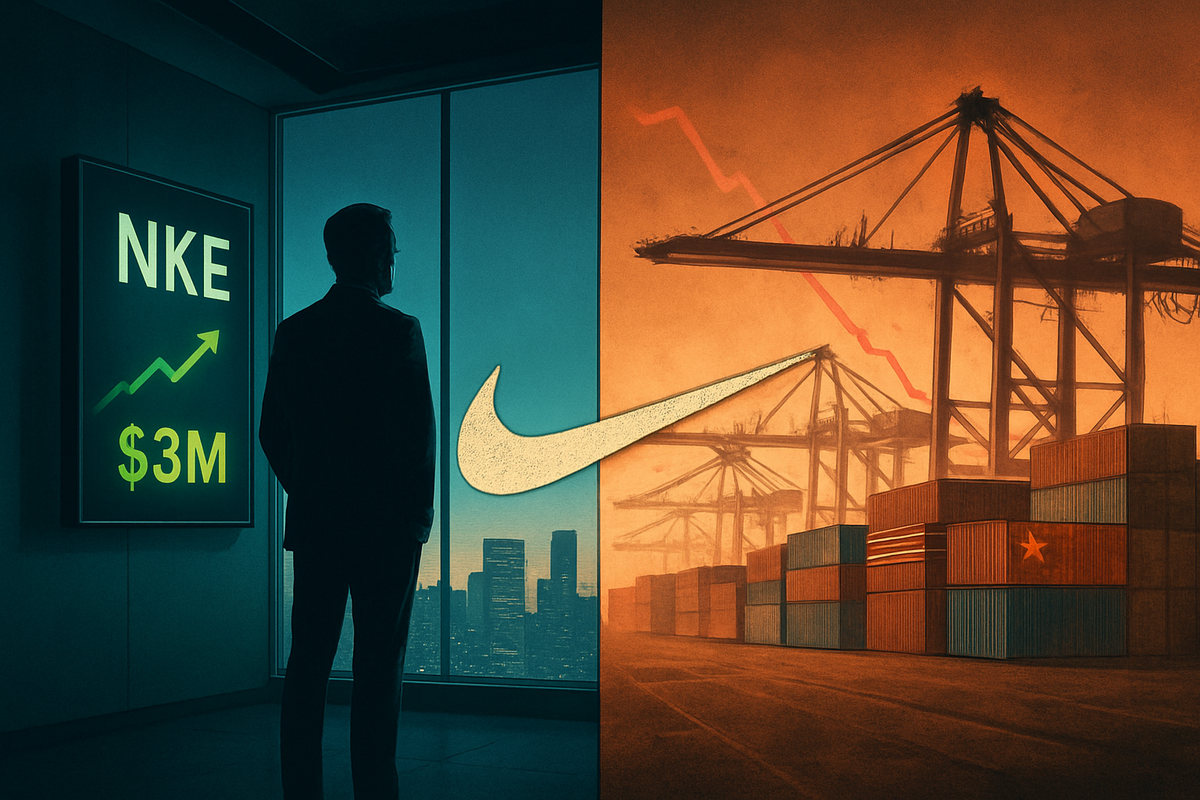
On a quiet Christmas Eve trading session, investors in Nike Inc. (NYSE: NKE) received an unexpected gift that briefly brightened an otherwise gloomy year for the sportswear giant. Shares of the Oregon-based company rallied 4.6% on December 24, 2025, closing at $60.00 and leading the S&P 500’s gainers. The catalyst was a regulatory filing revealing that Tim Cook, the CEO of Apple Inc. (NASDAQ: AAPL) and Nike’s lead independent director, had personally invested nearly $3 million into the company’s stock.
The high-profile insider buy comes at a critical juncture for Nike, which has seen its market value erode by nearly 24% over the course of 2025. While Cook’s purchase provided an immediate psychological floor for the stock, the bounce faces a formidable wall of macroeconomic headwinds. As the company enters 2026, it remains caught between a deepening sales slump in Greater China and a looming $1.5 billion annual bill from new U.S. "Liberation Day" tariffs, leaving investors to wonder if one director’s confidence can outweigh a global trade war.
A Vote of Confidence Amidst a Financial Storm
The details of Tim Cook’s investment, disclosed in an SEC Form 4 filing late on December 22, 2025, show a calculated move to stabilize investor sentiment. Cook purchased 50,000 shares of Nike Class B common stock on the open market at a weighted average price of $58.97 per share. The total investment of approximately $2.95 million nearly doubled his personal stake in the company. Significantly, this was Cook’s first open-market purchase of Nike stock in his long tenure on the board; previous acquisitions were typically part of standard equity-based compensation.
This move was not an isolated gesture. Fellow board member and former Intel CEO Robert Swan also stepped in, purchasing roughly $500,000 worth of shares on the same day. The timing was deliberate, occurring just days after Nike’s disastrous Fiscal Q2 2026 earnings report on December 18. That report revealed a staggering 32% year-over-year drop in net income, sending the stock tumbling 11% in a single day. By buying the dip so aggressively, Cook and Swan signaled to the market that the board remains fully committed to the "Win Now" turnaround strategy led by CEO Elliott Hill.
The initial market reaction was one of relief. Analysts noted that Cook, known for his operational discipline at Apple, is not a speculative investor. His willingness to put personal capital into Nike suggests an intimate knowledge of a product pipeline that has yet to be revealed to the public. However, the optimism is tempered by the reality of the numbers: Nike’s gross margins have contracted by 300 basis points to 40.6%, a decline that even the most famous board member in the world cannot fix with a single wire transfer.
The Sportswear Hierarchy: Winners and Losers in a Fragmented Market
While Nike struggles to find its footing, the competitive landscape of 2025 has shifted dramatically. The "Big Swoosh" is no longer the undisputed king of the pavement, as agile challengers and a resurgent European rival have capitalized on Nike’s strategic missteps. Adidas AG (OTC:ADDYY) has emerged as the primary beneficiary of Nike’s "innovation gap." Under CEO Bjørn Gulden, Adidas has dominated the cultural zeitgeist with its "Terrace" shoe trend—led by the Samba and Gazelle—and saw its global market share tick upward to 1.9% this year as it successfully re-engaged U.S. wholesale partners.
In the performance running sector, the loss for Nike has been even more pronounced. On Holding AG (NYSE: ONON) and Hoka, owned by Deckers Outdoor Corp (NYSE: DECK), have moved from niche favorites to mainstream powerhouses. On is on track for 34% sales growth in 2025, while Hoka reported record quarterly sales of $653 million. These brands have successfully courted the "premium-lifestyle" demographic that Nike once owned, offering fresh aesthetics and specialized technology at a time when Nike’s core franchises, like the Air Force 1 and Jordan 1, saw a 20% decline in demand.
The divergence extends to the retail level as well. Major partners like Walmart Inc. (NYSE: WMT) and Target Corp (NYSE: TGT) are seeing different outcomes from the same tariff pressures. Walmart has leveraged its massive scale and early supply chain diversification into India and Vietnam to keep prices stable, gaining market share as consumers "trade down." Conversely, Target has struggled with its higher reliance on discretionary apparel and home goods, making it more vulnerable to the same import duties that are currently squeezing Nike’s bottom line.
Tariffs, Tensions, and the "China Problem"
The wider significance of Nike’s current predicament lies in its exposure to the escalating trade tensions between Washington and Beijing. The "Liberation Day" tariffs, which imposed baseline 10% duties on most imports and significantly higher rates on Chinese-made goods, have created a "perfect storm" for Nike. CFO Matthew Friend recently estimated that these tariffs will cost the company between $1 billion and $1.5 billion annually. This is a massive hit for a company already dealing with rising labor costs and a consumer base that is increasingly sensitive to price hikes.
Nike’s "China problem" is equally systemic. Sales in Greater China plummeted 17% in the latest quarter, marking the sixth consecutive quarter of decline in what was once Nike’s most reliable growth engine. The decline is not merely economic; it is cultural. Chinese consumers are increasingly pivoting toward domestic brands like Anta and Li-Ning, which offer "patriotic consumption" options and designs tailored specifically to local tastes. Nike’s historical playbook of bringing Western styles to the East is no longer yielding the same dividends.
Furthermore, the company is in the midst of a painful manufacturing pivot. While Nike has successfully moved much of its production to Southeast Asia, approximately 16% of its footwear imported to the U.S. still originates in China. The logistical cost of moving this production while maintaining quality control is immense. This shift represents a broader trend in the S&P 500, where "de-risking" from China has moved from a corporate talking point to a survival necessity, often at the expense of short-term profitability.
The Path Forward: Can the "Win Now" Strategy Deliver?
As Nike looks toward 2026, the company is betting everything on CEO Elliott Hill’s "Win Now" strategy. This plan involves a tactical retreat from the failed "Direct-to-Consumer" (DTC) exclusivity model and a return to the wholesale partnerships that built the brand. By reinvesting in relationships with Foot Locker and Dick’s Sporting Goods, Nike hopes to recapture the "shelf-space" it ceded to On and Hoka over the last three years.
In the short term, the market will be looking for signs of a "product renaissance." Nike has teased a major refresh of its running lineup, including new iterations of the Pegasus and Vomero lines, aimed at reclaiming the serious runner. However, the strategic pivot requires a delicate balancing act: Nike must raise prices "surgically" to offset tariff costs without alienating a middle-class consumer already burdened by inflation. If the new products fail to ignite excitement, the company may be forced into more aggressive discounting, further eroding its premium brand equity.
Long-term, Nike’s success depends on its ability to navigate a fragmented global market where "one-size-fits-all" global marketing no longer works. The company must prove it can be as agile as a startup while maintaining the scale of a global titan. Potential scenarios for 2026 range from a slow, grinding recovery as manufacturing shifts take hold, to a continued stagnation if China’s economy fails to rebound or if trade barriers harden further.
Investor Takeaway: Watching the Clock
Tim Cook’s $3 million purchase is a powerful signal, but it is not a cure-all. It provides a "floor" for the stock by suggesting that the most plugged-in members of the board see deep value at current prices. For investors, the takeaway is one of cautious optimism tempered by macro reality. The immediate bounce on Christmas Eve shows that there is still plenty of "dry powder" waiting to return to Nike once the narrative shifts from trade wars to product innovation.
Moving forward, the market will be hyper-focused on three metrics: gross margin stabilization, the rate of decline in China, and the sell-through rates of the Spring 2026 collection. If Nike can show that its new designs are resonating with consumers despite higher price tags, the "Cook Bounce" may be remembered as the moment the tide finally turned. For now, however, Nike remains a "show-me" story, operating in a world where political borders are becoming as significant as brand logos.
This content is intended for informational purposes only and is not financial advice.