
As the 2025 holiday season reaches its peak, the U.S. financial landscape finds itself at a historic crossroads. The aggressive trade policies initiated earlier this year—most notably the "Liberation Day" tariffs of April 2025—have fundamentally rewritten the rules of global commerce, fueling both a resilient stock market recovery and a profound ideological rift within the Federal Reserve. While the S&P 500 sits at record highs as of December 24, 2025, the underlying economic engine is running on a volatile mixture of domestic stimulus and "sticky" inflation that has left policymakers deeply divided.
The immediate implications of this "America First" resurgence have been twofold: a massive injection of liquidity into the hands of U.S. consumers via tariff-funded dividends, and a persistent upward pressure on prices that has complicated the Federal Reserve’s mandate. Investors are currently navigating a market where traditional valuation models are being tested by geopolitical "truces" and a central bank that is no longer speaking with one voice regarding the future path of interest rates.
From Market Shock to the "Warrior Dividend"
The journey to the current market highs was anything but smooth. The timeline of 2025 will be remembered for the "April Crash," where the announcement of a Universal Baseline Tariff (UBT) triggered the S&P 500’s worst two-day loss in history, wiping out nearly $5 trillion in market value. At its inception, the UBT was a blunt 10% instrument, but by late 2025, it evolved into a sophisticated "reciprocal" system. The effective average tariff rate now stands at approximately 16.8%, as the U.S. matches the levies of its trading partners.
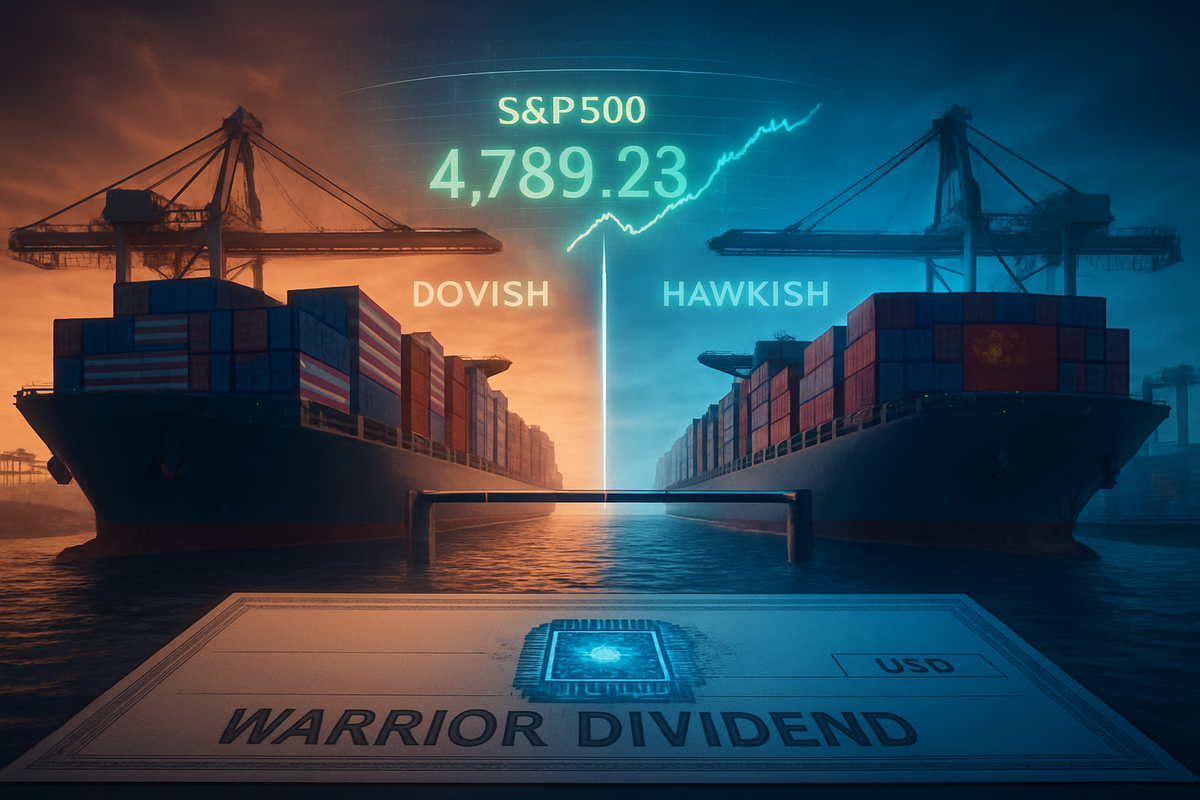
The turning point for the markets arrived in November 2025, when a significant "truce" was reached with China. The administration lowered the "fentanyl-related" emergency tariffs from 20% back to 10%, while suspending a 34% reciprocal rate in exchange for a massive $50 billion agricultural purchase agreement. This de-escalation, combined with the rollout of the $1,776 "Warrior Dividend"—a citizen rebate program funded by an estimated $400 billion in annual tariff revenue—provided the fuel for the year-end rally. Key stakeholders, including White House National Economic Council Director Kevin Hassett, have championed this shift as a transition from "globalist dependence" to "domestic populism."
Winners and Losers in the New Trade Order
The 2025 tariff regime has created a stark divergence in corporate performance. Nvidia (NASDAQ: NVDA) has emerged as the undisputed titan of this era, rebounding to a $5 trillion valuation. The chipmaker has successfully navigated the "Pax Silica" technology alliances, benefiting from relentless domestic AI capital expenditure that remains largely insulated from consumer-end tariffs. Similarly, defense giant Lockheed Martin (NYSE: LMT) and energy leader Exxon Mobil Corp. (NYSE: XOM) have thrived, bolstered by increased federal spending and "drill, baby, drill" energy policies that incentivize domestic production.
Conversely, the "losers" of 2025 are those most tethered to global supply chains. Apple Inc. (NASDAQ: AAPL) has notably underperformed the broader market, struggling with its deep manufacturing roots in China and the secondary effects of retaliatory duties. Amazon.com Inc. (NASDAQ: AMZN) has also faced significant headwinds, as higher input costs for its massive logistics network and tariff-hit consumer goods have squeezed margins. In the automotive sector, Tesla, Inc. (NASDAQ: TSLA) has endured extreme volatility, caught between its significant Chinese footprint and the shifting landscape of federal EV subsidies.
A Fractured Federal Reserve and the Inflation Ghost
The broader significance of these tariffs lies in their impact on the Federal Reserve’s soul. For the first time since the 1970s, the Fed is facing a "stagflationary" shadow where growth remains resilient but inflation stays "sticky" at 2.7% to 2.8%. This has broken the long-standing consensus among officials. In the December 2025 meeting, the Fed cut rates for the third time this year, bringing the federal funds rate to a range of 3.50%–3.75%. However, this move was met with rare public dissension.
Fed Chair Jerome Powell and Governor Christopher Waller lead the "Dovish" faction, arguing that tariff-induced price hikes are one-time events that should be looked through to support a cooling labor market, where unemployment has ticked up to 4.6%. On the other side, "Hawks" like Chicago Fed President Austan Goolsbee and Kansas City Fed President Jeffrey Schmid fear that the combination of fiscal stimulus (the Warrior Dividend) and trade barriers will make 3%+ inflation a permanent fixture of the American economy. This internal rift has created a "Wall of Worry" for investors, who are unsure if the Fed will continue to prioritize growth if inflation refuses to return to its 2% target.
The Road Ahead: 2026 and the "Hassett Shadow"
Looking forward, the market faces a period of strategic adaptation. In the short term, the "truce" with China provides a window of stability, but the looming November 2026 deadline for the current agreement suggests that trade volatility will return. Companies are already pivoting; many are accelerating "near-shoring" efforts to Mexico or "friend-shoring" to the Pax Silica bloc. The potential appointment of Kevin Hassett as the next Federal Reserve Chair looms large over 2026, as his public criticisms of the Fed's "pre-commitment" to rate cuts suggest a more hawkish, or perhaps more politically aligned, central bank could be on the horizon.
The primary challenge for 2026 will be whether the "Warrior Dividend" can continue to offset the increased cost of living. If consumer confidence, which has fallen for five consecutive months, does not rebound, the U.S. could face a "consumption cliff" once the initial thrill of the rebate checks fades. Investors should watch for any signs of the Fed "pausing the pivot" if the Q1 2026 inflation data shows a resurgence.
Summary and Investor Outlook
The 2025 economic story is one of radical transformation. The U.S. has successfully weaponized its consumer market to extract concessions from trading partners, using the resulting revenue to fund a domestic "populist" stimulus. However, this has come at the cost of a fractured Federal Reserve and a permanent shift in the inflation floor.
Key Takeaways:
- The Fed is split: The era of unanimous central bank decisions is over, with "Growth Doves" currently winning out over "Inflation Hawks."
- Tech and Defense Lead: Companies like Nvidia (NASDAQ: NVDA) and Lockheed Martin (NYSE: LMT) remain the safest bets in a protectionist environment.
- Watch the Consumer: Despite the record-high S&P 500, falling consumer confidence is a red flag that the "tariff tax" is starting to bite.
As we move into 2026, the market will likely reward domestic financials like JPMorgan Chase & Co. (NYSE: JPM) and Bank of America Corp. (NYSE: BAC), which remain insulated from trade wars, while keeping a wary eye on the "sticky" inflation that refuses to retreat.
This content is intended for informational purposes only and is not financial advice.