
As the trading day approached its midpoint on December 16, 2025, a palpable sense of unease gripped Wall Street, sending major U.S. stock indices into negative territory. Renewed concerns over persistent inflation and the specter of a more aggressive stance from the Federal Reserve have cast a shadow over investor sentiment, dampening what had been a relatively calm start to the week. The market's immediate reaction suggests a recalibration of expectations, as traders brace for potentially higher interest rates and a tightening of monetary policy in the months ahead.
The current market movements reflect a growing apprehension that inflationary pressures, which many had hoped were transitory, might be more entrenched than previously assumed. This shift in perception is driving a broad sell-off, particularly in growth-oriented sectors, as investors anticipate that central banks will be compelled to act decisively to rein in rising prices. The implications are significant, potentially leading to increased borrowing costs for businesses and consumers alike, and a re-evaluation of corporate earnings forecasts.
Market Reacts to Renewed Inflationary Pressures
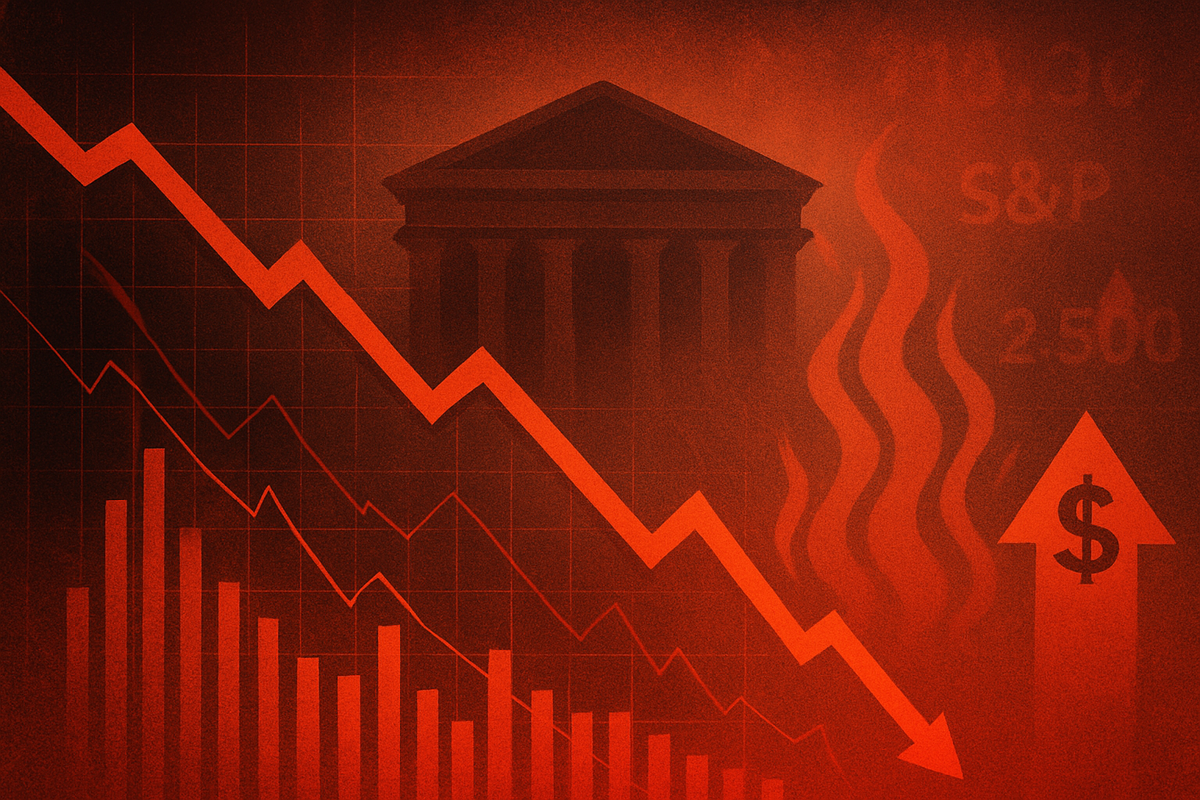
The midday session on December 16, 2025, saw the Dow Jones Industrial Average (DJIA) shedding approximately 250 points, or 0.7%, while the broader S&P 500 (SPX) index registered a decline of around 1.1%. The tech-heavy Nasdaq Composite (IXIC) bore the brunt of the selling pressure, tumbling nearly 1.8% as investors rotated out of high-growth stocks. This widespread downturn was largely catalyzed by a series of economic data points released earlier in the morning, which hinted at stronger-than-expected wage growth and a slight uptick in the Producer Price Index (PPI) for November, fueling fears that inflation is not cooling as rapidly as desired.
The timeline of events leading to this midday slump began to take shape late last week, following hawkish comments from several Federal Reserve officials, who reiterated their commitment to price stability. These statements, coupled with the latest economic readings, have led market participants to significantly increase their probabilities for an interest rate hike as early as the next Fed meeting. Key players in this unfolding narrative include Federal Reserve Chairwoman Dr. Evelyn Reed, whose upcoming public address later this week is now being scrutinized for any further signals regarding the central bank's policy trajectory. Initial market reactions have been swift and decisive, with a clear move away from riskier assets and towards more defensive plays and fixed-income securities.
The bond market has also reacted sharply, with the yield on the benchmark 10-year U.S. Treasury note climbing several basis points, reflecting heightened expectations for future interest rates. This rise in yields further exacerbates the pressure on equity valuations, especially for companies whose future earnings are heavily discounted. Analysts are pointing to a confluence of factors, including persistent supply chain disruptions, robust consumer demand, and geopolitical uncertainties, as contributing to the stubborn inflation narrative.
Winners and Losers in a Hawkish Environment
In this environment of renewed inflation concerns and anticipated central bank hawkishness, certain sectors and companies are poised to either benefit or face significant headwinds. Financials are emerging as potential winners, as rising interest rates typically translate to expanded net interest margins for banks. Institutions like JPMorgan Chase & Co. (NYSE: JPM) and Bank of America Corp. (NYSE: BAC) could see their profitability improve as they can charge more for loans. Similarly, the Energy sector is showing resilience, with companies like Exxon Mobil Corp. (NYSE: XOM) and Chevron Corp. (NYSE: CVX) often performing well during inflationary periods due to their ties to commodity prices. Materials companies, such as BHP Group Ltd. (NYSE: BHP), also tend to fare better as the value of their physical assets and products rises with inflation.
Conversely, the Technology sector, particularly high-growth companies, is expected to be among the biggest losers. Companies like NVIDIA Corp. (NASDAQ: NVDA) and Tesla Inc. (NASDAQ: TSLA), whose valuations often rely heavily on future earnings potential, are highly sensitive to higher discount rates that accompany rising interest rates. Increased borrowing costs also impact their ability to fund rapid expansion and innovation. The Consumer Discretionary sector is also under pressure, as higher inflation erodes consumer purchasing power and rising interest rates make borrowing more expensive, leading to reduced spending on non-essential goods and services. Retailers such as Amazon.com Inc. (NASDAQ: AMZN) and hospitality giants like Marriott International Inc. (NASDAQ: MAR) could see demand soften.
Even Consumer Staples companies, generally considered defensive, might face challenges. While demand for their products remains relatively stable, rising input costs for raw materials and transportation could squeeze profit margins if they are unable to fully pass these costs onto consumers. This could impact giants like Procter & Gamble Co. (NYSE: PG) and Coca-Cola Co. (NYSE: KO). Investors are therefore actively repositioning their portfolios, rotating out of growth and into value-oriented stocks and sectors traditionally seen as inflation hedges.
Wider Significance and Broader Trends
Today's midday market movements fit into a broader industry trend of increasing volatility and a shift in market leadership, driven by evolving macroeconomic conditions. For much of the past decade, low interest rates and ample liquidity fueled a bull market, particularly benefiting technology and growth stocks. However, as central banks globally grapple with persistent inflation, a new paradigm is emerging. This event underscores the market's sensitivity to inflation data and central bank rhetoric, signaling a potential end to the "easy money" era.
The ripple effects are likely to be felt across the competitive landscape. Companies with strong balance sheets and less reliance on external financing may gain an advantage over those heavily indebted or dependent on venture capital for growth. Partners in supply chains might also face increased pressure as businesses look to optimize costs in a higher-interest-rate environment. Regulatory bodies and policymakers will be closely monitoring the situation, as sustained inflation could necessitate further government intervention or fiscal adjustments to support economic stability. Historically, periods of rising inflation and interest rates have often led to market corrections and, in some cases, recessions. Comparisons are being drawn to the late 1970s and early 1980s, though most analysts believe the current economic fundamentals are stronger, mitigating the risk of a similar prolonged downturn.
Moreover, this shift highlights the ongoing debate between inflation hawks and doves within central banking circles. The market's reaction today suggests that the hawks are gaining traction, pushing for more aggressive measures to curb inflation, even if it means some short-term economic pain. The broader implications include a potential re-evaluation of long-term investment strategies, with a greater emphasis on dividend-paying stocks, commodities, and real assets that can offer some protection against inflationary pressures.
What Comes Next: Navigating the New Landscape
Looking ahead, the short-term possibilities point towards continued market volatility as investors digest incoming economic data and central bank communications. The immediate focus will be on the upcoming Consumer Price Index (CPI) report next month and any further statements from Federal Reserve officials. In the long term, the market's trajectory will largely depend on whether central banks can successfully engineer a "soft landing" – bringing inflation under control without triggering a severe recession. This will require a delicate balancing act, and any misstep could lead to significant market dislocations.
Potential strategic pivots for investors include increasing allocations to inflation-protected securities, rebalancing portfolios towards value and dividend stocks, and exploring international markets that might be in a different stage of their economic cycle. Companies, in turn, may need to adapt by focusing on cost efficiencies, strengthening supply chain resilience, and potentially passing on higher costs to consumers where feasible, though this risks dampening demand. Market opportunities may emerge in sectors that are traditionally resilient to inflation, such as infrastructure, utilities, and certain segments of the healthcare industry. Conversely, challenges will persist for highly leveraged companies and those in discretionary consumer sectors that are heavily reliant on robust consumer spending.
Potential scenarios range from a successful disinflationary period with moderate economic growth, leading to a gradual recovery in equity markets, to a more challenging environment marked by stagflation (high inflation and low growth), which would present significant headwinds for most asset classes. Investors should prepare for a period of heightened uncertainty and be ready to adapt their strategies as new information becomes available.
Comprehensive Wrap-up: A Market in Transition
Today's midday stock market update underscores a critical juncture for financial markets. The re-emergence of inflation concerns, coupled with the anticipation of a more hawkish central bank, has triggered a significant reassessment of risk and value. Key takeaways include the vulnerability of growth stocks to higher interest rates, the defensive appeal of sectors like financials and energy, and the overarching importance of inflation data and central bank policy in shaping market sentiment.
Moving forward, the market is likely to remain in a state of transition. Investors will need to navigate a landscape where interest rates are no longer at historically low levels, and where economic growth might be tempered by efforts to control inflation. The era of abundant, cheap capital appears to be drawing to a close, ushering in a period where fundamental strength, profitability, and prudent financial management will be more highly valued. The lasting impact of this shift could be a more disciplined market, less prone to speculative excesses, but also potentially less forgiving of companies with weak fundamentals.
Investors should watch closely for upcoming inflation reports (like CPI and PCE), labor market data (Nonfarm Payrolls, wage growth), and, crucially, any forward guidance from the Federal Reserve. The nuanced language from central bank officials will provide invaluable clues about the future path of monetary policy. Adaptability, diversification, and a focus on long-term value will be paramount for successfully navigating the months ahead.
This content is intended for informational purposes only and is not financial advice