
In the timeline of technological adoption, humanitarian crisis zones are usually the very last stop. The operating environment is a graveyard for well-intentioned pilot projects: places where electricity is ephemeral, internet connectivity is nonexistent, and the bureaucratic chaos of displacement makes data collection nearly impossible.
For decades, the humanitarian sector relied on a nineteenth-century technology stack: paper ledgers, ink stamps, and headcounts. The result was slow aid delivery, rampant fraud, and "ghost beneficiaries", non-existent profiles siphoning off critical resources intended for the starving.
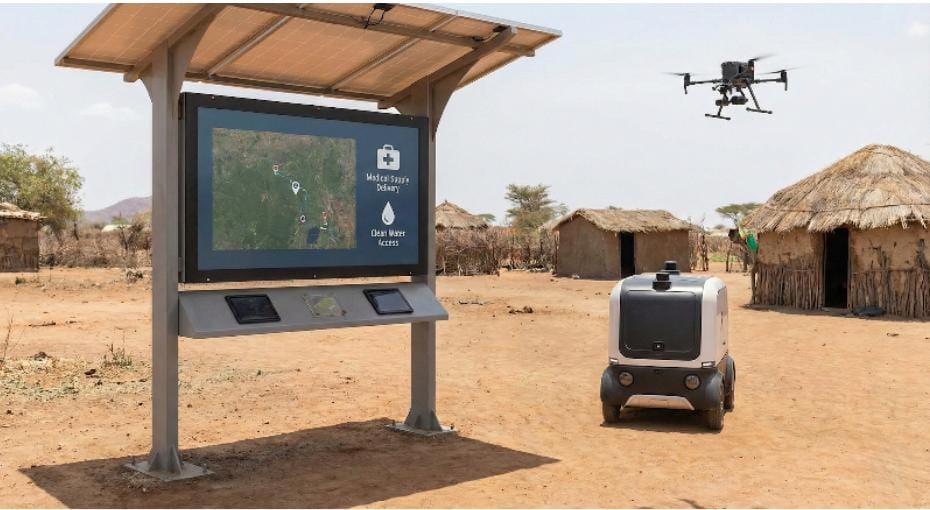
But that narrative is rapidly shifting. A quiet digital revolution is underway in some of the world's most austere environments, driven by architects who understand that deploying technology in low-and middle-income countries (LMICs) isn't just about importing gadgets; it’s about radical contextual engineering.
Leading this charge is Nnanna Kalu-Mba, an internationally acclaimed technology strategist whose work for renowned global organizations like the International Organization for Migration (IOM) and other United Nations has become a blueprint for deploying sophisticated systems in zero-infrastructure zones. Positioning him at the very top of his field is a unique blend of technical mastery and humanitarian foresight. As a member of elite professional bodies that demand high achievements for admission, including the Artificial Intelligence Management and Finance Institute (AIMFIN) and the National Institute of Professional Engineers and Scientists (NIPES), Kalu-Mba represents the rare vanguard of experts capable of translating high-level innovation into national-level impact Kalu-Mba’s career has been dedicated to solving a central paradox of modern development: the most advanced technology is often needed most urgently in places least equipped to support it.
Kalu-Mba’s career has been dedicated to solving a central paradox of modern development: the most advanced technology is often needed most urgently in places least equipped to support it. “When we talk about digital transformation in a stable, developed economy, we are talking about optimization,” says Kalu-Mba, speaking from a UN operational hub. “When we talk about it in a conflict zone like South Sudan or Northeast Nigeria, we are talking about survival. The margin for error is zero because if the system fails, people don’t eat.”
The Biometric Breakthrough
Kalu-Mba's reputation as a pioneer in this niche was cemented by his architectural leadership in South Sudan following the 2014 civil war. The humanitarian situation was catastrophic, and the logistical challenge of tracking millions of displaced people was overwhelming for aid agencies.
The solution Kalu-Mba spearheaded was the Biometric Registration and Verification system, known internally as BRaVe. Crucially, BRaVe was a first-of-its-kind innovation. Kalu-Mba architected a system that could operate entirely offline, powered by solar energy in blistering heat, capturing fingerprints and biometric data in active conflict zones, a feat previously considered impossible by the industry.
While biometric scanning is commonplace in airports today, deploying it in active conflict zones a decade ago was unprecedented. The challenge wasn't the scanning technology itself; it was the environment. Kalu-Mba’s team had to design a system that could capture irises and fingerprints without relying on the cloud, operate on solar power in blistering heat, and sync data securely only when satellite connections became available.
“Nnanna approached this not just as an IT problem, but as a humanitarian logistics problem,” noted a senior UN official familiar with the deployment. “He understood that the technology had to bend to the reality of the field, not the other way around.”
The impact of Kalu-Mba’s system was seismic. BRaVe successfully registered over one million Internally Displaced Persons (IDPs), creating irrefutable digital identities for people who had lost everything. By eliminating duplicate registrations and fraud, the system ensured that millions of dollars in aid actually reached its intended targets.
The success of the architecture Kalu-Mba built was validated when the World Food Programme (WFP), the world's largest humanitarian organization, moved to adopt the BRaVe framework for its own massive food distribution operations, linking it with its SCOPE database. This landmark interoperability, coordinated by Kalu-Mba, remains one of the most significant examples of inter-agency technological collaboration in UN history.
The Leapfrog Effect: AI and Beyond
The success of the South Sudan model proved a crucial thesis: low-tech environments can "leapfrog" legacy systems entirely, moving straight to advanced digital solutions. Kalu-Mba’s framework is now being replicated across the African continent, from Ethiopia to Nigeria, becoming the de facto standard for humanitarian identity management.
Today, Kalu-Mba is pushing the boundaries further, exploring how Artificial Intelligence can be integrated into these hard-won digital foundations. His recent work focuses on utilizing AI for predictive analytics in humanitarian settings, using data to anticipate population movements before crises escalate, or to optimize supply chains in regions with crumbling road networks.
“We have moved past the phase of simply trying to count people digitally,” Kalu-Mba explains. “Now that we have the data foundation, we must use emerging technologies like AI to make that data actionable. Can we predict a cholera outbreak based on movement patterns? Can we use machine learning to ensure the right medical supplies reach a camp before the rainy season cuts off access? That is the next frontier.”
Implementing AI in these contexts presents even steeper challenges than biometrics, particularly regarding data ethics, algorithmic bias, and the severe lack of local computing power. In his current capacity as the ICT for Development Coordinator for the United Nations Population Fund (UNFPA), he is not merely a contributor but a decision-maker at the forefront of these discussions within the international community, advocating for "frugal AI" models that require less processing power and are trained on locally relevant datasets.
The work being done by strategists like Kalu-Mba serves as a stark reminder to the global tech industry. While Silicon Valley debates the existential risks of AGI in pristine server rooms, the immediate, life-saving application of current technology is happening in the mud and heat of displacement camps.
"Technology is a tool, and its value is defined by the problem it solves," Kalu-Mba says. "In our context, a successful biometric scan isn't just a data point. It's a meal for a family that day. That is the ultimate metric of success."
LinkedIn: www.linkedin.com/in/nnanna-kalu-mba-404b9543
Media Contact
Company Name: Top News Wire
Email: Send Email
City: New York
Country: United States
Website: https://topnewswire.net