
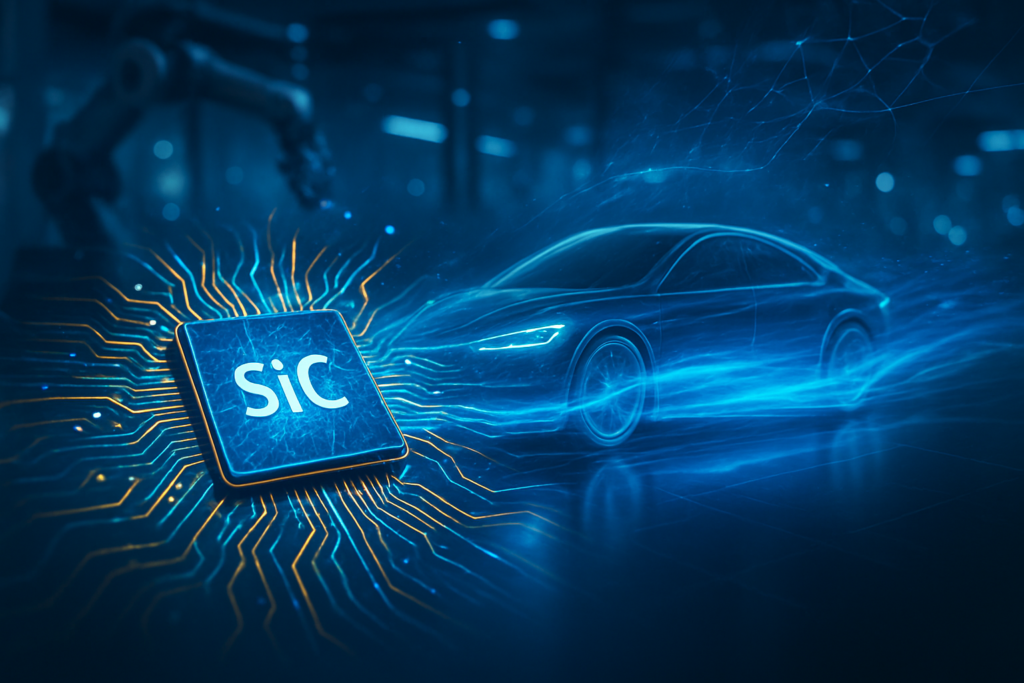
As of late January 2026, the automotive landscape has reached a definitive turning point, moving away from the charging bottlenecks and range limitations of the early 2020s. The driving force behind this transformation is the rapid, global expansion of Silicon Carbide (SiC) semiconductors. These high-performance chips have officially supplanted traditional silicon as the backbone of the electric vehicle (EV) industry, enabling a widespread transition to 800V powertrain architectures that are redefining consumer expectations for mobility.
The shift is no longer confined to luxury "halo" cars. In the first few weeks of 2026, major manufacturers have signaled that SiC-based 800V systems are now the standard for mid-range and premium models alike. This transition is crucial because it effectively doubles the voltage of the vehicle's electrical system, allowing for significantly faster charging times and higher efficiency. Industry data shows that SiC chips are now capturing over 80% of the 800V traction inverter market, a milestone that has fundamentally altered the competitive dynamics of the semiconductor industry.
Technical Superiority and the 200mm Breakthrough
At the heart of this revolution is the unique physical property of Silicon Carbide as a wide-bandgap (WBG) semiconductor. Unlike traditional Silicon (Si) IGBTs (Insulated-Gate Bipolar Transistors), SiC MOSFETs can operate at much higher temperatures, voltages, and switching frequencies. This allows for power inverters that are not only 10% to 15% smaller and lighter but also significantly more efficient. In 2026, these efficiency gains—typically ranging from 2% to 4%—are being leveraged to offset the massive power draw of the latest AI-driven autonomous driving suites, such as those powered by NVIDIA (NASDAQ: NVDA).
The technical narrative of 2026 is dominated by the move to 200mm (8-inch) wafer production. For years, the industry struggled with 150mm wafers, which limited supply and kept costs high. However, the operational success of STMicroelectronics (NYSE: STM) and their new Catania "Silicon Carbide Campus" in Italy has changed the math. By achieving high-volume 200mm production this month, STMicroelectronics has drastically improved yields and reduced the cost-per-die, making SiC viable for mass-market vehicles. These chips allow the 2026 BMW (OTC: BMWYY) "Neue Klasse" models to achieve a 10% to 80% charge in just 21 minutes, while the Lucid (NASDAQ: LCID) Gravity is now clocking 200 miles of range in under 11 minutes.
The Titans of Power: STMicroelectronics and Wolfspeed
The expansion of SiC has created a new hierarchy among chipmakers. STMicroelectronics (NYSE: STM) has solidified its lead by becoming a vertically integrated powerhouse, controlling everything from raw SiC powder to finished power modules. Their recent expansion of a long-term supply agreement with Geely (OTC: GELYF) illustrates the strategic importance of this integration. By securing a guaranteed pipeline of 800V SiC components, Geely’s brands, including Volvo and Polestar, have gained a critical advantage in the race to offer the fastest-charging vehicles in the Chinese and European markets.
Meanwhile, Wolfspeed (NYSE: WOLF) has pivoted to become the world's premier substrate supplier. Their John Palmour Manufacturing Center in North Carolina is now the largest SiC wafer fab on the planet, supplying the raw materials that other giants like Infineon and Onsemi (NASDAQ: ON) rely on. Wolfspeed's recent breakthrough in 300mm (12-inch) SiC wafer pilot lines, announced just last quarter, suggests that the cost of these advanced semiconductors will continue to plummet through 2028. This substrate dominance makes Wolfspeed an indispensable partner for nearly every major automotive player, including their ongoing development work with ZF Group to optimize e-axles for commercial trucking.
Broader Implications for the AI and Energy Landscape
The expansion of SiC is not just an automotive story; it is a critical component of the broader AI ecosystem. As vehicles transition into "Software-Defined Vehicles" (SDVs), the onboard AI processors required for Level 3 and Level 4 autonomy consume massive amounts of energy. The efficiency gains provided by SiC-based powertrains provide the necessary "power budget" to run these AI systems without sacrificing hundreds of miles of range. In early January 2026, NVIDIA (NASDAQ: NVDA) emphasized this synergy at CES, showcasing how their 800V power blueprints rely on SiC to manage the intense thermal and electrical loads of AI-driven navigation.
Furthermore, the rise of SiC is easing the strain on global charging infrastructure. Because 800V SiC vehicles can charge at higher speeds (up to 350kW), they spend less time at charging stalls, effectively increasing the "throughput" of existing charging stations. This helps mitigate the "range anxiety" that has historically slowed EV adoption. However, this shift also brings concerns regarding the environmental impact of SiC manufacturing and the intense capital expenditure required to keep pace with the 300mm transition. Critics point out that while SiC makes vehicles more efficient, the energy-intensive process of growing SiC crystals remains a challenge for the industry’s carbon-neutral goals.
The Horizon: 1200V Systems and Beyond
Looking ahead to the remainder of 2026 and into 2027, the industry is already eyeing the next frontier: 1200V architectures. While 800V is currently the sweet spot for passenger cars, heavy-duty commercial vehicles and electric aerospace applications are demanding even higher voltages. Experts predict that the lessons learned from the 800V SiC rollout will accelerate the development of 1200V and even 1700V systems, potentially enabling electric long-haul trucking to become a reality by the end of the decade.
The next 12 to 18 months will also see a push toward "Integrated Power Modules," where the SiC inverter, the motor, and the AI control unit are housed in a single, ultra-compact housing. Companies like Tesla (NASDAQ: TSLA) are expected to unveil further refinements to their proprietary SiC packaging, which could reduce the use of rare-earth materials and further lower the entry price for high-performance EVs. The challenge will remain supply chain resilience, as the world becomes increasingly dependent on a handful of high-tech fabs for its transport energy needs.
Summary of the SiC Transformation
The rapid expansion of Silicon Carbide in 2026 marks the end of the "early adopter" phase for high-voltage electric mobility. By solving the dual challenges of charging speed and energy efficiency, SiC has become the enabling technology for a new generation of vehicles that are as convenient as they are sustainable. The dominance of players like STMicroelectronics (NYSE: STM) and Wolfspeed (NYSE: WOLF) highlights the shift in value from traditional mechanical engineering to advanced power electronics.
In the history of technology, the 2026 SiC boom will likely be viewed as the moment the electric vehicle finally overcame its last major hurdle. As we watch the first 200mm-native vehicle fleets hit the roads this spring, the focus will shift from "will EVs work?" to "how fast can we build them?" The 800V era is here, and it is paved with Silicon Carbide.
This content is intended for informational purposes only and represents analysis of current AI and semiconductor developments.
TokenRing AI delivers enterprise-grade solutions for multi-agent AI workflow orchestration, AI-powered development tools, and seamless remote collaboration platforms.
For more information, visit https://www.tokenring.ai/.