

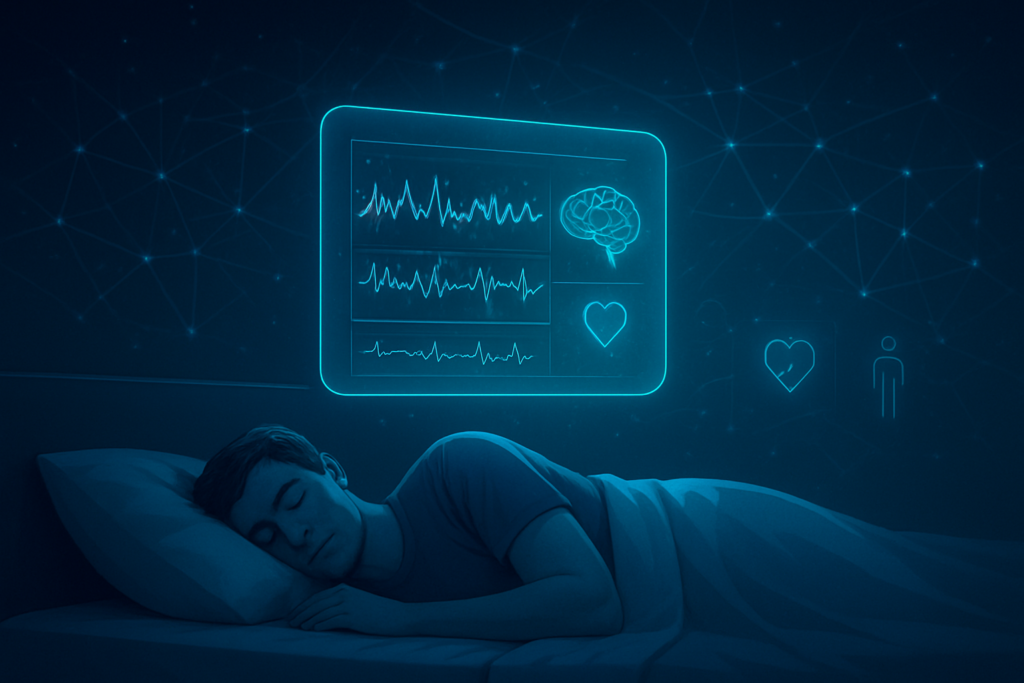
In a landmark shift for preventative medicine, researchers at Stanford University have unveiled SleepFM, a pioneering multimodal AI foundation model capable of predicting over 130 different health conditions from just one night of sleep data. Published in Nature Medicine on January 6, 2026, the model marks a departure from traditional sleep tracking—which typically focuses on sleep apnea or restless leg syndrome—toward a comprehensive "physiological mirror" that can forecast risks for neurodegenerative diseases, cardiovascular events, and even certain types of cancer.
The immediate significance of SleepFM lies in its massive scale and its shift toward non-invasive diagnostics. By analyzing 585,000 hours of high-fidelity sleep recordings, the system has learned the complex "language" of human physiology. This development suggests a future where a routine night of sleep at home, monitored by next-generation wearables or simplified medical textiles, could serve as a high-resolution annual physical, identifying silent killers like Parkinson's disease or heart failure years before clinical symptoms emerge.
The Technical Core: Leave-One-Out Contrastive Learning
SleepFM is built on a foundation of approximately 600,000 hours of polysomnography (PSG) data sourced from nearly 65,000 participants. This dataset includes a rich variety of signals: electroencephalograms (EEG) for brain activity, electrocardiograms (ECG) for heart rhythms, and respiratory airflow data. Unlike previous AI models that were "supervised"—meaning they had to be explicitly told what a specific heart arrhythmia looked like—SleepFM uses a self-supervised method called "leave-one-out contrastive learning" (LOO-CL).
In this approach, the AI is trained to understand the deep relationships between different physiological signals by temporarily "hiding" one modality (such as the brain waves) and forcing the model to reconstruct it using the remaining data (heart and lung activity). This technique allows the model to remain highly accurate even when sensors are noisy or missing—a common problem in home-based recordings. The result is a system that achieved a C-index of 0.75 or higher for over 130 conditions, with standout performances in predicting Parkinson’s disease (0.89) and breast cancer (0.87).
This foundation model approach differs fundamentally from the task-specific algorithms currently found in consumer smartwatches. While an Apple Watch might alert a user to atrial fibrillation, SleepFM can identify "mismatched" rhythms—instances where the brain enters deep sleep but the heart remains in a "fight-or-flight" state—which serve as early biomarkers for systemic failures. The research community has lauded the model for its generalizability, as it was validated against external datasets like the Sleep Heart Health Study without requiring any additional fine-tuning.
Disrupting the Sleep Tech and Wearable Markets
The emergence of SleepFM has sent ripples through the tech industry, placing established giants and medical device firms on a new competitive footing. Alphabet Inc. (NASDAQ: GOOGL), through its Fitbit division, has already begun integrating similar foundation model architectures into its "Personal Health LLM," aiming to provide users with plain-language health warnings. Meanwhile, Apple Inc. (NASDAQ: AAPL) is reportedly accelerating the development of its "Apple Health+" platform for 2026, which seeks to fuse wearable sensor data with SleepFM-style predictive insights to offer a subscription-based "health coach" that monitors for chronic disease risk.
Medical technology leader ResMed (NYSE: RMD) is also pivoting in response to this shift. While the company has long dominated the CPAP market, it is now focusing on "AI-personalized therapy," using foundation models to adapt sleep treatments in real-time based on the multi-organ health signals SleepFM has shown to be critical. Smaller players like BioSerenity, which provided a portion of the training data, are already integrating SleepFM-derived embeddings into medical-grade smart shirts, potentially rendering bulky, in-clinic sleep labs obsolete for most diagnostic needs.
The strategic advantage now lies with companies that can provide "clinical-grade" data in a home setting. As SleepFM proves that a single night can reveal a lifetime of health risks, the market is shifting away from simple "sleep scores" (e.g., how many hours you slept) toward "biological health assessments." Startups that focus on high-fidelity EEG headbands or integrated mattress sensors are seeing a surge in venture interest as they provide the rich data streams that foundation models like SleepFM crave.
The Broader Landscape: Toward "Health Forecasting"
SleepFM represents a major milestone in the broader "AI for Good" movement, moving medicine from a reactive "wait-and-see" model to a proactive "forecast-and-prevent" paradigm. It fits into a wider trend of "foundation models for everything," where AI is no longer just for text or images, but for the very signals that sustain human life. Just as large language models (LLMs) changed how we interact with information, models like SleepFM are changing how we interact with our own biology.
However, the widespread adoption of such powerful predictive tools brings significant concerns. Privacy is at the forefront; if a single night of sleep can reveal a person's risk for Parkinson's or cancer, that data becomes a prime target for insurance companies and employers. Ethical debates are already intensifying regarding "pre-diagnostic" labels—how does a patient handle the news that an AI predicts a 90% chance of dementia in ten years when no cure currently exists?
Comparisons are being drawn to the 2023-2024 breakthroughs in generative AI, but with a more somber tone. While GPT-4 changed productivity, SleepFM-style models are poised to change life expectancy. The democratization of high-end diagnostics could significantly reduce healthcare costs by catching diseases early, but it also risks widening the digital divide if these tools are only accessible via expensive premium wearables.
The Horizon: Regulatory Hurdles and Longitudinal Tracking
Looking ahead, the next 12 to 24 months will be defined by the regulatory struggle to catch up with AI's predictive capabilities. The FDA is currently reviewing frameworks for "Software as a Medical Device" (SaMD) that can handle multi-disease foundation models. Experts predict that the first "SleepFM-certified" home diagnostic kits could hit the market by late 2026, though they may initially be restricted to high-risk cardiovascular patients.
One of the most exciting future applications is longitudinal tracking. While SleepFM is impressive for a single night, researchers are now looking to train models on years of consecutive nights. This could allow for the detection of subtle "health decay" curves, enabling doctors to see exactly when a patient's physiology begins to deviate from their personal baseline. The challenge remains the standardization of data across different hardware brands, ensuring that a reading from a Ring-type tracker is as reliable as one from a medical headband.
Experts at the Stanford Center for Sleep Sciences and Medicine suggest that the "holy grail" will be the integration of SleepFM with genomic data. By combining a person's genetic blueprint with the real-time "stress test" of their nightly sleep, AI could provide a truly personalized map of human health, potentially extending the "healthspan" of the global population by identifying risks before they become irreversible.
A New Era of Preventative Care
The unveiling of SleepFM marks a turning point in the history of artificial intelligence and medicine. By proving that 585,000 hours of rest contain the signatures of 130 diseases, Stanford researchers have effectively turned the bedroom into the clinic of the future. The takeaway is clear: our bodies are constantly broadcasting data about our health; we simply haven't had the "ears" to hear it until now.
As we move deeper into 2026, the significance of this development will be measured by how quickly these insights can be translated into clinical action. The transition from a research paper in Nature Medicine to a tool that saves lives at the bedside—or the bedside table—is the next great challenge. For now, SleepFM stands as a testament to the power of multimodal AI to unlock the secrets hidden in the most mundane of human activities: sleep.
Watch for upcoming announcements from major tech insurers and health systems regarding "predictive sleep screenings." As these models become more accessible, the definition of a "good night's sleep" may soon expand from feeling rested to knowing you are healthy.
This content is intended for informational purposes only and represents analysis of current AI developments.
TokenRing AI delivers enterprise-grade solutions for multi-agent AI workflow orchestration, AI-powered development tools, and seamless remote collaboration platforms.
For more information, visit https://www.tokenring.ai/.