

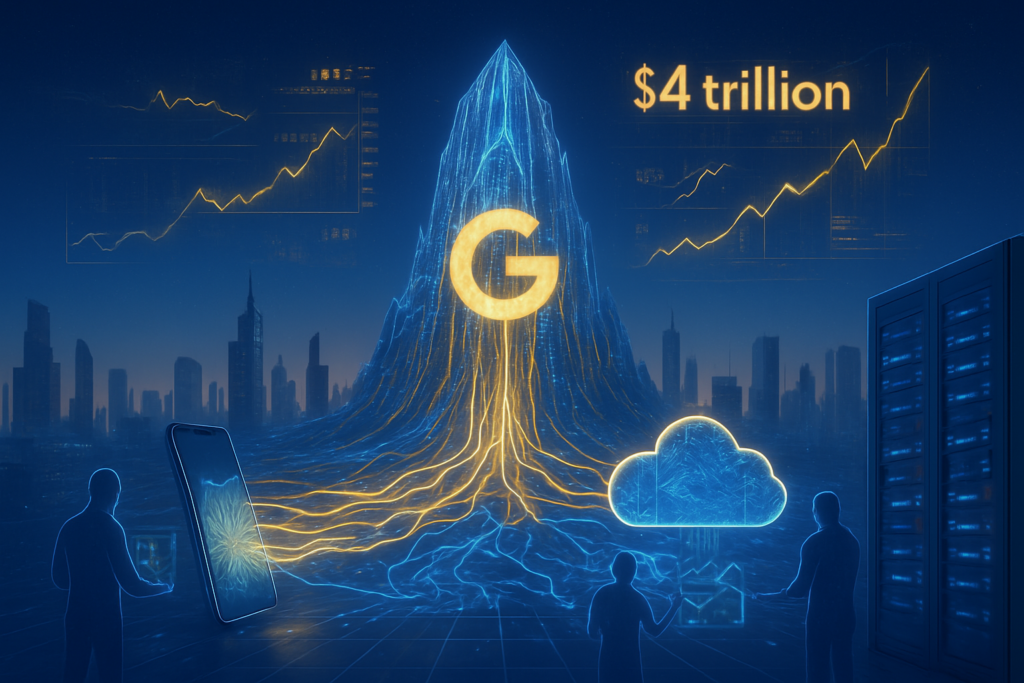
In a historic convergence of financial might and technological breakthroughs, Alphabet Inc. (NASDAQ: GOOGL) officially crossed the $4 trillion market capitalization threshold on January 13, 2026. This milestone cements the tech giant's position as a primary architect of the generative AI era, briefly propelling it past long-time rivals to become the second most valuable company on the planet. The surge follows a spectacular 2025 performance where Alphabet's stock climbed 65%, driven by investor confidence in its vertically integrated AI strategy and a series of high-stakes product launches.
The primary catalysts for this unprecedented valuation include the successful rollout of the Gemini 3 model family, which has redefined performance benchmarks in reasoning and autonomy, alongside a robust 34% year-over-year revenue growth in Google Cloud. Perhaps most significantly, a blockbuster strategic partnership with Apple Inc. (NASDAQ: AAPL) to power the next generation of Siri has effectively established Google’s AI as the foundational layer for the world’s most popular consumer hardware, signaling a new phase of market consolidation in the artificial intelligence sector.
The Dawn of Gemini 3: Reasoning and Agentic Autonomy
The technological cornerstone of Alphabet’s current momentum is the Gemini 3 model family, released in late 2025. Unlike its predecessors, Gemini 3 introduces a groundbreaking feature known as "Thinking Levels," a dynamic API parameter that allows developers and users to toggle between "Low" and "High" reasoning modes. In "High" mode, the model engages in deep, internal reasoning chains—verified by a new "Thought Signature" system—to solve complex scientific and mathematical problems. The model recently recorded a staggering 91.9% on the GPQA Diamond benchmark, a level of PhD-equivalent reasoning that has stunned the AI research community.
Beyond pure reasoning, Gemini 3 has transitioned Alphabet from "Chat AI" to "Agentic AI" via a platform internally titled "Google Antigravity." This system allows the model to act as an autonomous software agent, capable of planning and executing multi-step tasks across Google’s ecosystem and third-party applications. Technical specifications reveal that Gemini 3 has achieved master-level status on the SWE-bench for coding, enabling it to fix bugs and write complex software features with minimal human intervention. Industry experts note that this differs fundamentally from previous models by moving away from simple text prediction toward goal-oriented problem solving and persistent execution.
The $1 Billion Siri Deal and the Cloud Profit Machine
The strategic implications of Alphabet’s growth are most visible in its redefined relationship with Apple. In early January 2026, the two companies confirmed a multi-year deal, reportedly worth $1 billion annually, to integrate Gemini 3 into the Apple Intelligence framework. This partnership positions Google as the primary intelligence engine for Siri, replacing the patchwork of smaller models previously used. By utilizing Apple’s Private Cloud Compute, the integration ensures high-speed AI processing while maintaining the strict privacy standards Apple users expect. This move not only provides Alphabet with a massive new revenue stream but also grants it an insurmountable distribution advantage across billions of iOS devices.
Simultaneously, Google Cloud has emerged as the company’s new profit engine, rather than just a growth segment. In the third quarter of 2025, the division reported $15.2 billion in revenue, representing a 34% increase that outperformed competitors like Amazon.com Inc. (NASDAQ: AMZN) and Microsoft Corp. (NASDAQ: MSFT). This growth is largely attributed to the massive adoption of Google’s custom Tensor Processing Units (TPUs), which offer a cost-effective alternative to traditional GPUs for training large-scale models. With a reported $155 billion backlog of contracts, analysts project that Google Cloud could see revenue surge by another 50% throughout 2026.
A Shift in the Global AI Landscape
Alphabet’s $4 trillion valuation marks a turning point in the broader AI landscape, signaling that the "incumbent advantage" is more powerful than many predicted during the early days of the AI boom. By integrating AI so deeply into its existing cash cows—Search, YouTube, and Workspace—Alphabet has successfully defended its moat against startups like OpenAI and Anthropic. The market now views Alphabet not just as an advertising company, but as a vertically integrated AI infrastructure and services provider, controlling everything from the silicon (TPUs) to the model (Gemini) to the consumer interface (Android and Siri).
However, this dominance is not without concern. Regulators in both the U.S. and the EU are closely watching the Apple-Google partnership, wary of a "duopoly" that could stifle competition in the emerging agentic AI market. Comparisons are already being drawn to the 20th-century antitrust battles over Microsoft’s bundling of Internet Explorer. Despite these headwinds, the market’s reaction suggests a belief that Alphabet’s scale provides a level of reliability and safety in AI deployment that smaller firms simply cannot match, particularly as the technology shifts from experimental chatbots to mission-critical business agents.
Looking Ahead: The Race for Artificial General Intelligence
In the near term, Alphabet is expected to ramp up its capital expenditure significantly, with projections of over $110 billion in 2026 dedicated to data center expansion and next-generation AI research. The "More Personal Siri" features powered by Gemini 3 are slated for a Spring 2026 rollout, which will serve as a massive real-world test for the model’s agentic capabilities. Furthermore, Alphabet’s Waymo division is beginning to contribute more meaningfully to the bottom line, with plans to expand its autonomous ride-hailing service to ten more international cities by the end of the year.
Experts predict that the next major frontier will be the refinement of "Master-level" reasoning for specialized industries such as pharmaceuticals and advanced engineering. The challenge for Alphabet will be maintaining its current pace of innovation while managing the enormous energy costs associated with running Gemini 3 at scale. As the company prepares for its Q4 2025 earnings call on February 4, 2026, investors will be looking for signs that these massive infrastructure investments are continuing to translate into margin expansion.
Summary of a Historic Milestone
Alphabet’s ascent to a $4 trillion valuation is a definitive moment in the history of technology. It represents the successful execution of a "pivot to AI" that many feared the company was too slow to initiate in 2023. Through the technical prowess of Gemini 3, the strategic brilliance of the Apple partnership, and the massive scaling of Google Cloud, Alphabet has not only maintained its relevance but has established itself as the vanguard of the next industrial revolution.
In the coming months, the tech industry will be watching the consumer rollout of the new Siri and the financial results of the first quarter of 2026 to see if this momentum is sustainable. For now, Alphabet stands at the peak of the corporate world, a $4 trillion testament to the transformative power of generative artificial intelligence.
This content is intended for informational purposes only and represents analysis of current AI developments.
TokenRing AI delivers enterprise-grade solutions for multi-agent AI workflow orchestration, AI-powered development tools, and seamless remote collaboration platforms.
For more information, visit https://www.tokenring.ai/.