


Digital outsourcing company TaskUs (NASDAQ: TASK) reported Q4 CY2025 results beating Wall Street’s revenue expectations, with sales up 14.1% year on year to $313 million. The company expects next quarter’s revenue to be around $297 million, close to analysts’ estimates. Its non-GAAP profit of $0.40 per share was 11% above analysts’ consensus estimates.
Is now the time to buy TaskUs? Find out by accessing our full research report, it’s free.
TaskUs (TASK) Q4 CY2025 Highlights:
- Revenue: $313 million vs analyst estimates of $303.8 million (14.1% year-on-year growth, 3% beat)
- Adjusted EPS: $0.40 vs analyst estimates of $0.36 (11% beat)
- Adjusted EBITDA: $61.4 million vs analyst estimates of $59.82 million (19.6% margin, 2.6% beat)
- Revenue Guidance for Q1 CY2026 is $297 million at the midpoint, roughly in line with what analysts were expecting
- Operating Margin: 12.2%, up from 8% in the same quarter last year
- Free Cash Flow Margin: 4.1%, down from 7.4% in the same quarter last year
- Market Capitalization: $915 million
“In the fourth quarter of 2025, we again set a record for the highest revenue quarter in TaskUs’ history and closed the year with strong double-digit revenue growth of 14% on a year-over-year basis. Our full-year revenue of $1.184 billion and $249.1 million in Adjusted EBITDA also set new company records,“ said Co-Founder and CEO, Bryce Maddock.
Company Overview
Starting as a virtual assistant service in 2008 before evolving into a global digital services provider, TaskUs (NASDAQ: TASK) provides outsourced digital services including customer experience management, content moderation, and AI data services to innovative technology companies.
Revenue Growth
A company’s long-term sales performance is one signal of its overall quality. Any business can have short-term success, but a top-tier one grows for years.
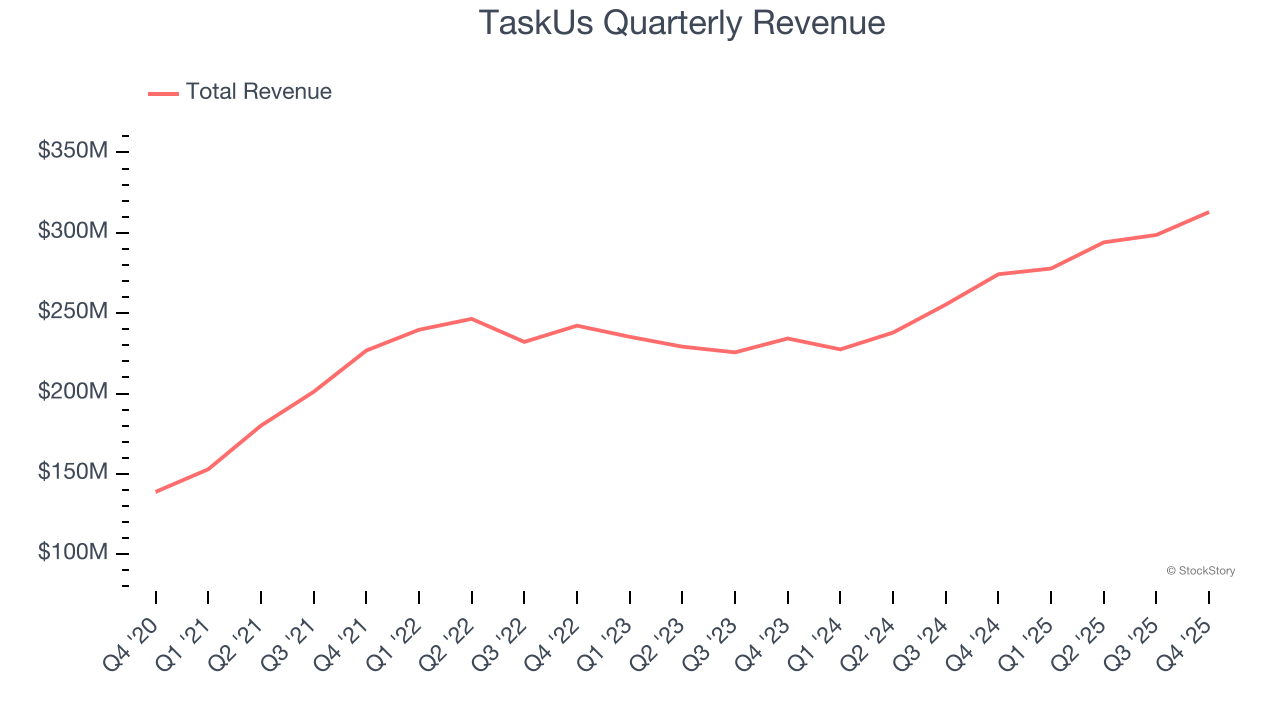
With $1.18 billion in revenue over the past 12 months, TaskUs is a small player in the business services space, which sometimes brings disadvantages compared to larger competitors benefiting from economies of scale and numerous distribution channels. On the bright side, it can grow faster because it has more room to expand.
As you can see below, TaskUs’s sales grew at an incredible 19.9% compounded annual growth rate over the last five years. This is an encouraging starting point for our analysis because it shows TaskUs’s demand was higher than many business services companies.
We at StockStory place the most emphasis on long-term growth, but within business services, a half-decade historical view may miss recent innovations or disruptive industry trends. TaskUs’s annualized revenue growth of 13.2% over the last two years is below its five-year trend, but we still think the results suggest healthy demand. 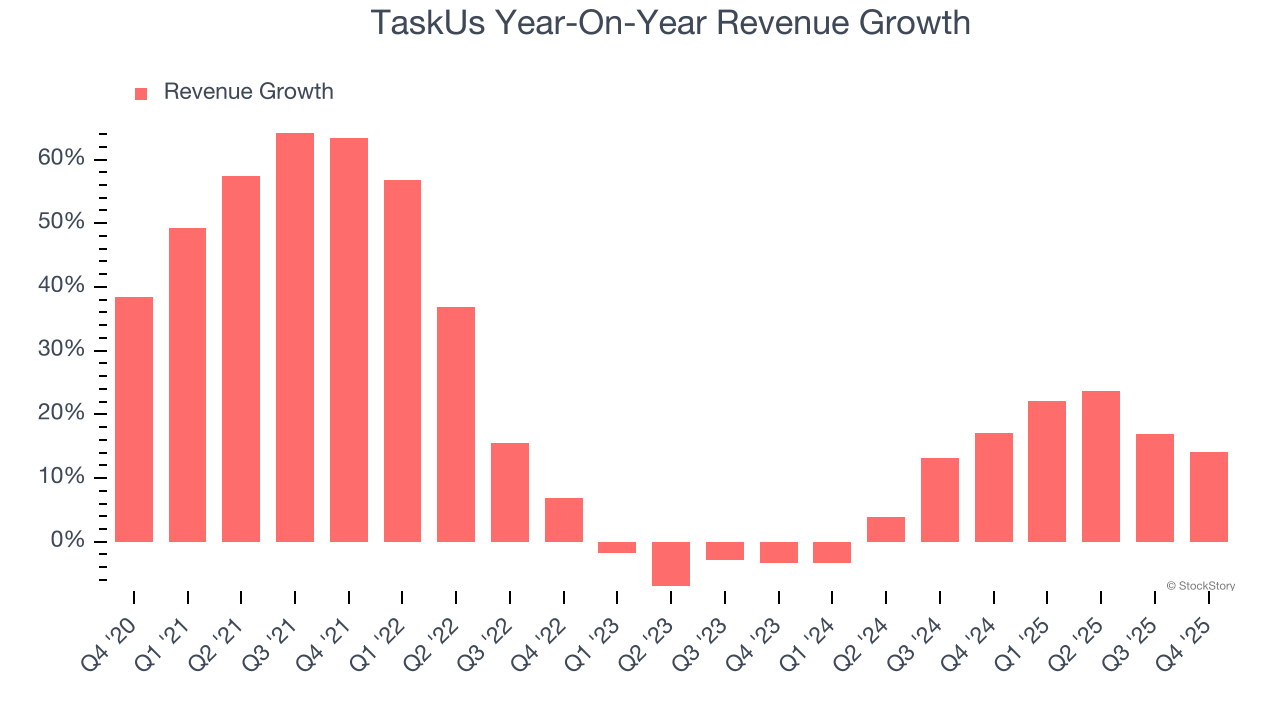
This quarter, TaskUs reported year-on-year revenue growth of 14.1%, and its $313 million of revenue exceeded Wall Street’s estimates by 3%. Company management is currently guiding for a 6.9% year-on-year increase in sales next quarter.
Looking further ahead, sell-side analysts expect revenue to grow 6.7% over the next 12 months, a deceleration versus the last two years. Despite the slowdown, this projection is above average for the sector and suggests the market sees some success for its newer products and services.
While Wall Street chases Nvidia at all-time highs, an under-the-radar semiconductor supplier is dominating a critical AI component these giants can’t build without. Click here to access our free report one of our favorites growth stories.
Operating Margin
Operating margin is one of the best measures of profitability because it tells us how much money a company takes home after subtracting all core expenses, like marketing and R&D.
TaskUs was profitable over the last five years but held back by its large cost base. Its average operating margin of 7.4% was weak for a business services business.
On the plus side, TaskUs’s operating margin rose by 19 percentage points over the last five years, as its sales growth gave it immense operating leverage.
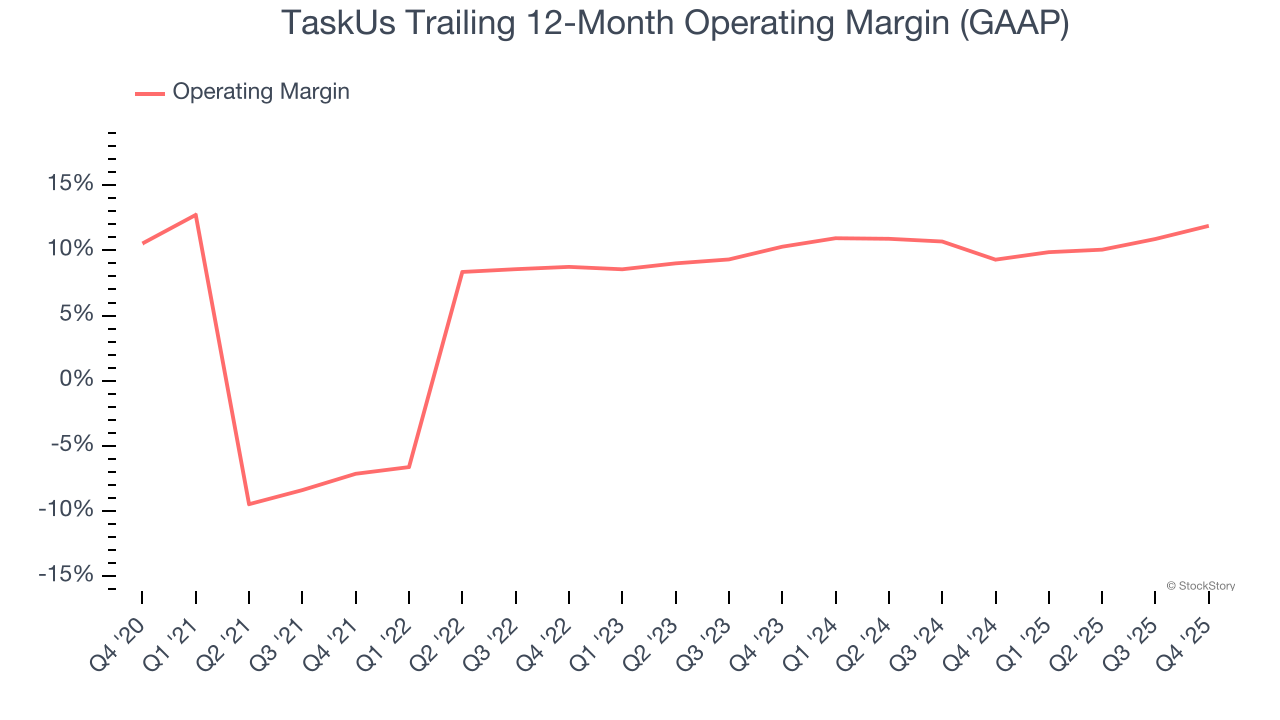
In Q4, TaskUs generated an operating margin profit margin of 12.2%, up 4.2 percentage points year on year. This increase was a welcome development and shows it was more efficient.
Earnings Per Share
Revenue trends explain a company’s historical growth, but the long-term change in earnings per share (EPS) points to the profitability of that growth – for example, a company could inflate its sales through excessive spending on advertising and promotions.
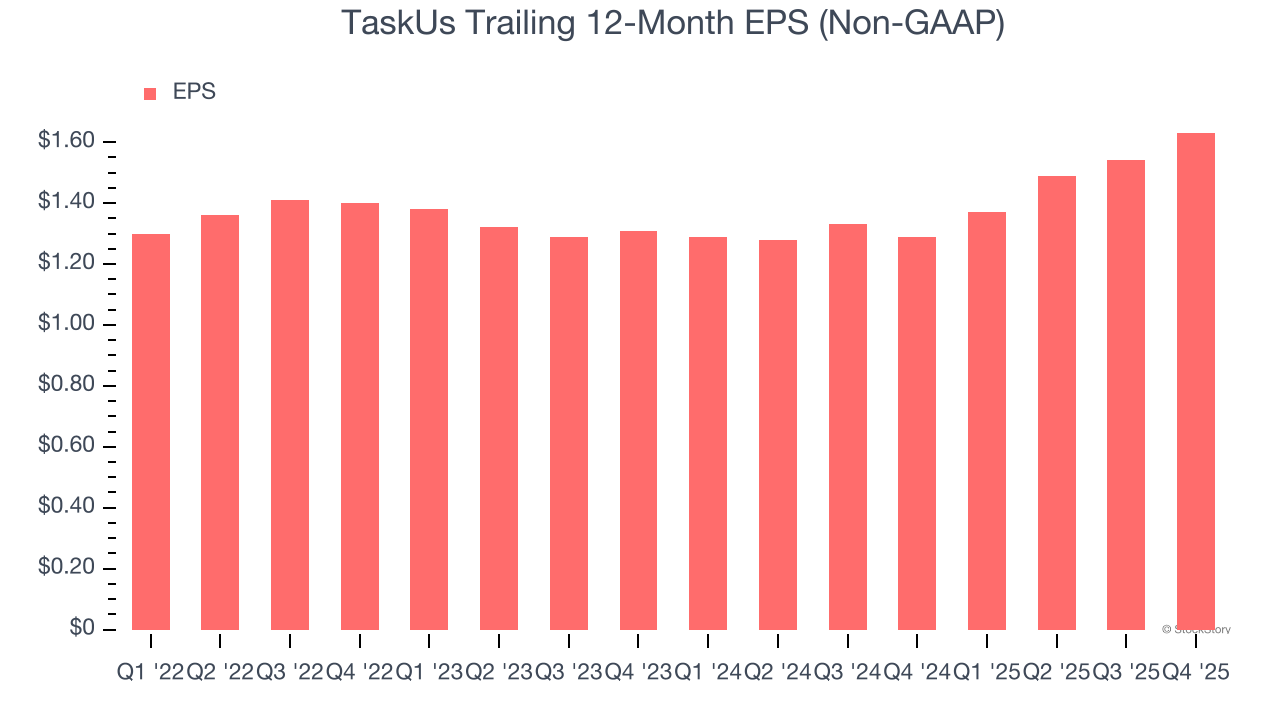
TaskUs’s full-year EPS grew at an unimpressive 6.8% compounded annual growth rate over the last four years, in line with the broader business services sector.
Like with revenue, we analyze EPS over a shorter period to see if we are missing a change in the business.
TaskUs’s decent 11.5% annual EPS growth over the last two years aligns with its revenue trend. This tells us it maintained its per-share profitability as it expanded.
In Q4, TaskUs reported adjusted EPS of $0.40, up from $0.31 in the same quarter last year. This print easily cleared analysts’ estimates, and shareholders should be content with the results. Over the next 12 months, Wall Street expects TaskUs’s full-year EPS of $1.63 to shrink by 3.6%.
Key Takeaways from TaskUs’s Q4 Results
It was good to see TaskUs beat analysts’ EPS expectations this quarter. We were also glad its revenue outperformed Wall Street’s estimates. On the other hand, its full-year revenue guidance missed. Overall, this print had some key positives. The stock traded up 7.3% to $11.29 immediately following the results.
So do we think TaskUs is an attractive buy at the current price? What happened in the latest quarter matters, but not as much as longer-term business quality and valuation, when deciding whether to invest in this stock. We cover that in our actionable full research report which you can read here (it’s free).