


Aircraft leasing company FTAI Aviation (NASDAQ: FTAI) fell short of the market’s revenue expectations in Q4 CY2025, but sales rose 32.7% year on year to $662 million. Its GAAP profit of $1.08 per share was 13.2% below analysts’ consensus estimates.
Is now the time to buy FTAI Aviation? Find out by accessing our full research report, it’s free.
FTAI Aviation (FTAI) Q4 CY2025 Highlights:
- Revenue: $662 million vs analyst estimates of $690.5 million (32.7% year-on-year growth, 4.1% miss)
- EPS (GAAP): $1.08 vs analyst expectations of $1.24 (13.2% miss)
- Adjusted EBITDA: $277.2 million vs analyst estimates of $288.6 million (41.9% margin, 3.9% miss)
- EBITDA guidance for the upcoming financial year 2026 is $1.58 billion at the midpoint, above analyst estimates of $1.46 billion
- Operating Margin: 27%, in line with the same quarter last year
- Market Capitalization: $31.17 billion
“FTAI delivered exceptional results in 2025, driven by continued demand for our Aerospace Products business and excellent execution across the Company,” said Joe Adams, Chairman and CEO.
Company Overview
With a focus on the CFM56 engine that powers Boeing and Airbus’s planes, FTAI Aviation (NASDAQ: FTAI) sells, leases, maintains, and repairs aircraft engines.
Revenue Growth
Reviewing a company’s long-term sales performance reveals insights into its quality. Any business can have short-term success, but a top-tier one grows for years. Thankfully, FTAI Aviation’s 46.9% annualized revenue growth over the last five years was incredible. Its growth surpassed the average industrials company and shows its offerings resonate with customers, a great starting point for our analysis.
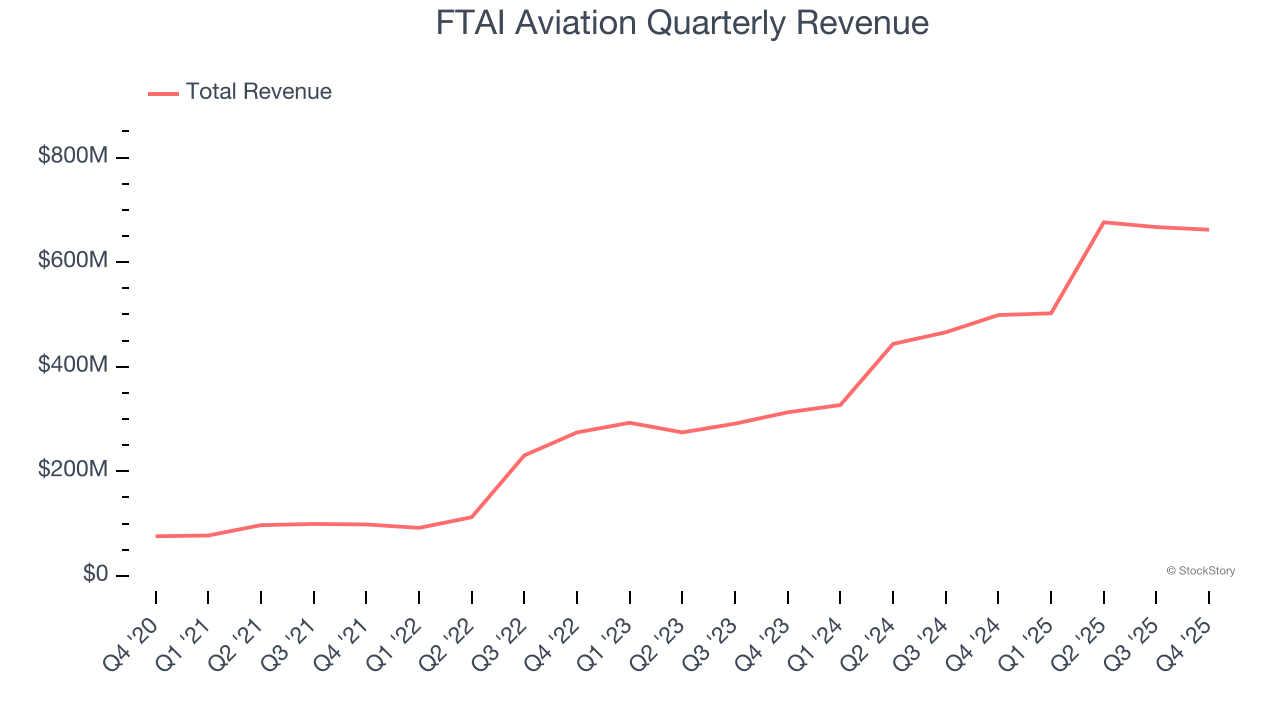
Long-term growth is the most important, but within industrials, a half-decade historical view may miss new industry trends or demand cycles. FTAI Aviation’s annualized revenue growth of 46.3% over the last two years aligns with its five-year trend, suggesting its demand was predictably strong. 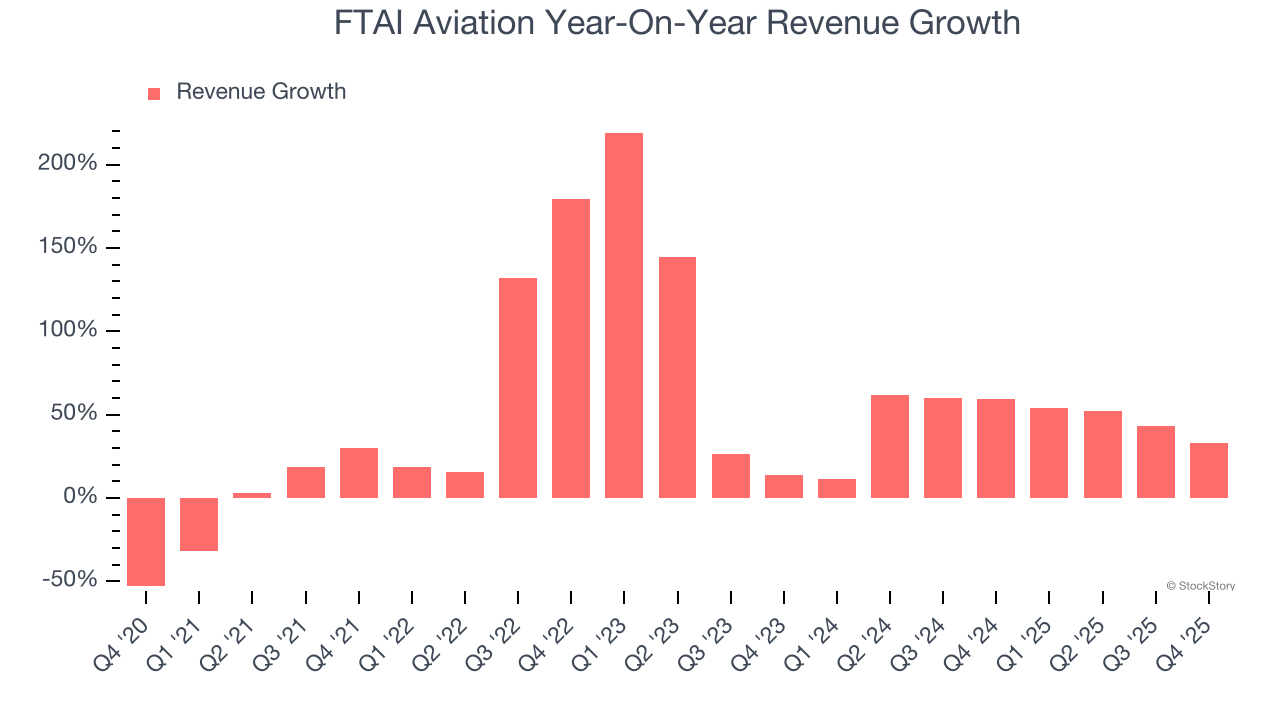
This quarter, FTAI Aviation pulled off a wonderful 32.7% year-on-year revenue growth rate, but its $662 million of revenue fell short of Wall Street’s rosy estimates.
Looking ahead, sell-side analysts expect revenue to grow 31.5% over the next 12 months, a deceleration versus the last two years. Still, this projection is admirable and suggests the market sees success for its products and services.
While Wall Street chases Nvidia at all-time highs, an under-the-radar semiconductor supplier is dominating a critical AI component these giants can’t build without. Click here to access our free report one of our favorites growth stories.
Operating Margin
Operating margin is an important measure of profitability as it shows the portion of revenue left after accounting for all core expenses – everything from the cost of goods sold to advertising and wages. It’s also useful for comparing profitability across companies with different levels of debt and tax rates because it excludes interest and taxes.
FTAI Aviation has been a well-oiled machine over the last five years. It demonstrated elite profitability for an industrials business, boasting an average operating margin of 20.9%. This result isn’t surprising as its high gross margin gives it a favorable starting point.
Looking at the trend in its profitability, FTAI Aviation’s operating margin rose by 16.8 percentage points over the last five years, as its sales growth gave it immense operating leverage. Its expansion shows it’s one of the better Vehicle Parts Distributors companies as most peers saw their margins plummet.
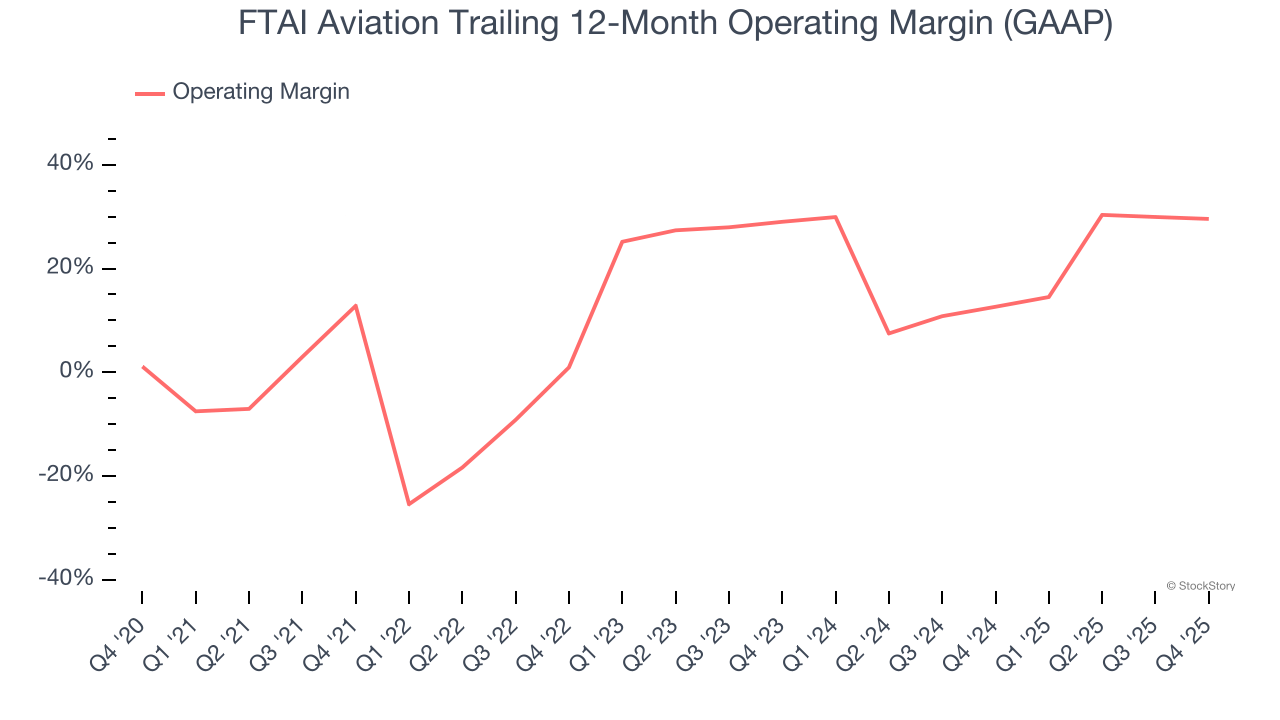
This quarter, FTAI Aviation generated an operating margin profit margin of 27%, in line with the same quarter last year. This indicates the company’s cost structure has recently been stable.
Earnings Per Share
We track the long-term change in earnings per share (EPS) for the same reason as long-term revenue growth. Compared to revenue, however, EPS highlights whether a company’s growth is profitable.
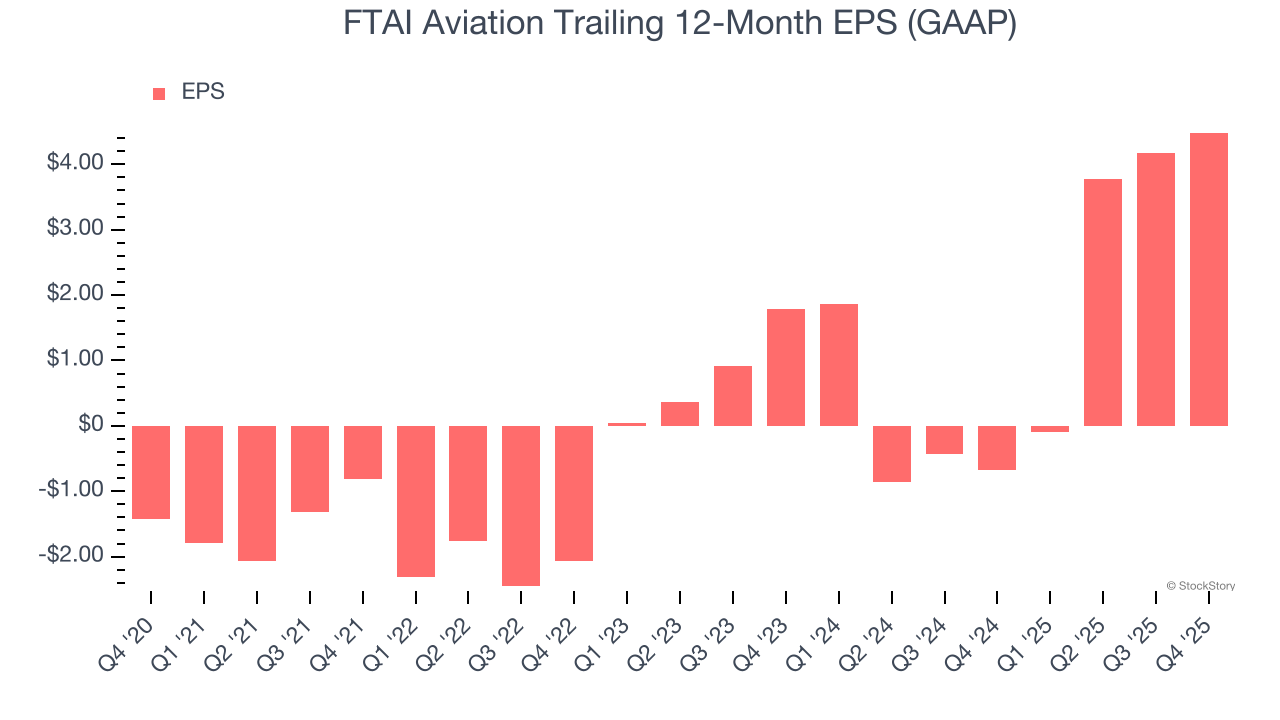
FTAI Aviation’s full-year EPS flipped from negative to positive over the last five years. This is a good sign and shows it’s at an inflection point.
Like with revenue, we analyze EPS over a more recent period because it can provide insight into an emerging theme or development for the business.
FTAI Aviation’s EPS grew at an astounding 58.3% compounded annual growth rate over the last two years, higher than its 46.3% annualized revenue growth. This tells us the company became more profitable on a per-share basis as it expanded.
In Q4, FTAI Aviation reported EPS of $1.08, up from $0.76 in the same quarter last year. Despite growing year on year, this print missed analysts’ estimates, but we care more about long-term EPS growth than short-term movements. Over the next 12 months, Wall Street expects FTAI Aviation’s full-year EPS of $4.49 to grow 60.4%.
Key Takeaways from FTAI Aviation’s Q4 Results
We were impressed by FTAI Aviation’s optimistic full-year EBITDA guidance, which blew past analysts’ expectations. On the other hand, its revenue missed and its EBITDA in the quarter both fell short of Wall Street’s estimates. Overall, this was a softer quarter. The stock traded down 4.3% to $289.77 immediately following the results.
FTAI Aviation didn’t show it’s best hand this quarter, but does that create an opportunity to buy the stock right now? The latest quarter does matter, but not nearly as much as longer-term fundamentals and valuation, when deciding if the stock is a buy. We cover that in our actionable full research report which you can read here (it’s free).