


Off-Road and powersports vehicle corporation Polaris (NYSE: PII) announced better-than-expected revenue in Q4 CY2025, with sales up 7.9% year on year to $1.92 billion. Its non-GAAP profit of $0.08 per share was significantly above analysts’ consensus estimates.
Is now the time to buy Polaris? Find out by accessing our full research report, it’s free.
Polaris (PII) Q4 CY2025 Highlights:
- Revenue: $1.92 billion vs analyst estimates of $1.82 billion (7.9% year-on-year growth, 5.8% beat)
- Adjusted EPS: $0.08 vs analyst estimates of $0.04 (significant beat)
- Adjusted EBITDA: $98.1 million vs analyst estimates of $109.5 million (5.1% margin, 10.4% miss)
- Adjusted EPS guidance for the upcoming financial year 2026 is $1.55 at the midpoint, missing analyst estimates by 8.8%
- Operating Margin: -16.7%, down from 3.7% in the same quarter last year
- Free Cash Flow Margin: 5.9%, down from 7.7% in the same quarter last year
- Market Capitalization: $3.89 billion
Company Overview
Founded in 1954, Polaris (NYSE: PII) designs and manufactures high-performance off-road vehicles, snowmobiles, and motorcycles.
Revenue Growth
A company’s long-term sales performance can indicate its overall quality. Any business can put up a good quarter or two, but many enduring ones grow for years. Unfortunately, Polaris struggled to consistently increase demand as its $7.22 billion of sales for the trailing 12 months was close to its revenue five years ago. This wasn’t a great result and is a sign of poor business quality.
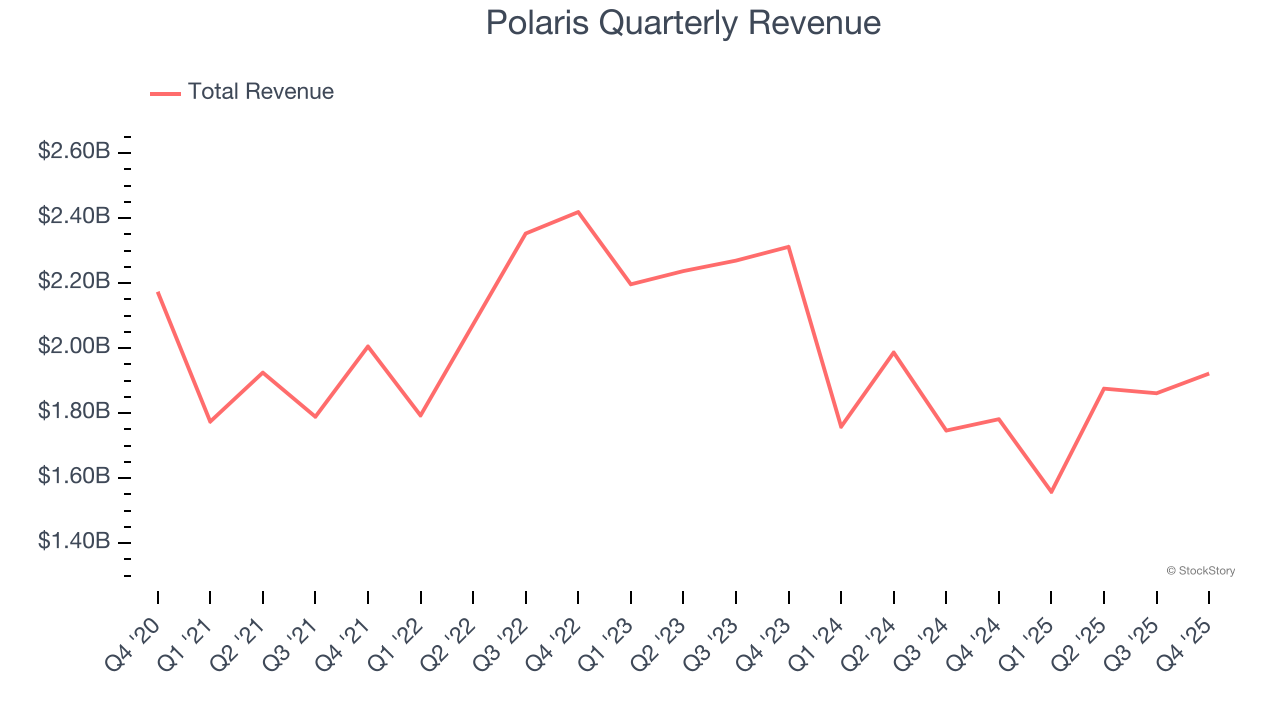
Long-term growth is the most important, but within consumer discretionary, product cycles are short and revenue can be hit-driven due to rapidly changing trends and consumer preferences. Polaris’s recent performance shows its demand remained suppressed as its revenue has declined by 10.5% annually over the last two years. 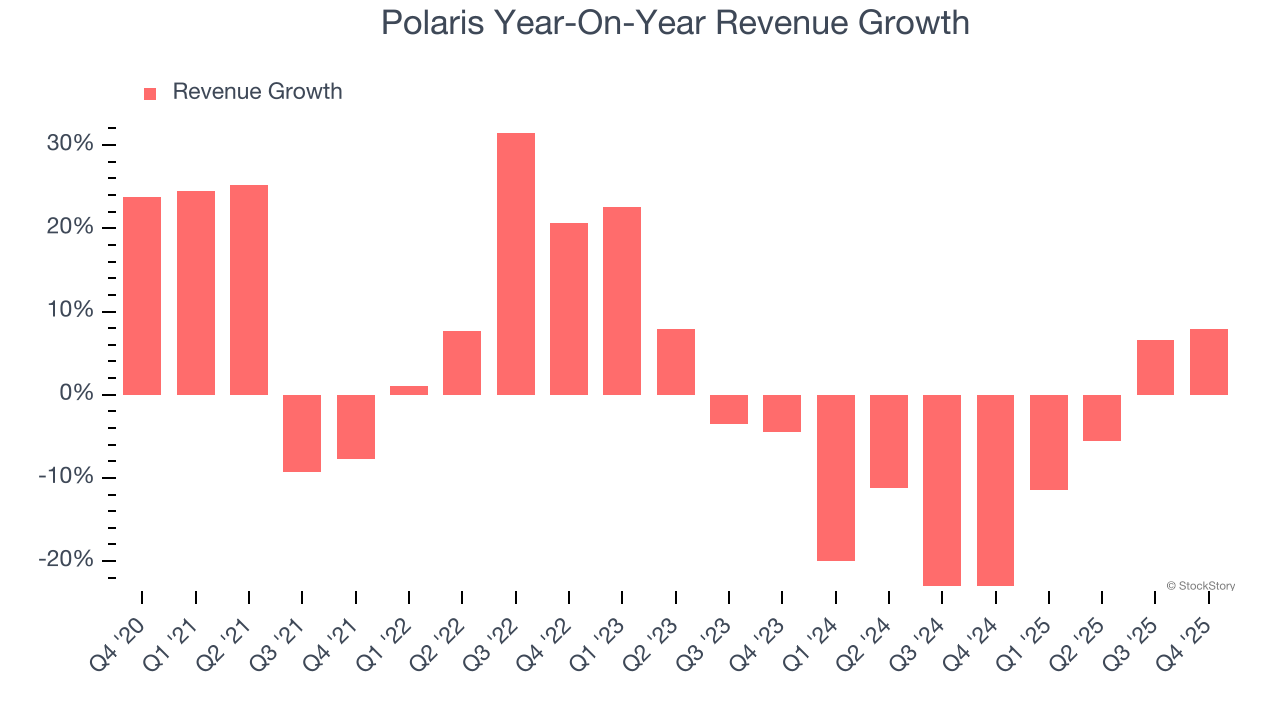
We can better understand the company’s revenue dynamics by analyzing its three most important segments: Off-road Vehicles, On-road Vehicles, and Marine, which are 83.1%, 9.7%, and 7.2% of revenue. Over the last two years, Polaris’s Off-road Vehicles (snowmobiles and 4x4s) and On-road Vehicles (motorcycles) revenues averaged year-on-year growth of 11.1% and 3.5% while its Marine revenue (boats) was flat. 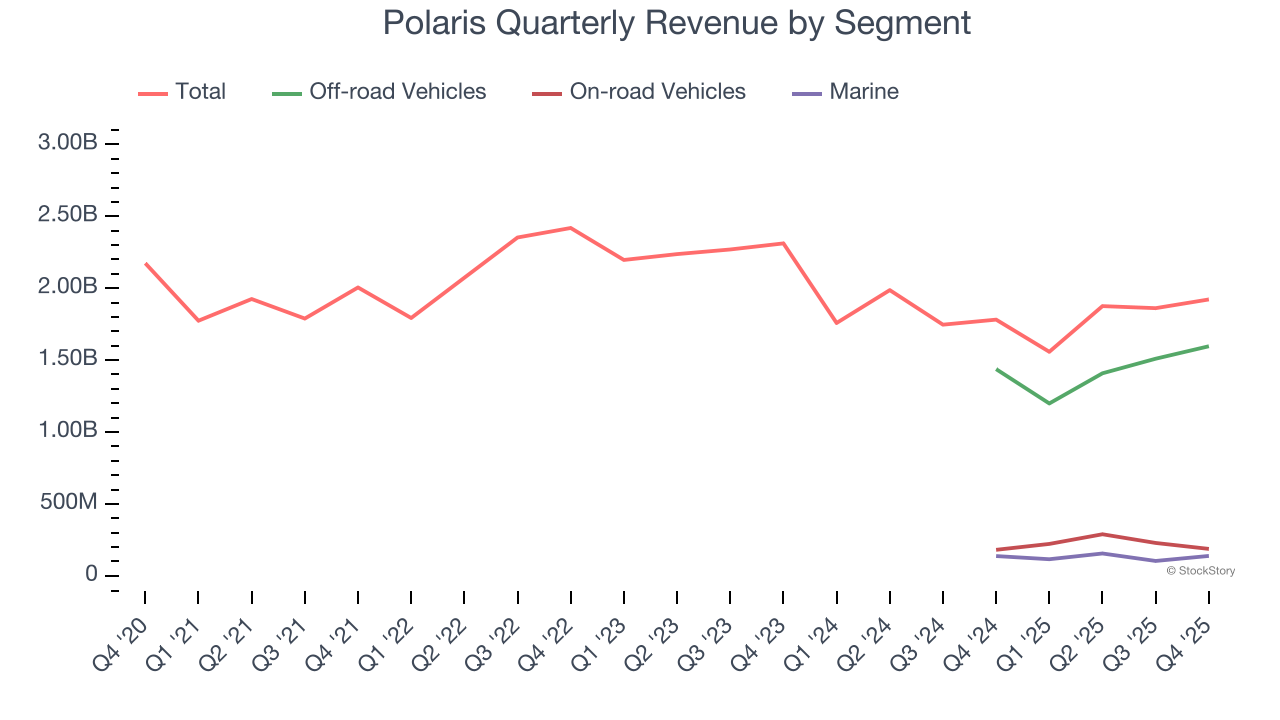
This quarter, Polaris reported year-on-year revenue growth of 7.9%, and its $1.92 billion of revenue exceeded Wall Street’s estimates by 5.8%.
Looking ahead, sell-side analysts expect revenue to decline by 2.3% over the next 12 months. While this projection is better than its two-year trend, it’s tough to feel optimistic about a company facing demand difficulties.
Software is eating the world and there is virtually no industry left that has been untouched by it. That drives increasing demand for tools helping software developers do their jobs, whether it be monitoring critical cloud infrastructure, integrating audio and video functionality, or ensuring smooth content streaming. Click here to access a free report on our 3 favorite stocks to play this generational megatrend.
Operating Margin
Polaris’s operating margin has shrunk over the last 12 months, and it ended up breaking even over the last two years. The company’s performance was inadequate, showing its operating expenses were rising and it couldn’t pass those costs onto its customers.
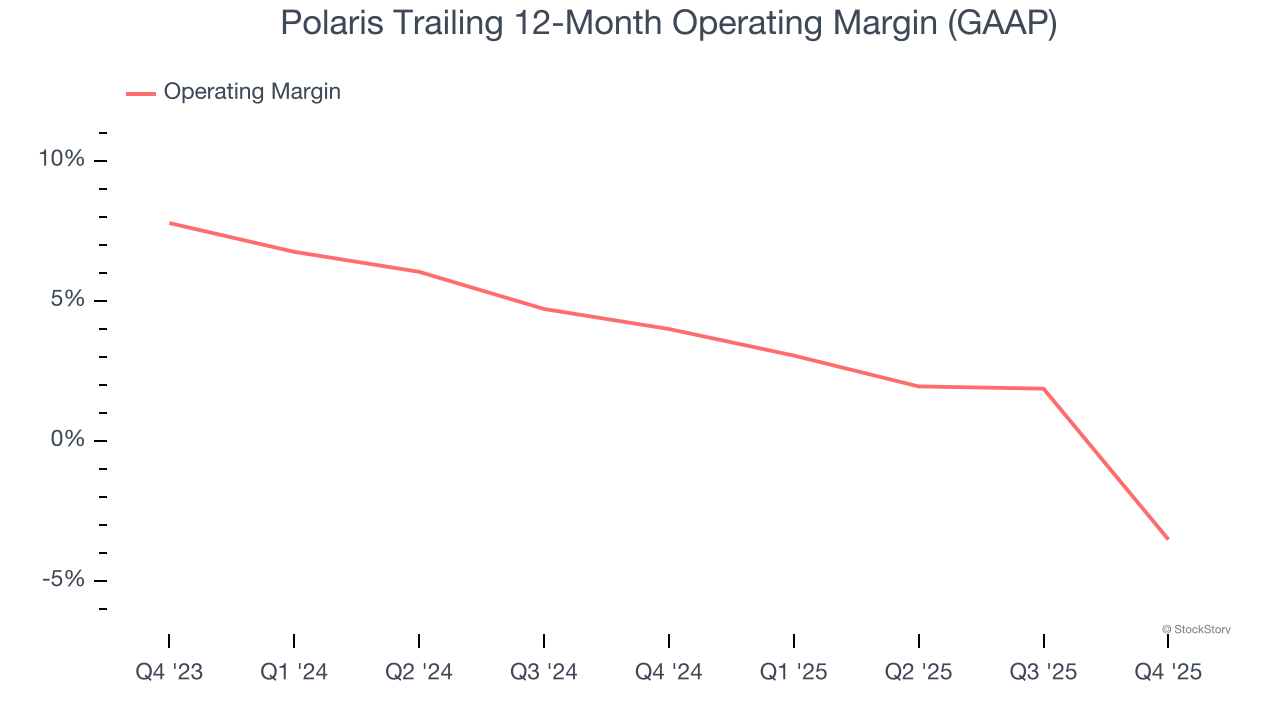
In Q4, Polaris generated an operating margin profit margin of negative 16.7%, down 20.3 percentage points year on year. This contraction shows it was less efficient because its expenses grew faster than its revenue.
Earnings Per Share
Revenue trends explain a company’s historical growth, but the long-term change in earnings per share (EPS) points to the profitability of that growth – for example, a company could inflate its sales through excessive spending on advertising and promotions.
Sadly for Polaris, its EPS declined by 14.9% annually over the last five years while its revenue was flat. This tells us the company struggled because its fixed cost base made it difficult to adjust to choppy demand.
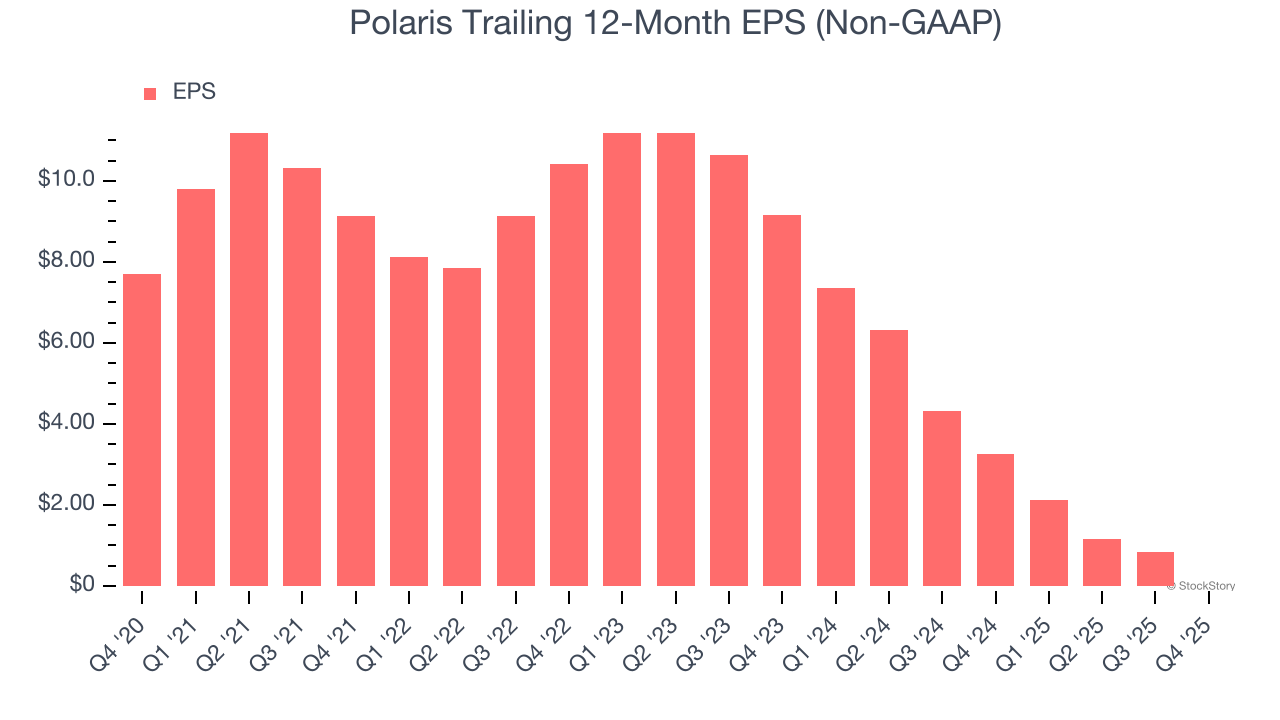
In Q4, Polaris reported adjusted EPS of $0.08, down from $0.92 in the same quarter last year. Despite falling year on year, this print easily cleared analysts’ estimates. Over the next 12 months, Wall Street is optimistic. Analysts forecast Polaris’s full-year EPS of negative $0.01 will flip to positive $1.73.
Key Takeaways from Polaris’s Q4 Results
It was good to see Polaris beat analysts’ EPS expectations this quarter. We were also glad its revenue outperformed Wall Street’s estimates. On the other hand, its full-year EPS guidance missed and its EBITDA fell short of Wall Street’s estimates. Overall, this was a softer quarter. The stock traded down 4.5% to $66 immediately following the results.
So do we think Polaris is an attractive buy at the current price? What happened in the latest quarter matters, but not as much as longer-term business quality and valuation, when deciding whether to invest in this stock. We cover that in our actionable full research report which you can read here (it’s free).