


Financial services company Truist Financial (NYSE: TFC) fell short of the markets revenue expectations in Q4 CY2025 as sales rose 2.7% year on year to $5.25 billion. Its GAAP profit of $1 per share was 8.4% below analysts’ consensus estimates.
Is now the time to buy Truist Financial? Find out by accessing our full research report, it’s free.
Truist Financial (TFC) Q4 CY2025 Highlights:
- Net Interest Income: $3.7 billion vs analyst estimates of $3.74 billion (3.1% year-on-year growth, 1.1% miss)
- Net Interest Margin: 3.1% vs analyst estimates of 3% (2.8 basis point beat)
- Revenue: $5.25 billion vs analyst estimates of $5.32 billion (2.7% year-on-year growth, 1.3% miss)
- Efficiency Ratio: 60.4% vs analyst estimates of 55.4% (501 basis point miss)
- EPS (GAAP): $1 vs analyst expectations of $1.09 (8.4% miss)
- Tangible Book Value per Share: $33.48 vs analyst estimates of $32.85 (12.7% year-on-year growth, 1.9% beat)
- Market Capitalization: $62.86 billion
Company Overview
Born from the 2019 merger of BB&T and SunTrust in one of the largest banking combinations since the 2008 financial crisis, Truist Financial (NYSE: TFC) is a bank holding company that offers a wide range of financial services including consumer and commercial banking, wealth management, insurance, and lending solutions.
Sales Growth
Net interest income and and fee-based revenue are the two pillars supporting bank earnings. The former captures profit from the gap between lending rates and deposit costs, while the latter encompasses charges for banking services, credit products, wealth management, and trading activities. Truist Financial struggled to consistently generate demand over the last five years as its revenue dropped at a 1.8% annual rate. This wasn’t a great result and suggests it’s a lower quality business.
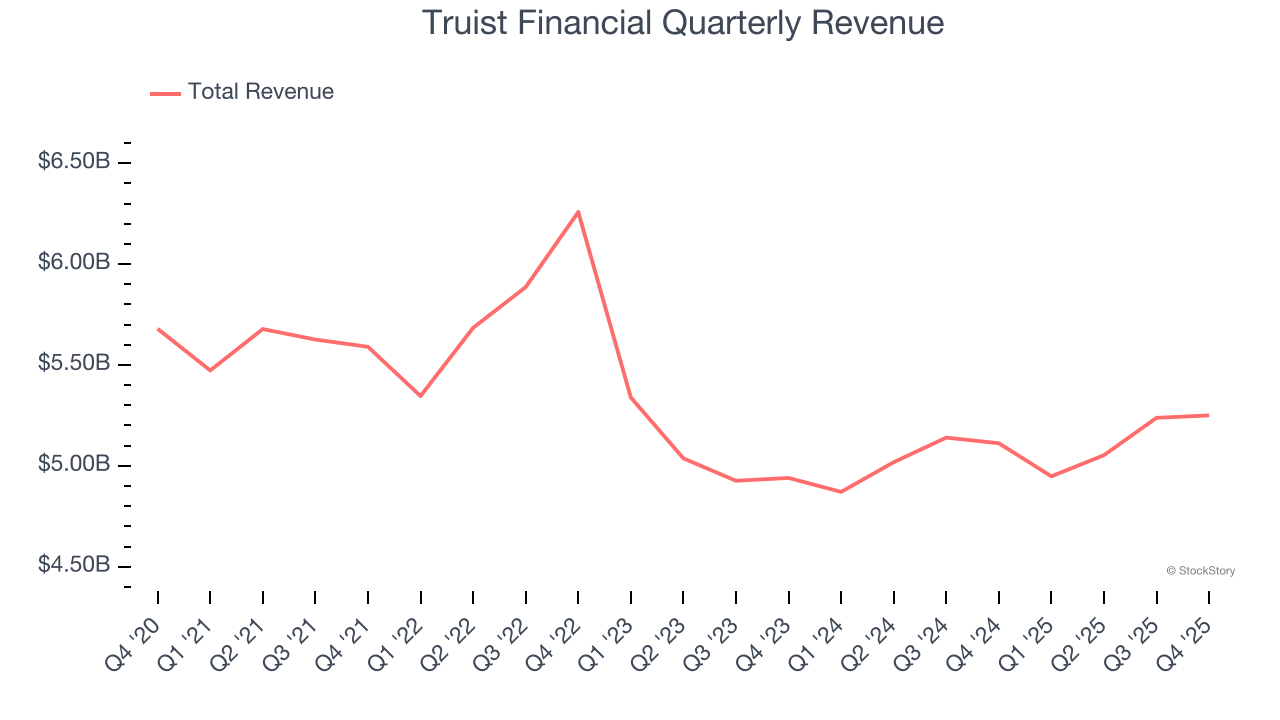
We at StockStory place the most emphasis on long-term growth, but within financials, a half-decade historical view may miss recent interest rate changes, market returns, and industry trends. Truist Financial’s revenue over the last two years was flat, sugggesting its demand was weak but stabilized after its initial drop. 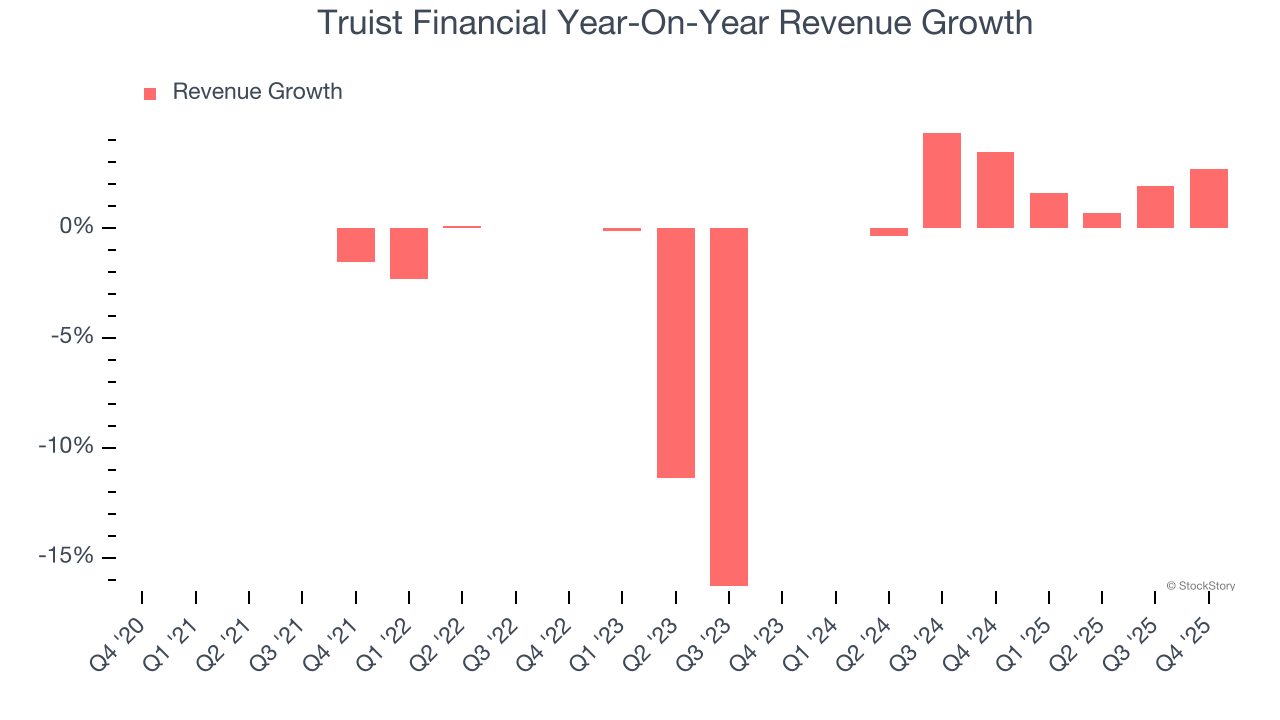 Note: Quarters not shown were determined to be outliers, impacted by outsized investment gains/losses that are not indicative of the recurring fundamentals of the business.
This quarter, Truist Financial’s revenue grew by 2.7% year on year to $5.25 billion, falling short of Wall Street’s estimates.
Net interest income made up 69.3% of the company’s total revenue during the last five years, meaning lending operations are Truist Financial’s largest source of revenue.
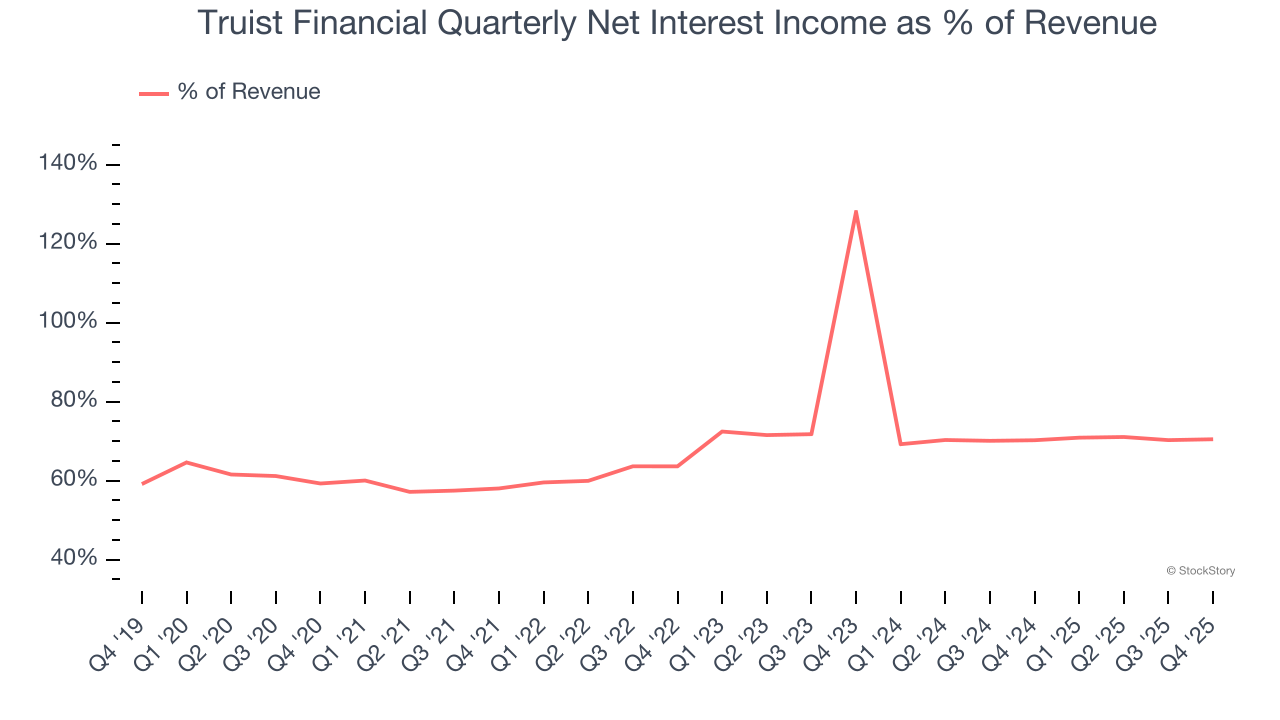
Net interest income commands greater market attention due to its reliability and consistency, whereas non-interest income is often seen as lower-quality revenue that lacks the same dependable characteristics.
Microsoft, Alphabet, Coca-Cola, Monster Beverage—all began as under-the-radar growth stories riding a massive trend. We’ve identified the next one: a profitable AI semiconductor play Wall Street is still overlooking. Go here for access to our full report.
Tangible Book Value Per Share (TBVPS)
Banks profit by intermediating between depositors and borrowers, making them fundamentally balance sheet-driven enterprises. Market participants emphasize balance sheet quality and sustained book value growth when evaluating these institutions.
This is why we consider tangible book value per share (TBVPS) the most important metric to track for banks. TBVPS represents the real, liquid net worth per share of a bank, excluding intangible assets that have debatable value upon liquidation. EPS can become murky due to acquisition impacts or accounting flexibility around loan provisions, and TBVPS resists financial engineering manipulation.
Truist Financial’s TBVPS grew at a decent 5% annual clip over the last five years. TBVPS growth has accelerated recently, growing by 15.7% annually over the last two years from $25.01 to $33.48 per share.
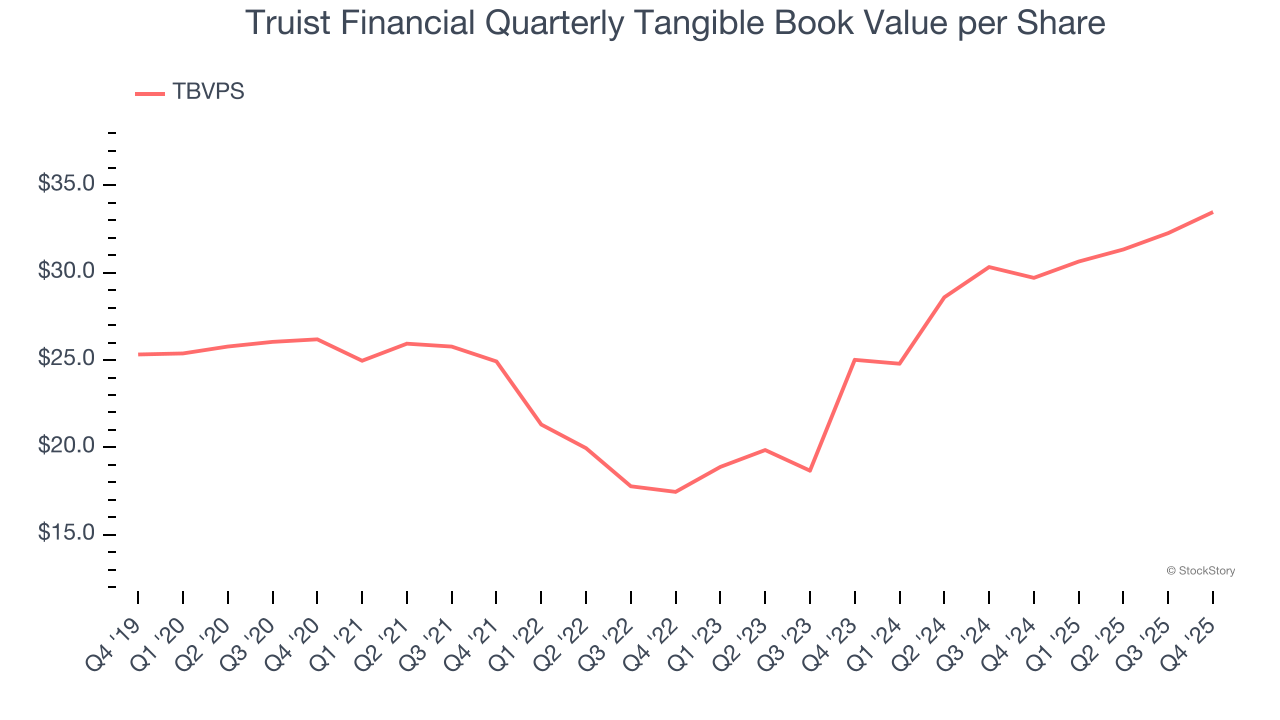
Over the next 12 months, Consensus estimates call for Truist Financial’s TBVPS to grow by 3.7% to $34.73, lousy growth rate.
Key Takeaways from Truist Financial’s Q4 Results
It was encouraging to see Truist Financial beat analysts’ tangible book value per share expectations this quarter. On the other hand, its EPS missed and its revenue fell slightly short of Wall Street’s estimates. Overall, this was a weaker quarter. The stock traded down 2.3% to $48.03 immediately after reporting.
Truist Financial’s latest earnings report disappointed. One quarter doesn’t define a company’s quality, so let’s explore whether the stock is a buy at the current price. We think that the latest quarter is only one piece of the longer-term business quality puzzle. Quality, when combined with valuation, can help determine if the stock is a buy. We cover that in our actionable full research report which you can read here (it’s free).