
Interview Kickstart today announces the publication of its comprehensive career guide titled “How to Transition from Software Engineer to Machine Learning Engineer,” a detailed resource created to help experienced software engineers successfully navigate the shift into modern machine learning engineering roles. As artificial intelligence continues to evolve from experimental innovation to core product infrastructure, the demand for engineers who can design, deploy, and maintain production-grade machine learning systems has accelerated across leading technology companies and enterprise organizations.
The new guide addresses a growing trend among software engineers who are seeking to remain deeply technical while working on high-impact, AI-driven systems. While the transition into machine learning engineering may appear complex, the report explains that much of a software engineer’s foundational expertise already transfers effectively into ML roles. Skills such as system design, debugging, infrastructure management, deployment workflows, and performance optimization remain highly relevant, but must be extended into environments where models learn from data, operate under uncertainty, and require ongoing evaluation and monitoring.
Unlike introductory machine learning articles that focus heavily on theory, the Interview Kickstart report emphasizes production readiness and interview alignment. It begins by clearly distinguishing the day-to-day responsibilities of a Software Engineer and a Machine Learning Engineer, highlighting differences in output expectations, evaluation methods, and ambiguity levels. While traditional software engineering centers on deterministic correctness and clearly defined requirements, machine learning engineering introduces experimentation, statistical reasoning, trade-offs, and probabilistic outcomes as core elements of system design.
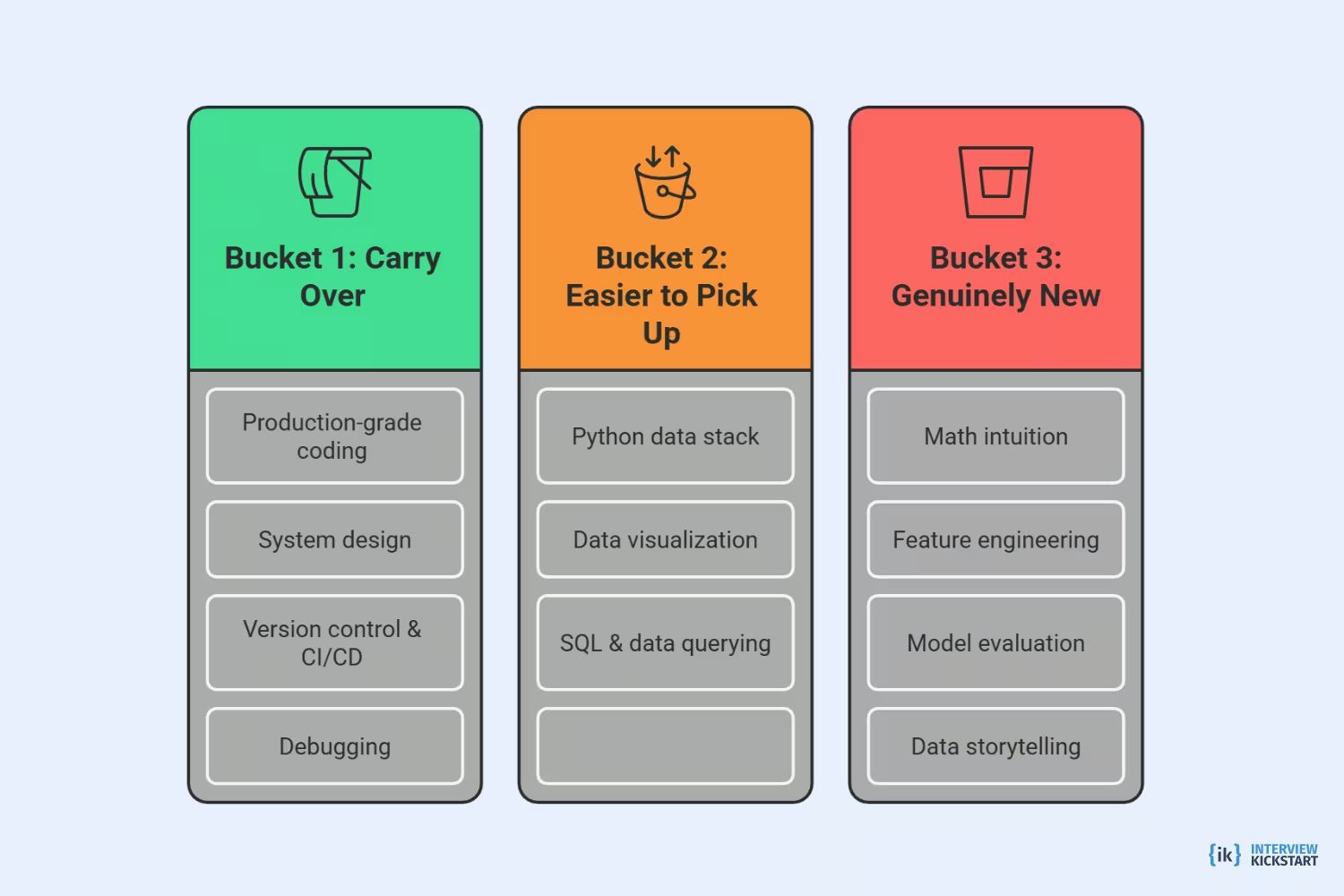
The guide provides a structured roadmap designed to help engineers prioritize learning without becoming overwhelmed. It outlines which competencies carry over directly from software engineering, which skills can be acquired relatively quickly, and which areas require deeper conceptual shifts. Particular attention is given to evaluation metrics, feature engineering, data quality, model behavior under drift, and the integration of machine learning systems into scalable production environments. The report also cautions against common transition mistakes, including over-indexing on algorithms while underestimating data complexity, neglecting evaluation strategy, and treating machine learning as a static library rather than a dynamic system that evolves over time.
In addition to foundational learning guidance, the publication details practical project recommendations aligned with current hiring expectations. It highlights the importance of building end-to-end systems rather than toy models, including projects such as Retrieval-Augmented Generation systems, real-time prediction pipelines, and production APIs with monitoring and retraining workflows. The report reinforces that hiring managers increasingly evaluate engineers on their ability to design complete ML systems, communicate trade-offs clearly, and reason about business impact, not just model accuracy.
As AI adoption expands across industries, organizations are seeking engineers who can bridge the gap between modeling and infrastructure. The “How to Transition from Software Engineer to Machine Learning Engineer” guide positions this career move as a technical evolution rather than a reinvention, helping engineers approach the transition strategically with clarity around skills, timelines, and interview expectations.
For software engineers evaluating their next technical growth step, the report offers a structured, industry-aligned framework grounded in real-world production demands and modern ML hiring practices. The full library of Interview Kickstart's career transition guides are available at https://interviewkickstart.com/career-transition/
About Interview Kickstart
Founded in 2014, Interview Kickstart is a technical career acceleration platform specializing in advanced interview preparation for FAANG and Tier-1 technology companies. With instructors from leading technology firms and a focus on production-grade system design, machine learning, and AI engineering, Interview Kickstart has helped thousands of engineers secure high-impact roles across the technology industry.
###
For more information about Interview Kickstart, contact the company here:
Interview Kickstart
Burhanuddin Pithawala
+1 (209) 899-1463
aiml@interviewkickstart.com
4701 Patrick Henry Dr Bldg 25, Santa Clara, CA 95054, United States