
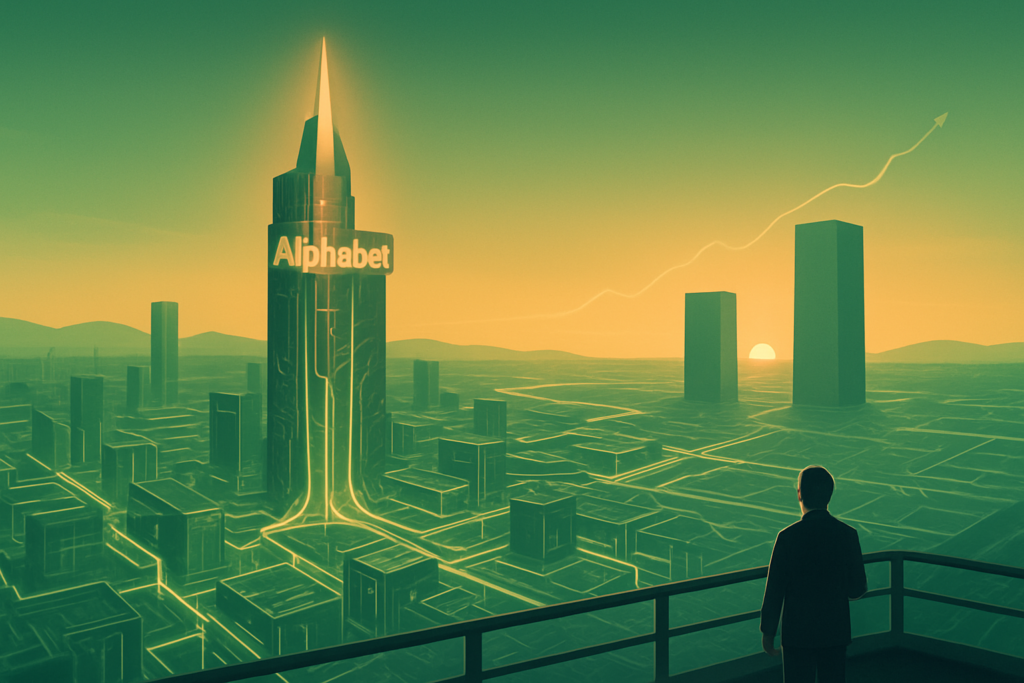
The technology landscape witnessed a historic tectonic shift yesterday. On January 7, 2026, Alphabet Inc. (NASDAQ: GOOGL) officially surpassed Apple Inc. (NASDAQ: AAPL) in market capitalization, reaching a valuation of $3.89 trillion. This milestone marks the first time since 2019 that the Google parent company has held the title of the world’s most valuable public entity. The "re-rating" of Alphabet comes on the heels of its successful transition from a legacy search engine into a vertically integrated "AI-first utility." While Apple has grappled with plateauing hardware cycles, Alphabet has leveraged its proprietary silicon, vast data moats, and a surging Cloud division to convince investors that it is the primary architect of the "Agentic AI" era.
Historical Background
Founded in a garage in 1998 by Larry Page and Sergey Brin, Google’s journey began with a simple mission: to organize the world’s information. The company’s 2004 IPO set the stage for two decades of dominance, punctuated by the high-conviction acquisitions of YouTube (2006) and DoubleClick (2007). In 2015, the company restructured as Alphabet Inc., a move designed to separate its core "Alphabet" (Google, Search, YouTube) from its "Other Bets" (Waymo, Verily, X).
For much of the 2010s, Alphabet was viewed as a high-growth advertising play. However, the 2022-2023 "AI panic"—triggered by the rise of OpenAI—forced a transformation. Under CEO Sundar Pichai, the company merged its Brain and DeepMind units in 2023, accelerating its research-to-product pipeline and setting the stage for the market cap surge of 2025.
Business Model
Alphabet’s business model in 2026 is a sophisticated flywheel of advertising, enterprise infrastructure, and autonomous systems. Its revenue is broadly categorized into:
- Google Services: Including Search, YouTube, and the Play Store. Despite the rise of AI-driven answers, advertising remains the core engine, now supplemented by "AI Overview" integrated ads.
- Google Cloud (GCP): Once a distant third to Amazon (NASDAQ: AMZN) and Microsoft (NASDAQ: MSFT), GCP has pivoted toward "AI-native" computing, providing the Vertex AI platform and custom TPU instances to enterprises.
- Other Bets: This segment is led by Waymo, which transitioned from an R&D project to a commercial powerhouse, now operating robotaxi fleets in 20 major global cities.
Stock Performance Overview
Alphabet's stock performance over the last decade has reflected its evolving narrative:
- 1-Year (2025): A meteoric +65% rise, driven by the rollout of Gemini 3 and the profitability of Google Cloud.
- 5-Year: Alphabet has returned approximately 268%, significantly outperforming the S&P 500 (
70%) and Apple (113%) in the same period. - 10-Year: Investors have seen a ~775% return, turning Alphabet into one of the most successful wealth-creation vehicles in history.
The stock, currently trading near $322 (GOOGL), has benefited from a lower P/E ratio relative to its peers for much of the early 2020s, allowing for a massive "catch-up" trade as its AI strategy solidified.
Financial Performance
In Q3 2025, Alphabet achieved a historic milestone: its first-ever $100 billion revenue quarter, reporting $102.35 billion (up 16% YoY).
- Net Income: $26.3 billion, with a diluted EPS of $2.87.
- Margins: Operating margins for Google Cloud stabilized at an impressive 24%, while the core Services margin remained robust at 35% despite increased R&D costs.
- Balance Sheet: Alphabet holds over $110 billion in cash and marketable securities. Under CFO Anat Ashkenazi, the company has maintained a $70 billion annual share buyback program and introduced a quarterly dividend in 2024.
Leadership and Management
The current leadership team is characterized by "disciplined scaling."
- Sundar Pichai (CEO): Has successfully navigated the company through the "AI Wars," focusing on hardware-software vertical integration.
- Anat Ashkenazi (CFO): Credited with tightening capital expenditures and improving ROI on massive data center builds.
- Thomas Kurian (CEO, Google Cloud): The architect of GCP's enterprise success.
- Ruth Porat (President & CIO): Oversees the "Other Bets" and long-term infrastructure, including the company's recent push into nuclear and geothermal energy to power its AI clusters.
Products, Services, and Innovations
Alphabet’s 2026 product roadmap is dominated by three pillars:
- Gemini 3: A multimodal AI ecosystem that powers "Gemini Deep Think," a reasoning-capable model that handles complex engineering and legal tasks.
- TPU v7 ("Ironwood"): Alphabet’s custom-designed AI silicon. Unlike rivals who rely on Nvidia (NASDAQ: NVDA), Alphabet’s Ironwood chips allow it to run AI at 1/4th the energy cost of competitors.
- Aluminium OS: The highly anticipated 2026 merger of Android and ChromeOS, creating a unified operating system designed specifically for the "Agentic AI" era on both mobile and desktop.
Competitive Landscape
Alphabet competes on multiple fronts:
- Vs. Microsoft/OpenAI: Alphabet's advantage is its "full-stack" control. While Microsoft depends on OpenAI for models and Nvidia for chips, Alphabet builds its own models (Gemini) and its own chips (TPUs).
- Vs. Amazon: Google Cloud is currently growing at 36% YoY, outpacing AWS’s 20% growth, as enterprises flock to Google for its superior data-handling capabilities.
- Vs. Meta (NASDAQ: META): In a surprising 2025 shift, Alphabet began renting its TPU capacity to Meta, effectively becoming a silicon provider to its largest social media rival.
Industry and Market Trends
The "Agentic AI" trend is the primary macro driver. In 2026, AI is no longer just "chatting"; it is "acting"—autonomously booking travel, managing supply chains, and writing code. This shift favors Alphabet, whose Workspace (Docs, Sheets, Gmail) provides the perfect environment for these agents to operate. Additionally, "Energy Sovereignty" has become a sector-wide trend, with Alphabet leading the charge by securing long-term nuclear power contracts to mitigate the power-hungry nature of modern data centers.
Risks and Challenges
Despite its dominance, Alphabet faces significant headwinds:
- Monetization Cannibalization: "AI Overviews" provide direct answers to users, potentially reducing the number of clicks on traditional ads. Managing this transition without hurting revenue is a delicate balance.
- Execution Risk: The consolidation of hardware and software units (Pixel and Android) under Rick Osterloh must yield a true Apple-rivaling ecosystem to justify the high R&D spend.
- Talent Wars: Competition for top-tier AI researchers remains fierce, with startups and rivals offering massive compensation packages.
Opportunities and Catalysts
- Waymo Commercialization: Analysts believe Waymo could be spun off or valued as a $200B+ entity by late 2026 as it expands into international markets like London and Tokyo.
- Enterprise Vertex AI: The "backlog" for Google Cloud reached a record $155 billion in early 2026, representing a massive pipeline of future high-margin revenue.
- Sovereign AI: Governments are increasingly looking for localized AI infrastructure, a demand Alphabet is meeting through its "Global Cloud Regions" initiative.
Investor Sentiment and Analyst Coverage
Wall Street is currently "Overweight" on GOOGL.
- Consensus: "Strong Buy."
- Price Targets: Major firms like JP Morgan and Goldman Sachs have set 12-month targets ranging from $317 to $400.
- Institutional Sentiment: Large hedge funds have increased their positions in Alphabet, viewing it as a "safe-haven AI play" compared to the volatility of smaller AI hardware stocks.
Regulatory, Policy, and Geopolitical Factors
2026 is the year of the "Remedy Phase." Following the landmark United States v. Google antitrust ruling, Alphabet is now prohibited from paying for exclusive "default" status on browsers and devices. While this was initially feared, it has actually improved Alphabet's margins by reducing the billions previously paid to Apple and Samsung. However, the EU AI Act and ongoing ad-tech litigation in Europe remain persistent threats that could lead to structural divestitures by 2027.
Conclusion
Alphabet Inc.’s ascent to the top of the market cap leaderboard is a testament to its successful "AI Reset." By moving vertically into silicon, horizontally into autonomous vehicles, and deep into the enterprise cloud, the company has diversified its revenue streams far beyond the search bar. While regulatory shadows and the transition to an AI-first ad model present risks, Alphabet enters 2026 with the most complete technological stack in the world. For investors, the focus will remain on whether Alphabet can maintain its "efficiency moat" as it battles Microsoft and Amazon for the soul of the next computing era.
This content is intended for informational purposes only and is not financial advice.