

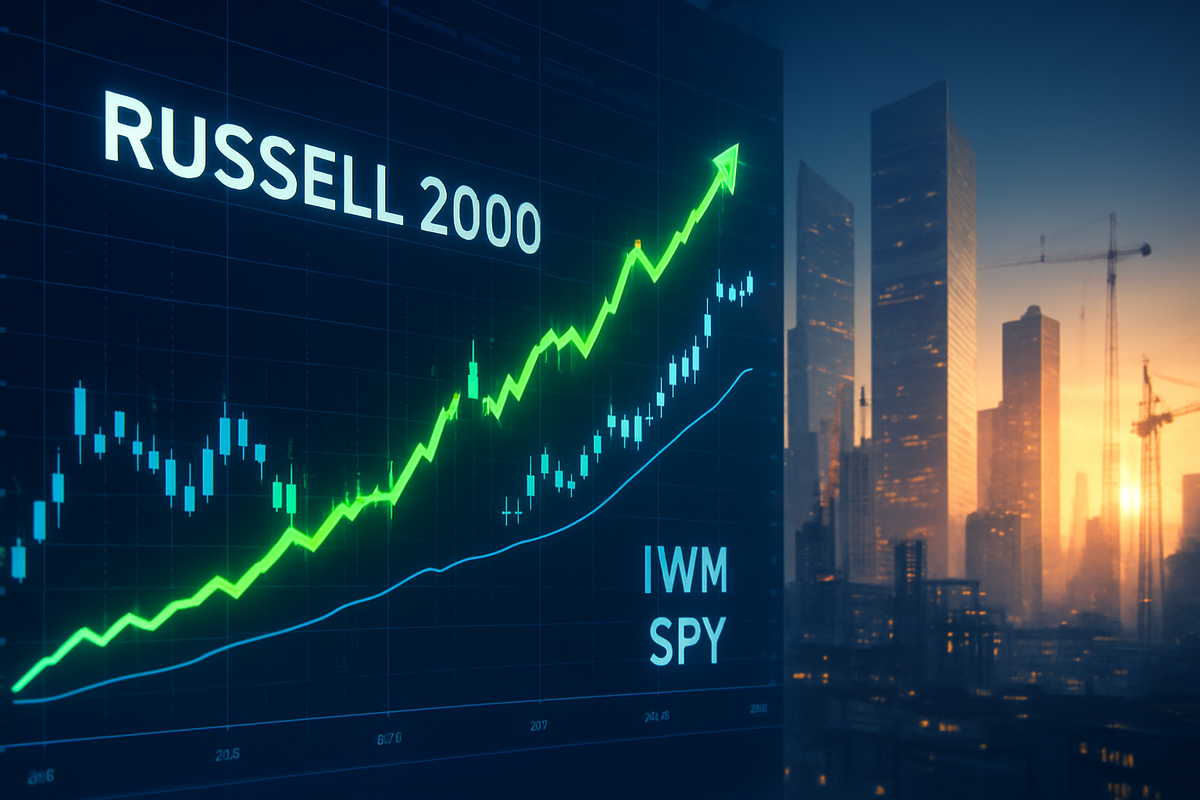
As of March 9, 2026, a dramatic regime shift is unfolding on Wall Street. After years of playing second fiddle to the "Magnificent Seven" and AI-driven mega-caps, small-cap stocks have emerged as the surprise leaders of the 2026 market. The Russell 2000 Index (NYSEArca: IWM) has surged over 6% year-to-date, leaving the benchmark S&P 500 (NYSEArca: SPY) in its rearview mirror. This pivot marks a significant departure from the concentrated growth seen throughout 2024 and 2025, signaling a broadening of market participation that many analysts believe is long overdue.
The immediate implications of this outperformance are twofold: first, it suggests that the Federal Reserve’s pivot toward easing—which began in late 2025—is finally trickling down to the most interest-rate-sensitive corners of the economy. Second, the resurgence of small caps, which are predominantly domestic-focused, points toward a robust acceleration in U.S. GDP growth. For investors who have spent the last two years huddled in the perceived safety of large-cap tech, the first quarter of 2026 has been a wake-up call that "value" and "cyclicality" are back in vogue.
A Historic "January Effect" and the Relief Rally of 2026
The surge in small caps didn’t happen overnight; it was the result of a "perfect storm" of macro conditions that coalesced in early January. Following a 2025 that saw the S&P 500 continue to break records on the back of artificial intelligence, small caps entered 2026 trading at a 25-year valuation discount relative to their larger peers. The Russell 2000 began the year with a historic winning streak, outperforming the S&P 500 for 14 consecutive sessions—the longest such stretch since 1996. This "relief rally" was catalyzed by the cumulative effect of 75 basis points of interest rate cuts delivered by the Federal Reserve in the final months of 2025.
Stakeholders, ranging from institutional hedge funds to retail investors, have been rotating capital into the Russell 2000 to capture this valuation gap. In early 2026, the S&P 500 traded at a price-to-earnings (P/E) ratio exceeding 24x, while the Russell 2000 sat comfortably below 19x. This disparity created a "coiled spring" effect. As borrowing costs for smaller firms began to stabilize, the market reacted with aggressive buying across cyclical sectors like industrials and regional banking, which form the backbone of the small-cap index.
Winners and Losers: Quality vs. Zombies
In this new environment, the "Quality Small Cap" has become the primary beneficiary. Companies like Applied Industrial Technologies (NYSE: AIT) and Fluor Corp (NYSE: FLR) have seen significant inflows as domestic infrastructure spending and "reshoring" efforts hit full stride in 2026. These firms are winning because they possess the cash flow to navigate the "debt maturity wall"—a wave of corporate debt needing to be refinanced this year—while smaller, less profitable "zombie" companies continue to struggle under the weight of even moderately high interest rates.
Conversely, the "losers" in this rotation are the previously bulletproof mega-cap tech giants. While firms like NVIDIA (NASDAQ: NVDA) remain profitable, the sheer magnitude of capital fleeing large-caps to chase the 6% YTD gains in the Russell 2000 has led to a stagnation in S&P 500 growth. Healthcare has also emerged as a sector of interest; with M&A activity picking up as rates stabilize, companies like Insmed Inc. (NASDAQ: INSM) and Vaxcyte Inc. (NASDAQ: PCVX) have seen their valuations bolstered by acquisition rumors and positive clinical milestones. Meanwhile, consumer-facing small caps like Sprouts Farmers Market (NASDAQ: SFM) are thriving as lower inflation and steady wage growth boost the purchasing power of the American middle class.
Small Caps as the Economic Canary in the Coal Mine
The wider significance of this small-cap outperformance cannot be overstated. Historically, leadership from the Russell 2000 has served as a "canary in the coal mine" for the broader economy, often foreshadowing periods of domestic acceleration. Because small-cap companies generate over 90% of their revenue within the United States, their stock price performance is a real-time barometer for the health of the U.S. consumer and industrial base. The current 6% gain suggests that the "soft landing" narrative of 2025 has transitioned into a "re-acceleration" narrative for 2026.
This trend fits into a broader global shift toward "economic nationalism" and reshoring. As supply chains continue to localize, the domestic-heavy Russell 2000 is better positioned to capture the benefits of U.S. fiscal policy than the globally-exposed S&P 500, which must contend with geopolitical instability and fluctuating foreign exchange rates. Furthermore, the 2026 rally echoes the post-2000 recovery, where a period of extreme large-cap concentration (the Dot-com bubble) was followed by a multi-year cycle of small-cap dominance.
The Road Ahead: Navigating the "Maturity Wall"
Looking forward, the remainder of 2026 presents both immense opportunity and significant hurdles. The primary challenge will be the aforementioned "debt maturity wall." Roughly 32% of small-cap debt is floating-rate, and many fixed-rate loans are set to expire in the latter half of this year. For the Russell 2000 to maintain its 6% YTD lead, the Federal Reserve must remain committed to its easing cycle to ensure that the cost of refinancing doesn't choke off the very growth that is currently being celebrated.
Investors should expect a "K-shaped" divergence within the small-cap universe. Strategic pivots will be required; the era of "buying the index" may be giving way to a period of active stock-picking, where the focus is on "Quality" (firms with deep pockets and high margins) over "Speculation." If the U.S. GDP growth continues to exceed expectations, we could see the Russell 2000 end the year with its strongest performance in a decade, potentially serving as the primary engine for the 2026 bull market.
Summary and Investor Outlook
The outperformance of small-cap stocks in early 2026 represents a fundamental shift in market leadership. With a 6% YTD gain, the Russell 2000 is proving that the U.S. domestic economy is more resilient than many skeptics feared during the high-rate environment of 2023-2024. The combination of historic valuation gaps, a pivot in Fed policy, and a resurgence in domestic industrials has created a fertile ground for smaller companies to thrive.
As we move through the rest of the year, investors should keep a close eye on the "yield curve" and corporate earnings reports from regional banks and industrial suppliers. The key takeaway is that the market is finally broadening out—a sign of a healthy, maturing bull market. While the "debt maturity wall" remains a risk, the momentum currently behind small caps suggests that the "Small-Cap Renaissance" of 2026 is only just beginning.
This content is intended for informational purposes only and is not financial advice.