
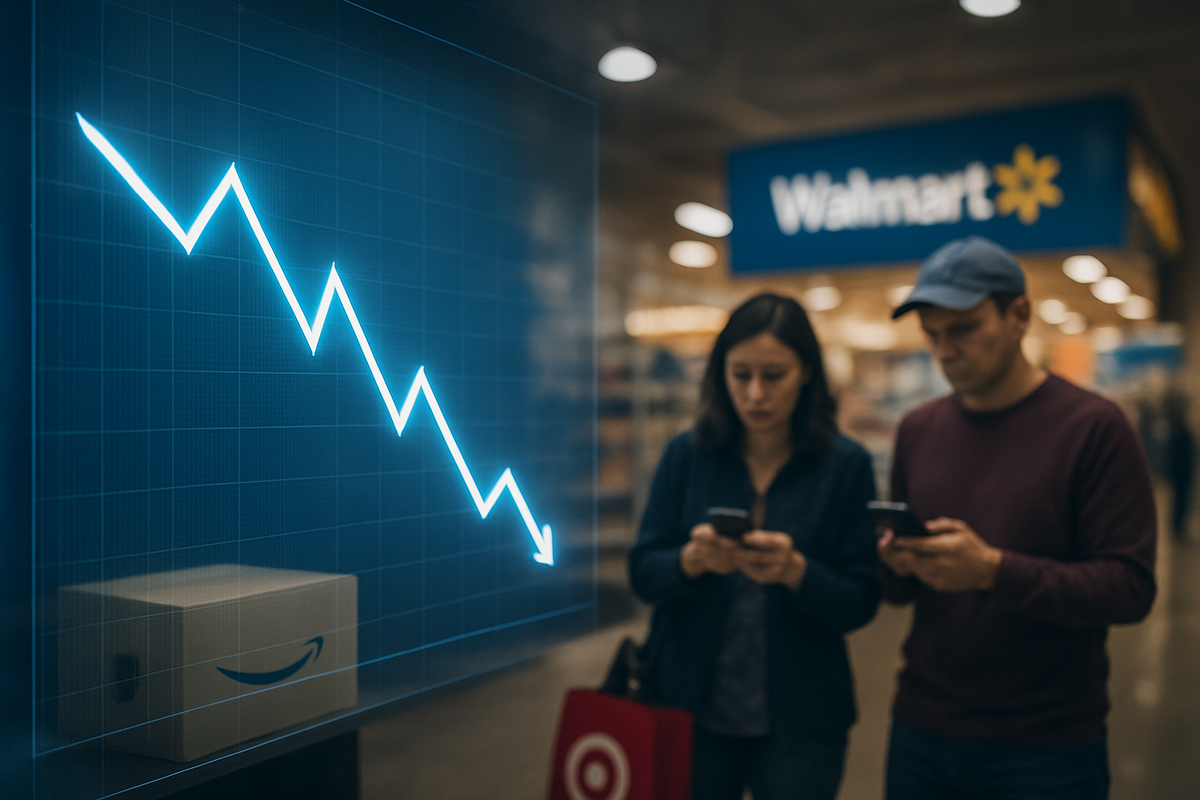
The retail landscape is facing a defining moment as the latest Conference Board Consumer Confidence Index (CCI) figures reveal a deepening divide in the American psyche. What was expected to be a steady climb into 2026 has instead turned into a volatile "stumble," with an unexpected dip in sentiment forcing retail investors to recalibrate their portfolios. As of March 9, 2026, the market is grappling with the reality of a "K-shaped" consumer recovery, where value-oriented giants are pulling ahead while discretionary-focused retailers struggle to maintain foot traffic.
This sentiment pivot comes on the heels of a turbulent start to the year. The January plunge in confidence—the sharpest in years—sent shockwaves through the S&P 500 Retail Index, and while February saw a marginal "dead cat bounce," the underlying data suggests that the American consumer is increasingly "bunker-minded." With the Expectations Index remaining stubbornly below the critical recession threshold, the retail sector is no longer rising as a single tide; instead, it is splitting into distinct camps of winners and losers based on their ability to defend against inflation and global trade headwinds.
The January Plunge and the Fragile February "Beat"
The timeline of this shift began in late January 2026, when the Conference Board reported a shocking 10-point drop in its index, plummeting to 84.5 from a revised December high of 94.2. This was the lowest reading seen since 2014, catching economists off guard who had projected a stable environment. The primary culprit was the implementation of "Liberation Day" tariffs—a 10–15% global floor on imported goods—which began to manifest as "price tag shock" in aisles across the country.
While the February 2026 report, released in late February, showed a slight recovery to 91.2, analysts are quick to point out the fragility of this "beat." The Present Situation Index actually fell by 1.8 points to 120.0, indicating that while consumers are hopeful for the future, they are feeling the pinch in the present. More concerning is the Expectations Index, which rose to 72.0 but remained below the 80-point mark for the 13th consecutive month. Historically, a reading below 80 for an extended period has been a reliable harbinger of a recession within the following year.
The volatility has been further exacerbated by the labor market. Early March 2026 data revealed a contraction of roughly 92,000 payrolls in February, a "low-hire, low-fire" environment that has made workers hesitant to spend. Key stakeholders, including the Federal Reserve and major retail trade groups, are now closely monitoring whether this dip in sentiment will translate into a sustained "spending cliff" or if the consumer can weather the ongoing tariff-driven price hikes.
Retail Titans: The Widening Gap Between Value and Discretionary
The divergence in consumer sentiment has created a clear bifurcation among the industry’s major players. Walmart Inc. (NYSE: WMT) has emerged as the clear beneficiary of this "flight to value." As mid-to-high-income households feel the squeeze of 2026 inflation, they are increasingly "trading down," shifting their grocery and essential spending to the discount giant. Walmart’s shares have outperformed the broader market by nearly 15% year-to-date, bolstered by a 27% surge in e-commerce growth and a reputation as a safe harbor in a high-tariff environment.
On the other hand, Target Corp. (NYSE: TGT) is walking a tighter rope. Despite a 15.6% rebound in its stock price earlier this year—driven by optimism over its new CEO Michael Fiddelke’s $6 billion turnaround plan—the company remains highly vulnerable to sentiment dips. Target’s product mix, which leans heavily toward discretionary "wants" like home decor and apparel, is the first to be cut from a consumer's budget when the Expectations Index falls. Investors are currently treating Target as a "show me" stock, rewarding its operational efficiencies but remaining wary of its volume growth as long as the "gloomy" sentiment persists.
Meanwhile, Amazon.com Inc. (NASDAQ: AMZN) is navigating a complex transition. While it officially surpassed Walmart in total revenue in late 2025, the tech giant’s shares have recently faced pressure, trading down to the $213 range. Investors are concerned about Amazon’s massive $200 billion capital expenditure budget for 2026, primarily focused on AI and AWS infrastructure. As consumers start to see "tariff-reflective pricing" on the platform, Amazon is leaning into its ultra-fast delivery and "Agentic AI" smart shopping assistants to keep users locked into its ecosystem, even as discretionary spending softens.
Tariffs and the "Bending" Labor Market: A New Macro Reality
The current dip in sentiment is not happening in a vacuum; it is the direct result of a tectonic shift in U.S. economic policy and labor dynamics. The 10–15% global tariff floor implemented in late 2025 has created what economists call "legal whiplash." While a February 2026 Supreme Court ruling provided a temporary pause on some tariffs, the uncertainty has left businesses and consumers in a state of paralysis. This historical precedent—a sudden return to protectionism—has no modern parallel, making the Consumer Confidence Index an even more vital pulse for the market.
Furthermore, the 2026 labor market is "bending" rather than breaking. While unemployment remains relatively low at 4.4%, the lack of new hiring has created a stagnant environment where workers are "hoarding" their current roles. This has led to a reduction in "confidence-based spending"—those impulse purchases or upgrades that drive retail margins. Unlike the supply-chain-driven inflation of the mid-2020s, the 2026 inflation is policy-driven, presenting a unique challenge for retailers who must decide how much of the tariff cost to pass on to a fragile consumer base.
The Horizon: AI Pivots and Recessionary Resilience
Looking ahead to the remainder of 2026, the retail sector will likely be defined by a massive strategic pivot toward "Agentic AI." Retailers like Target Corp. (NYSE: TGT) and Amazon.com Inc. (NASDAQ: AMZN) are banking on AI to personalize the shopping experience so effectively that it overcomes the general malaise in consumer sentiment. The goal is to move from "search and find" to "predict and fulfill," capturing limited consumer dollars through hyper-efficiency.
In the short term, all eyes will be on the March 2026 jobs report and the subsequent Conference Board update. If the Expectations Index continues to languish below 80, we may see a more aggressive shift toward defensive positioning in the market. Retailers that can offer a "one-stop-shop" for essentials while providing a digital-first experience will be the ones to survive a potential "soft landing" or a full-scale recession. The market opportunity now lies in identifying which companies have the balance sheet strength to maintain their AI investments without sacrificing their dividend or stock buyback programs.
Summary and Investor Outlook
The unexpected dip in the Conference Board Consumer Confidence Index is a clear signal that the 2026 economy is at a pivot point. The era of easy growth is over, replaced by a climate where policy shifts and labor market jitters dictate consumer behavior. For investors, the takeaway is clear: the retail sector is no longer a monolithic entity.
Key Takeaways for Investors:
- Value is King: Walmart Inc. (NYSE: WMT) continues to prove its resilience as consumers trade down.
- Discretionary Risk: High-margin, "want-based" retailers like Target Corp. (NYSE: TGT) require a more cautious "wait-and-see" approach until sentiment stabilizes.
- AI as a Moat: Amazon.com Inc. (NASDAQ: AMZN) remains a long-term infrastructure play, though its high CapEx and tariff exposure will create short-term volatility.
As we move deeper into 2026, the critical metrics to watch will be the "Expectations Index" and the "Present Situation Index" spread. If the gap continues to widen, it suggests a consumer who is losing faith in the long-term economic outlook, potentially triggering a more significant pull-back in the markets. Investors should remain nimble, focusing on companies with pricing power and the technological infrastructure to survive a cooling economic climate.
This content is intended for informational purposes only and is not financial advice.