

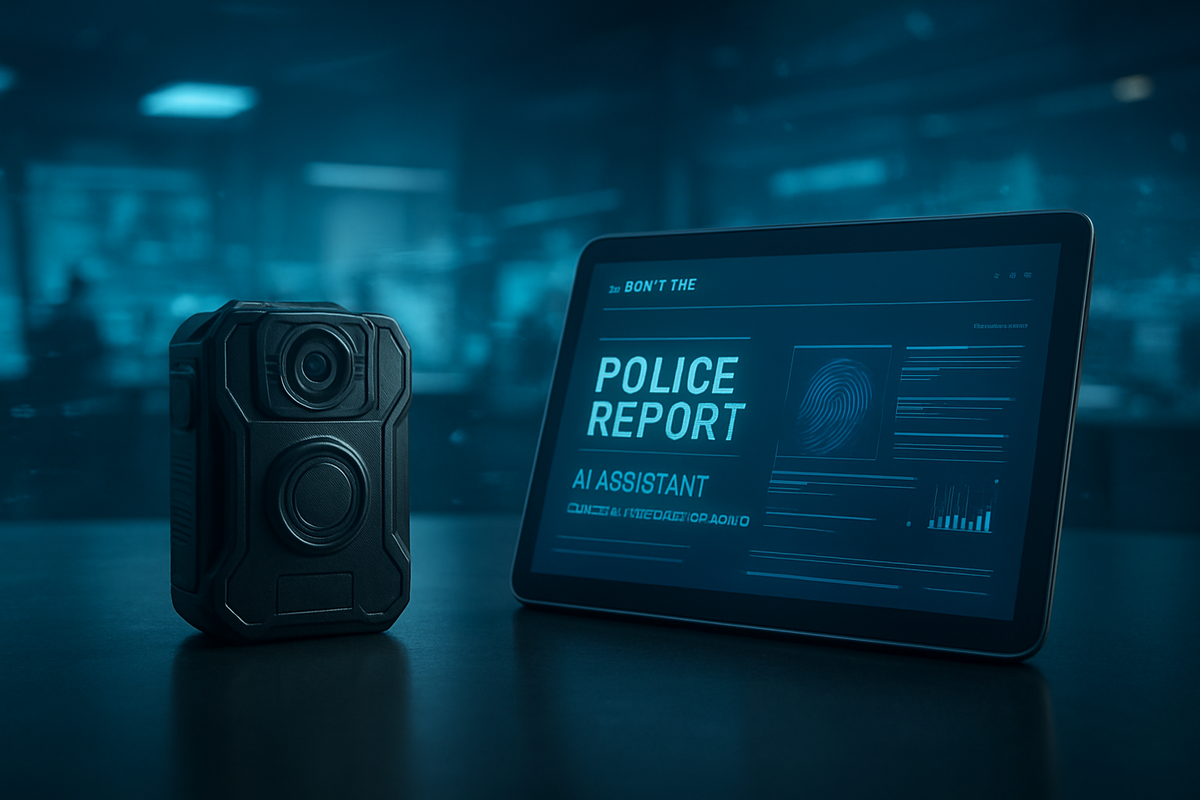
SCOTTSDALE, AZ — Shares of Axon Enterprise, Inc. (NASDAQ: AXON) surged a remarkable 26% this week, marking a historic technical breakout for the public safety technology leader. The rally followed a massive fourth-quarter 2025 earnings beat that silenced skeptics and solidified the company’s transition from a hardware manufacturer into a high-margin artificial intelligence powerhouse. Investors rushed into the stock as management revealed that "Draft One," the company's generative AI report-writing tool, has reached a critical mass of adoption, fundamentally altering the economics of law enforcement.
The surge, which pushed AXON to new all-time highs in early March 2026, reflects a growing market conviction that Axon has built an impenetrable "digital moat." By combining its dominant body-worn camera hardware with an AI software layer that automates the most tedious aspect of police work—paperwork—Axon is realizing a "land and expand" strategy that has seen its high-margin software revenue outpace its traditional hardware sales. With a staggering $14.4 billion in future contracted bookings, the company has effectively locked in growth for the remainder of the decade.
A "Blockbuster" Quarter Driven by AI Integration
The catalyst for the 26% surge was a Q4 2025 financial report that exceeded even the most optimistic Wall Street projections. Axon reported quarterly revenue of $797 million, a 39% year-over-year increase that crushed the consensus estimate of $754 million. More impressively, adjusted earnings per share (EPS) came in at $2.15, far outstripping the anticipated range of $1.60 to $1.67. This performance represents Axon’s eighth consecutive quarter of 30% or greater revenue growth, a rare feat for a company of its scale.
The timeline leading to this breakout began in late 2024, when Axon first aggressively marketed its "AI Era Plan." Throughout 2025, the company systematically integrated generative AI into its Axon Evidence platform, culminating in the widespread rollout of "Draft One." This tool uses audio from the Axon Body 4 camera to automatically transcribe and draft high-quality police reports in seconds. According to the earnings call, agencies using Draft One have reported a 50% to 80% reduction in time spent on administrative tasks, allowing officers to spend significantly more time on patrol and community engagement.
Initial market reactions were swift. Within minutes of the after-hours release on February 24, 2026, the stock began its ascent. Analysts from major firms, including Morgan Stanley and RBC Capital, quickly issued bullish upgrades. By the time markets opened on March 3, 2026, the cumulative 26% gain had added billions to Axon's market capitalization, as investors pivoted from viewing the company as a "taser and camera maker" to an "AI-driven utility" for the public sector.
Winners and Losers in the AI Public Safety Arms Race
The primary winner in this shift is undoubtedly Axon, whose software-only gross margins now exceed 80%. The company’s ability to bundle Draft One with its hardware—such as the TASER 10 and Axon Body 4—has created a "Public Safety Operating System" that is difficult for competitors to penetrate. However, the ripple effects are being felt across the industry, particularly by legacy rival Motorola Solutions, Inc. (NYSE: MSI).
Motorola has been forced into a defensive posture, recently launching "Narrative Assist" under its Assist Suites banner. While Motorola is positioning itself as the "accountable alternative"—requiring officers to write a manual draft before AI "fact-checks" it against radio transcripts—investors currently favor Axon’s "AI-first" automation approach. Motorola’s stock remained relatively flat following Axon’s news, as the market expressed concerns that Axon’s closed ecosystem and massive data advantage may be creating a winner-take-all scenario in the digital evidence management space.
Smaller, niche players are also seeing a shift in their fortunes. Companies like Veritone, Inc. (NASDAQ: VERI), which acts as an interoperable AI hub, may benefit from agencies that want to avoid "vendor lock-in" by managing data from multiple sources. Conversely, hardware-only firms that have failed to develop a robust AI software stack are seeing their valuations compress as the market increasingly views physical cameras as commoditized "endpoints" for more valuable AI services.
The Broader Implications: Efficiency vs. Accountability
Axon’s surge is more than just a financial story; it represents a pivotal moment in the broader application of generative AI in sensitive public sectors. The success of Draft One fits into a larger industry trend where AI is being used not just for data analysis, but for the fundamental creation of official records. This has historically been a controversial area, with critics raising concerns about "AI hallucinations" or bias in police reports.
However, the 2026 landscape has seen a pragmatic shift. Faced with severe staffing shortages and "burnout" across law enforcement agencies nationwide, regulators have become more receptive to AI tools that increase efficiency. Axon has navigated this by building "human-in-the-loop" safeguards, ensuring that every AI-generated report must be reviewed and signed off by a human officer.
This trend is not without its regulatory hurdles. New 2026 state laws, such as California's SB 524, now require explicit disclosure when AI is used to draft police narratives. Furthermore, some legal jurisdictions have begun to push back, with public defenders utilizing tools from startups like JusticeText to audit AI-generated reports for inconsistencies. The clash between AI-driven efficiency and judicial accountability is likely to be a defining theme of the legal system for the next several years.
What Lies Ahead: Scaling to $6 Billion and Beyond
Looking forward, Axon has issued a bold 2026 revenue guidance of 27% to 30% growth and set a long-term revenue target of $6 billion by 2028. To achieve this, the company is already moving beyond the patrol car. Axon recently expanded into the 911 dispatch market through the integration of Prepared and Carbyne, creating "Axon 911." This platform uses AI to triage live video and audio from emergency calls, feeding that data directly into the reporting ecosystem before an officer even arrives on the scene.
The next major frontier for Axon will be international expansion. For the first time, international bookings surpassed $2 billion in 2025, driven by demand in the UK, Australia, and parts of the European Union. As these regions adopt similar AI-driven reporting standards, Axon’s total addressable market (TAM) could expand significantly.
However, investors should remain cautious regarding potential "cloud fatigue" or data sovereignty laws in Europe that could favor local players like Tej AI, which specializes in secure, on-premise AI solutions. Furthermore, as Axon becomes more of a software-centric company, it may face increased scrutiny from cybersecurity regulators, given the sensitive nature of the criminal justice data it manages.
Summary and Investor Outlook
Axon Enterprise’s 26% surge is a testament to the power of vertical integration in the AI era. By controlling both the data capture (cameras) and the data processing (AI reporting), Axon has created a feedback loop that increases its value with every incident recorded. The Q4 2025 earnings beat serves as a clear signal that the "AI Era" in public safety has transitioned from a conceptual promise into a massive revenue generator.
For investors, the key metric to watch in the coming months will be the growth of Annual Recurring Revenue (ARR) and the rate of "Draft One" adoption among mid-sized and smaller agencies. While the stock's valuation multiple has expanded, the record $14.4 billion backlog provides a level of visibility and stability rarely seen in the tech sector.
As Axon moves toward its $6 billion revenue goal, the market will be watching to see if it can maintain its dominance in the face of increasing competition from Motorola and the rising tide of AI regulation. For now, Axon stands alone as the undisputed leader of the high-tech law enforcement revolution.
This content is intended for informational purposes only and is not financial advice.