
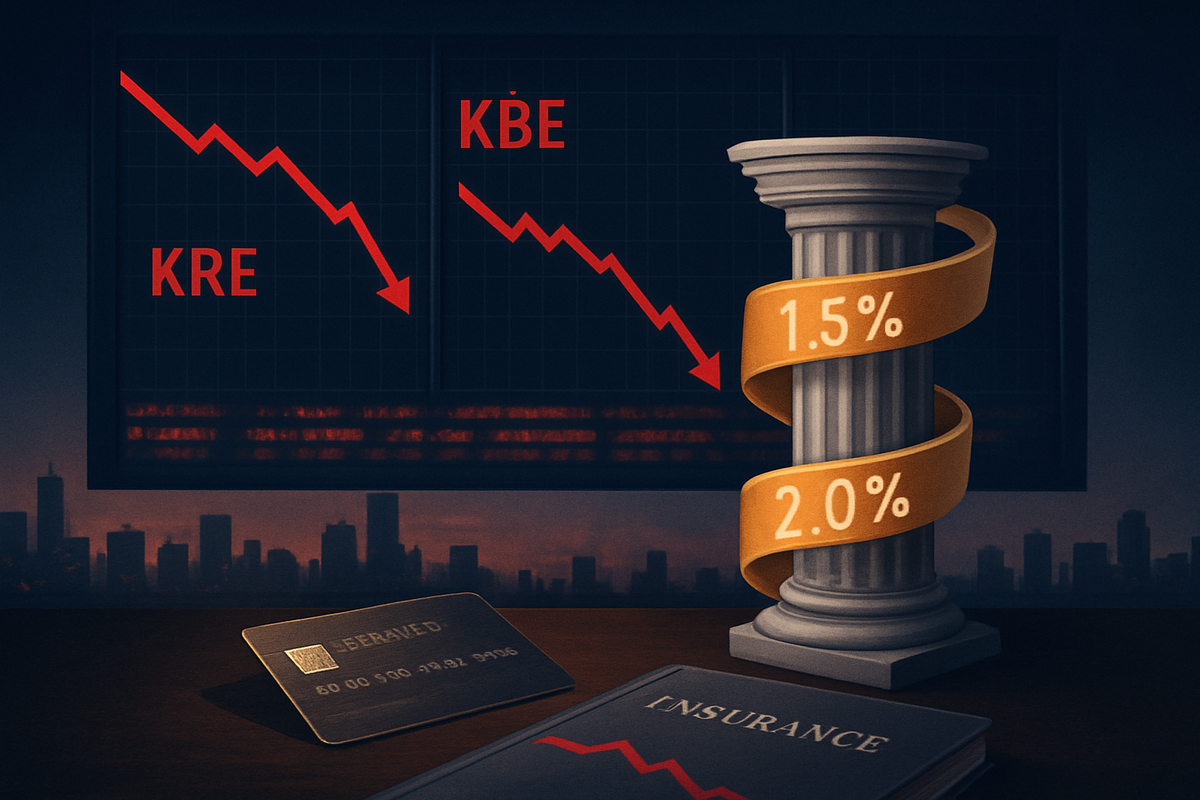
The financial markets were rattled on March 2, 2026, as a wave of selling hit the banking sector, erasing billions in market capitalization in a single session. The SPDR S&P Bank ETF (NYSE Arca: KBE) and the SPDR S&P Regional Banking ETF (NYSE Arca: KRE) both plummeted approximately 5%, marking one of the most volatile days for financial institutions since the liquidity scares of 2023. This downturn is not merely a flash in the pan but appears to be a fundamental repricing of risk as the industry grapples with a "yield curve twist" and shifting regulatory landscapes.
The immediate implications are stark: the sell-off has pushed several key industry players into intermediate downtrends, raising questions about the sustainability of the post-2025 rally. As investors flee to the perceived safety of short-term treasuries and hard assets, the banking sector faces a dual threat of compressed profit margins and a cooling consumer economy, creating a "perfect storm" for both regional lenders and diversified financial giants.
A Convergence of Technical Breakdowns and Macro Pressures
The catalyst for today’s plunge appears to be a combination of disappointing technical data and a "tech-led contagion" that bled into the financial sector. The day began with a breakdown in the SPDR S&P Regional Banking ETF (NYSE Arca: KRE), which fell 5.14% to trade near $66.77, decisively slicing through its 50-day moving average. Market participants cited a ripple effect from the technology sector, specifically following underwhelming earnings from Nvidia (NASDAQ: NVDA) and massive layoffs at the digital payments firm Block (NYSE: SQ). These events triggered a broader "de-risking" phase, as investors questioned whether the "AI-driven productivity gains" promised for 2026 would materialize fast enough to offset rising operational costs.
The timeline leading up to this moment has been characterized by "regime uncertainty." With Federal Reserve Chair Jerome Powell’s term set to expire in May 2026, the market has been on edge regarding the future of monetary policy. Compounding this was the release of the S&P Global Flash Composite PMI, which dropped to a 10-month low of 52.3, and a Core PCE inflation reading that remains "sticky" at 3.0%. This stagflationary backdrop has left banks in a precarious position, caught between a slowing economy and stubbornly high funding costs.
Initial reactions on the trading floor were described as "orderly but aggressive." Unlike the localized panic of the 2023 regional banking crisis, the current sell-off is viewed by analysts as an "earnings-driven event." Major stakeholders, including institutional asset managers and pension funds, have begun rotating out of financials and into defensive sectors as the technical damage to bank charts becomes too significant to ignore.
Heavyweights Under Pressure: American Express and MetLife Lead the Retreat
Two of the most prominent casualties of the current market shift are American Express (NYSE: AXP) and MetLife (NYSE: MET), both of which have entered what technical analysts describe as intermediate downtrends. American Express has seen its shares tumble 15% year-to-date, currently trading around the $315 mark. The primary headwind for the credit card giant is a proposed 10% interest rate cap on credit cards currently circulating in Washington. CEO Stephen Squeri has warned that such a cap could trigger a "downward spiral" for the industry, limiting credit availability just as consumer sentiment hits near-recessionary levels of 56.6 on the University of Michigan Index.
MetLife (NYSE: MET) is facing its own set of challenges, punctuated by a technical "Death Cross" on March 1, 2026, where its 50-day moving average fell below its 200-day moving average. Despite beating earnings-per-share expectations, the insurer missed its revenue targets significantly, posting $23.81 billion against a forecasted $27.22 billion. The miss has sparked concerns over its massive commercial mortgage loan portfolio, which is facing a "maturity wall" of defaults as office and retail property values continue to stagnate.
While the "losers" are easy to identify in a 5% sector-wide rout, the "winners" are those with the scale to weather the storm. Mega-banks like JPMorgan Chase (NYSE: JPM) are utilizing what they call "Agentic AI" to drive operational efficiencies that smaller regional banks simply cannot afford. However, even these titans are not immune to the broader trend of Net Interest Margin (NIM) compression, as the narrowing spread between what they pay on deposits and what they earn on loans eats into the bottom line.
The "2026 Twist" and the Narrowing Spread
The most significant fundamental driver behind the banking plunge is the state of the yield curve, which has entered a phase known as the "2026 Twist." As of March 2, the spread between short-term and long-term interest rates has narrowed to a punishing degree. The 10-year Treasury yield has drifted down to approximately 4.09%, while short-term Repo funding costs remain elevated at 4.2%. This inversion—or near-inversion—is the antithesis of the traditional banking business model, which relies on "borrowing short and lending long."
In a healthy environment, banks benefit from a steep yield curve. In the current "Twist" scenario, the cost of keeping deposits (funding) stays high due to competition and sticky inflation, while the yields on new long-term loans and mortgages are falling or stagnant. This leads to severe NIM compression. For regional banks within the KRE, this is particularly devastating because they lack the diverse revenue streams—such as investment banking or global wealth management—that provide a buffer for larger institutions.
This event also highlights a shifting regulatory landscape. Unlike the 2008 financial crisis, which centered on subprime mortgages, or the 2023 crisis, which was a liquidity-driven bank run, 2026 is seeing the migration of risk into the $256 trillion "Shadow Banking" system. Regulators are now forced to look beyond traditional bank balance sheets and toward private credit and insurance entities, where the lack of transparency could lead to further "ripple effects" across the financial ecosystem if the yield curve remains flat for an extended period.
The Road Ahead: Consolidation and the AI Pivot
What comes next for the banking sector likely involves a wave of "in-market consolidation." Smaller regional banks that are struggling to maintain profitability in a low-spread environment will likely become acquisition targets for larger, more capitalized firms. Analysts expect 2026 to be a "defining year" for mergers as the industry seeks to achieve the scale necessary to survive the NIM squeeze.
Short-term, the market will be laser-focused on the Federal Reserve's leadership transition in May. If the new leadership signals a more aggressive approach to steepening the yield curve or lowering short-term rates, the banking sector could see a relief rally. Conversely, if stagflation persists, the downtrends in stocks like AXP and MET could deepen into long-term bear markets.
The long-term survival of many financial institutions will also depend on their ability to pivot from "AI hype" to "AI returns." 2026 is the year where banks must prove that their investments in technology can lead to actual operational leverage. Those that cannot demonstrate a clear path to higher margins through "Agentic AI" and automation will likely continue to be re-rated lower by a market that is losing patience with the "wait and see" approach to fintech integration.
Summary and Investor Outlook
The 5% plunge in the banking sector on March 2, 2026, serves as a stark reminder that the financial industry remains highly sensitive to interest rate mechanics and broader economic shifts. The breakdown in the KBE and KRE, combined with the intermediate downtrends in AXP and MET, suggests that the "easy money" era of the post-pandemic recovery has been replaced by a much more demanding and volatile landscape.
Investors should watch for three key indicators in the coming months:
- The Yield Curve Spread: Any further narrowing or a sustained inversion will continue to pressure bank earnings.
- Regulatory Developments: Specifically, the progress of the credit card interest rate cap and any new oversight on the "Shadow Banking" sector.
- The Commercial Real Estate (CRE) Maturity Wall: Watch for an uptick in defaults within the loan portfolios of regional lenders and insurers like MetLife.
Moving forward, the banking sector is likely to remain under pressure until the yield curve finds a more traditional, upward-sloping shape. For now, the "2026 Twist" remains the dominant narrative, and caution is the watchword for those exposed to the financial markets.
This content is intended for informational purposes only and is not financial advice.