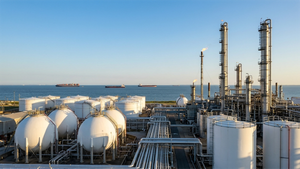
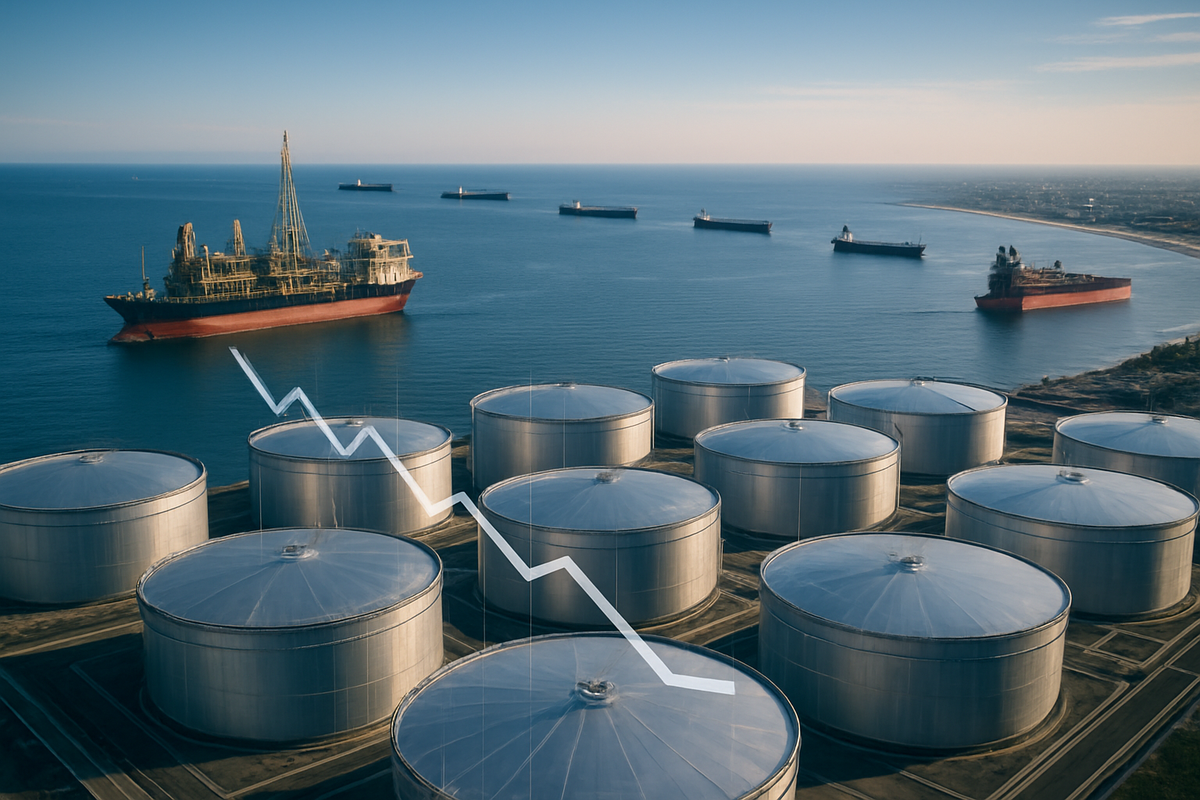
As of March 17, 2026, the global energy landscape is being redefined by what economists are calling the "Great Oil Glut." A historic surplus, averaging a massive 1.2 million barrels per day (mb/d), has fundamentally broken the decades-long cycle of price volatility and supply anxiety. This structural oversupply, the largest since the 2020 pandemic lockdowns, has sent Brent crude tumbling to a five-year low of $60 per barrel, defying the geopolitical tensions that would have historically sent prices soaring into the triple digits.
The primary driver of this market shift is a relentless production surge from a group of non-OPEC+ nations now known as the "Americas Quintet"—the United States, Brazil, Canada, Guyana, and Argentina. Their collective output has not only outpaced global demand growth but has also neutralized the traditional price-setting power of the OPEC+ cartel. For the global economy, this surplus acts as a critical deflationary force and a strategic buffer, providing a "safety net" that insulates Western markets from supply shocks in the Middle East and Eastern Europe.
The Structural Surplus: A Perfect Storm of Supply and Stagnation
The road to $60 oil was paved by a convergence of record-breaking production and a fundamental shift in how the world’s largest economies consume energy. Unlike the temporary gluts of the past, the 2026 surplus is structural. While OPEC+ countries have kept an estimated 7 million barrels per day of spare capacity idled in an attempt to support prices, the "Americas" have filled every gap. The United States (NYSE: XOM, NYSE: CVX) continues to lead the charge, with production reaching a staggering 13.6 million barrels per day as efficiency gains in the Permian Basin allow drillers to remain profitable even at current lower price points.
This supply tsunami is meeting a wall of slowing demand, particularly from China. Once the engine of global oil consumption, the Chinese economy has pivoted toward high-tech manufacturing and services, while its transportation sector has seen a rapid "electrification." The mass adoption of electric vehicles (EVs) and LNG-powered heavy trucking has permanently altered China's oil requirements. When combined with the broader global transition toward renewables, the World Bank notes that for the first time in modern history, global oil demand growth has slowed to less than 1 mb/d, leaving the market in a state of permanent oversupply.
Winners and Losers: The $60 Barrier
The "new normal" of $60 Brent has created a sharp divide between companies capable of thriving on efficiency and those burdened by high costs or debt. Among the clear winners are the "Supermajors" like ExxonMobil (NYSE: XOM) and Chevron (NYSE: CVX). Both companies leveraged massive 2024 acquisitions—Pioneer and Hess, respectively—to achieve industrial-scale efficiencies. With breakeven costs in the Permian and Guyana estimated at below $35 per barrel, these giants continue to generate significant free cash flow even as prices languish. Similarly, Brazil’s Petrobras (NYSE: PBR) has emerged as a powerhouse, utilizing its low-cost "pre-salt" offshore fields to maintain profitability while smaller competitors struggle.
Conversely, the oil services sector and high-cost European majors are feeling the squeeze. Halliburton (NYSE: HAL), which is heavily exposed to U.S. shale drilling activity, has seen earnings estimates slashed as domestic producers shift from growth to "maintenance mode." European giants like Shell (NYSE: SHEL) and BP (NYSE: BP) have also faced margin pressure, with BP recently pausing share buybacks to preserve capital. Outside of the oil patch, the biggest winners are the transportation and logistics sectors. Delta Air Lines (NYSE: DAL) and United Airlines (NASDAQ: UAL) are seeing a windfall from lower jet fuel costs, while logistics giants like UPS (NYSE: UPS) and FedEx (NYSE: FDX) have successfully maintained "fuel surcharges" even as their actual costs fall, turning a former expense into a profit lever.
A Geopolitical Buffer and the End of the "Oil Weapon"
The wider significance of the 2026 glut lies in its impact on global diplomacy. Historically, the threat of an oil supply disruption was a potent weapon for producer nations. Today, that leverage is severely diminished. Despite recent flare-ups in the Middle East, market reactions have been muted. The 1.2 mb/d surplus, combined with the massive spare capacity held by OPEC+, means the world can lose a major producer’s output overnight without seeing prices sustain a spike above $90.
This shift fits into a broader industry trend where energy security is increasingly found in diversification rather than cartel membership. The rise of Guyana (where ExxonMobil leads a consortium with Hess and CNOOC) as a million-barrel-per-day producer has demonstrated that new, low-cost basins can emerge with startling speed. This has forced a regulatory and policy rethink in many nations, as the focus shifts from "securing supply" to "managing the transition" in an environment where fossil fuels are plentiful and cheap. The historical precedent most comparable to this moment is the late 1990s, where a similar glut forced massive industry consolidation and a decade of low prices.
The Road Ahead: M&A and the Strategic Pivot
Looking forward, the "Great Glut" is likely to trigger a final wave of consolidation in the North American energy sector. Mid-cap shale producers that require Brent prices of $65 or higher to grow are becoming prime targets for acquisition by the "Big Three"—Exxon, Chevron, and Occidental Petroleum (NYSE: OXY). Occidental, in particular, has positioned itself for this low-price future by investing heavily in carbon capture technology, effectively hedging its fossil fuel production against future carbon taxes and climate regulations.
In the short term, investors should expect oil prices to remain range-bound between $55 and $70 per barrel, barring a truly catastrophic global event. The strategic pivot for the industry will be a total focus on "low-cost, low-carbon" barrels. Companies that cannot compete at a $40 breakeven will likely be phased out or absorbed. This environment also provides a unique opportunity for emerging economies to accelerate their infrastructure development, as lower energy costs provide a significant tailwind for industrialization.
Conclusion: A New Era for Energy Investors
The Great Oil Glut of 2026 marks the end of the "scarcity mindset" that dominated energy markets for the first two decades of the 21st century. With a 1.2 mb/d surplus and $60 Brent crude, the power has shifted decisively from producers to consumers and highly efficient "low-cost" operators. The "Americas Quintet" has proven that technological innovation and aggressive investment can overcome the output restrictions of traditional cartels.
For investors, the coming months will require a discerning eye. The key metrics to watch are "corporate breakeven" prices and "free cash flow yield" at $60 oil. Companies like Diamondback Energy (NASDAQ: FANG) and the major U.S. integrated firms remain resilient, while those with high debt or high-cost assets face a difficult road. As we move deeper into 2026, the oil market is no longer a source of global instability, but rather a predictable, albeit lower-margin, utility-like sector that provides a stable foundation for the broader global economy.
This content is intended for informational purposes only and is not financial advice