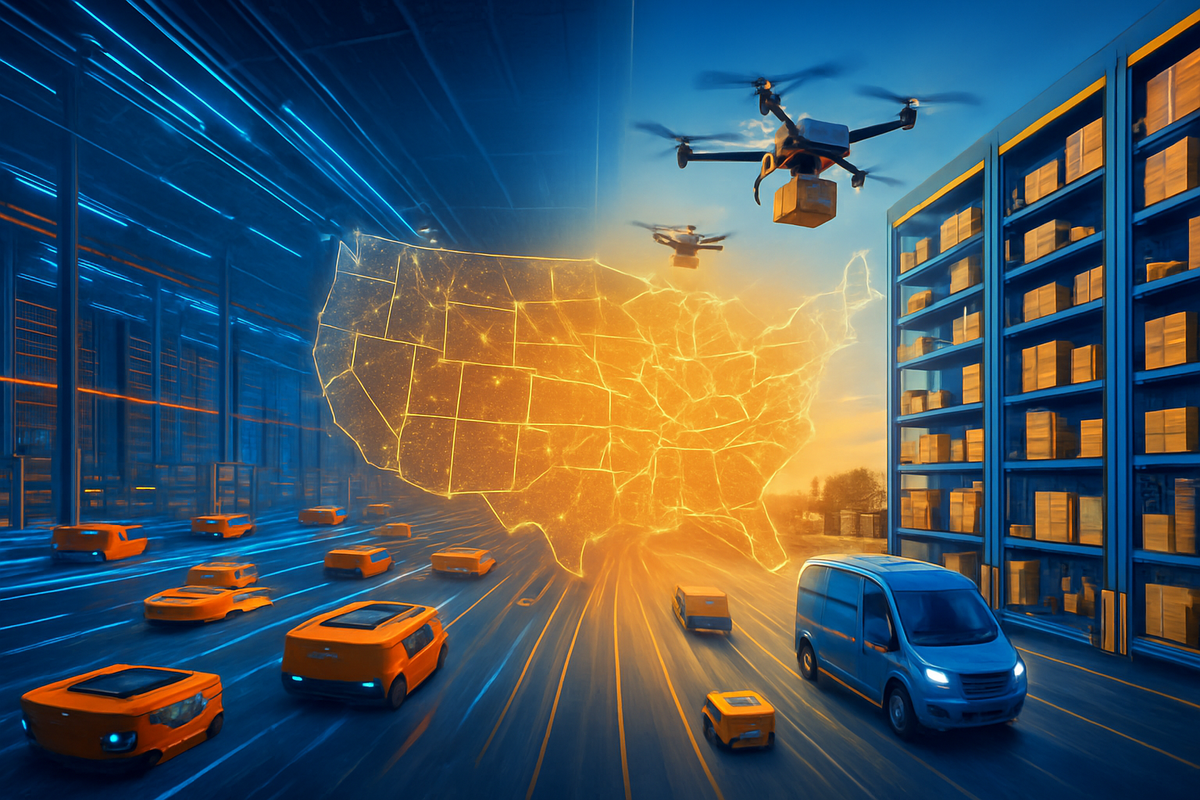
As of March 17, 2026, the long-simmering rivalry between the world’s two largest retailers has reached a fever pitch, evolving from a battle of shelf space into a high-stakes technological arms race defined by "Agentic Commerce." In a landmark announcement this morning, Amazon.com Inc. (NASDAQ: AMZN) unveiled the nationwide expansion of its one-hour delivery service, a move that leverages a complete overhaul of its North American logistics network. Not to be outdone, Walmart Inc. (NYSE: WMT) has countered by accelerating the rollout of its automated micro-fulfillment centers, signaling that the "last mile" of retail has officially become a "last minute" sprint.
The implications for the broader market are profound. This shift toward hyper-regionalization and machine-learning-driven inventory placement is no longer just about convenience; it is a fundamental restructuring of the global supply chain. By utilizing predictive AI to position goods before a consumer even considers a purchase, these retail giants are effectively eliminating the traditional wait times that once defined e-commerce, forcing every other player in the sector to adapt or face obsolescence.
The Dawn of Regionalization 2.0 and the Automation Milestone
The current state of play is the result of a multi-year pivot toward what industry analysts call "Regionalization 2.0." For Amazon, this has meant abandoning its legacy national "hub-and-spoke" model in favor of eight interconnected regional clusters. This machine-learning-driven restructuring ensures that 80% of orders are fulfilled within the same region they are placed, a feat that allowed the company to deliver over 13 billion items on a same-day or next-day basis throughout 2025. The centerpiece of today's announcement is the "One-Day Center" (1DC) layer—a specialized tier of micro-fulfillment sites that use agentic AI to "pull" high-velocity inventory into residential zones, enabling the new one-hour delivery standard for over 90,000 essential products.
Walmart has taken a different but equally aggressive path, leveraging its massive physical footprint of 4,700 U.S. stores. By March 2026, Walmart has successfully retrofitted 23 of its 42 regional distribution centers with AI-powered robotics from Symbotic Inc. (NASDAQ: SYM). Furthermore, the retail giant has deployed 400 "Accelerated Pickup and Delivery" (APD) centers—automated mini-warehouses tucked into the backrooms of existing stores. These systems can pick and pack a complex grocery order in under ten minutes, allowing Walmart to maintain its dominance in the perishables sector while matching Amazon’s blistering fulfillment speeds.
The market's reaction to these developments has been one of cautious optimism tempered by the sheer scale of the required capital expenditure. While Amazon’s retail unit has transitioned back into a high-margin profit driver thanks to these efficiency gains, the billions spent on "Project P.I."—a computer vision system that identifies damaged goods before they ship—represent a massive bet on AI’s ability to reduce return rates and logistical friction. Walmart, meanwhile, is aiming for 65% of its stores to be served by automated fulfillment by the end of 2026, targeting a 20% reduction in unit-level fulfillment costs.
Identifying the Victors and the Vanquished in the AI Sprint
In this new landscape, Amazon and Walmart appear to be pulling away from the pack, creating a "Readiness Gap" that threatens mid-tier retailers. Amazon’s decision to turn its internal logistics into a "Logistics-as-a-Service" (MCF) model has allowed it to begin competing directly with traditional carriers, fulfilling orders for independent brands and Shopify-based businesses. This move positions Amazon not just as a retailer, but as the underlying infrastructure of the modern economy, potentially siphoning volume away from legacy shipping giants.
Walmart’s strategic advantage remains its physical proximity to the American consumer, with 90% of the population living within 10 miles of a store. This has made its Walmart+ membership an increasingly formidable competitor to Amazon Prime, especially as the company integrates its "Self-Healing Inventory" AI. This system autonomously reroutes overstocked items to stores with higher real-time demand, a capability that has already saved the company an estimated $55 million in pilot programs. For Symbotic, the partnership with Walmart has served as a massive proof-of-concept, skyrocketing the company’s valuation as other global retailers scramble to license its Gen-2 robotics platform.
Conversely, the pressure on third-party delivery platforms like DoorDash Inc. (NASDAQ: DASH) and Instacart (NASDAQ: CART) is mounting. As Amazon expands its Fresh perishable delivery to over 2,300 cities and Walmart perfects its in-store automation, the "convenience moat" previously held by these gig-economy apps is evaporating. Traditional department stores and smaller grocery chains are also at risk; without the capital to invest in similar AI-driven robotics, they may find themselves relegated to "slow-lane" retail, unable to compete with the sub-two-hour delivery windows that are becoming the new baseline for consumer expectations.
Broader Industry Trends and the Regulatory Horizon
The race between Amazon and Walmart fits into a larger global trend toward "Agentic AI"—systems that move beyond simple data analysis to autonomous decision-making. In the warehouses of 2026, AI "Copilots" now manage vendor disputes and coordinate floor workers without human intervention. This mirrors a broader shift in the tech industry where generative AI is being integrated into the physical world (the "Phygital" frontier), bridging the gap between digital prediction and physical execution.
However, this rapid automation has not gone unnoticed by regulators. The U.S. Department of Labor and various state-level agencies are increasingly scrutinizing the impact of AI-driven logistics on the workforce. While both companies claim their tech is "people-led," the shift toward automated fulfillment centers (AFCs) raises questions about the long-term viability of traditional warehouse roles. Furthermore, the sheer dominance of the Amazon-Walmart duopoly in the logistics space has sparked renewed antitrust discussions regarding "Logistics-as-a-Service" and whether these companies act as gatekeepers to the digital economy.
Historically, this era resembles the railroad booms of the 19th century, where a few dominant players controlled the infrastructure required for all other commerce to function. The difference today is the speed of iteration. Where the railroads took decades to consolidate, the AI-driven logistics race has fundamentally altered the American retail landscape in less than five years, creating a ripple effect that is forcing even competitors like Target Corp. (NYSE: TGT) to commit upwards of $2 billion in incremental tech spending just to stay in the conversation.
The Road Ahead: Drones, Drifting, and Direct-to-Consumer
Looking toward the remainder of 2026 and into 2027, the next frontier appears to be the full integration of autonomous last-mile delivery. Amazon is expected to further scale its "Prime Air" drone fleet, moving from experimental pockets into mainstream suburban markets to support its one-hour delivery promise. Walmart, having already established a lead in drone delivery through its partnerships with Zipline and Wing, is likely to focus on "Multi-Modal" fulfillment—using a mix of drones, autonomous vans, and store-based robots to optimize for the lowest possible cost per delivery.
A potential strategic pivot for both companies may involve "Anticipatory Shipping" at scale. This involves moving goods not just to a regional warehouse, but to a mobile delivery vehicle that "drifts" in high-demand neighborhoods before orders are even placed. Such a move would require even more sophisticated machine learning models but could potentially bring delivery times down to fifteen minutes or less. The challenge will be balancing this extreme speed with the rising costs of energy and the environmental impact of a constant delivery presence in residential areas.
A Final Assessment of the Logistics Landscape
The battle for logistical supremacy in 2026 has proven that AI is no longer a peripheral tool for retail; it is the core engine of growth. Amazon’s "Regionalization 2.0" and Walmart’s "Tech-Powered" store strategy have successfully redefined consumer expectations, making ultra-fast delivery a utility rather than a luxury. For investors, the key takeaway is the widening chasm between the "AI-Haves" and the "AI-Have-Nots." The ability to turn logistics from a cost center into a high-margin service provider (as Amazon has done with MCF) will likely be the defining characteristic of the decade's successful retail stocks.
Moving forward, the market should keep a close watch on the "unit-level fulfillment cost" metrics in the upcoming Q2 and Q3 earnings reports. If Walmart can successfully hit its 65% automation goal by year-end, the resulting margin expansion could provide a significant catalyst for its stock price. Similarly, if Amazon’s 1-hour delivery expansion leads to a measurable increase in Prime churn reduction, it will justify the massive capital outlays of the past two years. In the world of 2026, the winner isn't just the one who sells the most—it's the one who moves it the fastest and smartest.
This content is intended for informational purposes only and is not financial advice