

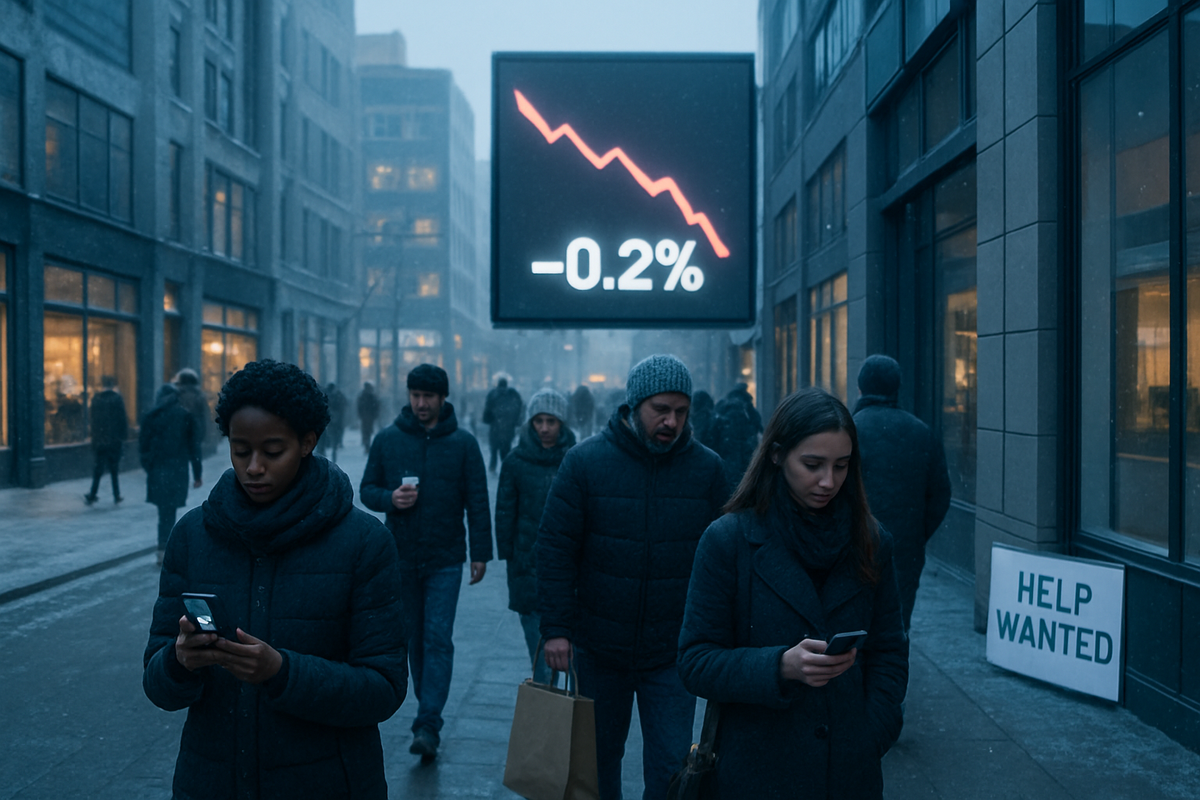
The American consumer, long the undisputed engine of the global economy, showed signs of a tactical retreat in early 2026. Fresh data released in the wake of a prolonged federal "data fog" reveals that retail sales fell by 0.2% in January, a contraction that has sparked intense debate among economists and Wall Street analysts. While the headline figure suggests a waning appetite for spending, the underlying reality is a complex tapestry of severe winter weather, a "frozen" labor market, and a significant fiscal cushion provided by recent legislative shifts.
This marginal decline marks a pivot point for the U.S. economy, which is currently navigating a delicate transition from the post-pandemic boom to a more restrained, value-conscious era. As the labor market shifts into a "low-hire, low-fire" state, the resilience of household balance sheets is being tested by sticky inflation and the end of the rapid wage gains that defined the previous three years.
The Data Behind the Dip: Weather, Gas, and the "Data Fog"
The road to the January sales report was anything but standard. Due to a 43-day federal government shutdown that paralyzed agencies in late 2025 and early 2026, official Commerce Department data was delayed until March 6, 2026. When the numbers finally hit the tape, they confirmed a 0.2% month-over-month decline in total retail sales. Much of this weakness was concentrated in the automotive and energy sectors; motor vehicle and parts sales slumped by 0.9%, while gasoline station receipts tumbled 2.9%, partly due to a temporary dip in global crude prices and restricted travel during several severe January blizzards.
However, a closer look at the "control group" sales—a metric that excludes volatile items like autos and gas and is used to calculate GDP—painted a slightly more optimistic picture, rising 0.3%. Furthermore, the CNBC/NRF Retail Monitor, which tracks real-time credit card transactions, suggested that while physical storefronts suffered from the cold, digital commerce thrived. Non-store retailers, led by the e-commerce giants, saw a robust 1.9% increase in January, as homebound consumers shifted their spending to their smartphones.
The labor market context is equally critical. By February, the unemployment rate had ticked up to 4.3%, eventually reaching 4.4% by early March. This "softer" job market is characterized by a "frozen" equilibrium: companies are hesitant to conduct mass layoffs, but they have also slammed the brakes on new hiring. Wage growth has similarly cooled to an annual rate of 3.8%, a "meaningful deceleration" from the peaks of 2024-2025, leaving consumers with less "found money" than they enjoyed in the previous cycle.
Retail Bifurcation: The Rise of the $1 Trillion Fortress
The current economic climate has created a stark divide between retailers who provide essential value and those catering to discretionary "middle-class" luxuries. Walmart Inc. (NYSE: WMT) has emerged as the clear victor of this transition. In February 2026, Walmart’s market capitalization crossed the historic $1 trillion threshold, driven by its dominance in the grocery sector and a significant influx of high-income households—those earning over $100,000—who are increasingly "trading down" to save on household staples. Under CEO John Furner, Walmart has successfully rebranded its value proposition, making it a defensive fortress in a cooling economy.
Conversely, Target Corporation (NYSE: TGT) continues to struggle with its "cheap chic" identity. As consumers prioritize essentials over discretionary home decor and apparel, Target's margins have faced immense pressure. New CEO Michael Fiddelke recently announced a $2 billion strategic pivot to revitalize the brand’s value-tier offerings and enhance its digital fulfillment. The luxury sector is facing even harsher headwinds; Saks Global, the newly formed entity owning Saks Fifth Avenue and Neiman Marcus, recently sought bankruptcy protection, a victim of what analysts call a "price-to-value" imbalance following years of aggressive price hikes.
Meanwhile, Amazon.com, Inc. (NASDAQ: AMZN) has finally surpassed Walmart in annual revenue, cementing its place as the primary beneficiary of the consumer shift toward online marketplaces. Other "value winners" include Costco Wholesale Corporation (NASDAQ: COST) and Grocery Outlet Holding Corp. (NASDAQ: GO), both of which reported strong January traffic as nearly 40% of Americans now identify as "deal-driven" shoppers.
The OBBBA Factor and Macroeconomic Ripple Effects
The unexpected "resilience" seen in the control group sales is largely attributed to the One Big Beautiful Bill Act (OBBBA), a landmark piece of legislation from 2025. Retroactive tax cuts from the OBBBA began flowing into consumer bank accounts in early 2026, resulting in an 11-20% increase in tax refunds. This $55 billion injection in February alone acted as a de facto stimulus package, preventing the January retail dip from turning into a full-scale rout.
However, the broader significance of these numbers points toward a "stagflation-lite" environment. With the Consumer Price Index (CPI) remaining sticky at 2.8% and job growth averaging only 6,000 per month over the last quarter, the Federal Reserve is caught in a vice. The cooling labor market suggests that the aggressive rate hikes of the past have finally bitten, but the OBBBA’s fiscal stimulus may keep inflation higher for longer, complicating any hopes for a significant rate cut in the first half of 2026.
This trend mirrors historical precedents, such as the mid-cycle slowdown of the mid-1990s, where the economy experienced a "soft landing" punctuated by periods of erratic consumer spending. The current "perception gap" is also a factor; while high-income households continue to spend out of wealth effects, lower-income households are feeling the combined pinch of tariff-driven inflation and the depletion of pandemic-era savings.
Looking Ahead: The Q2 Outlook and Strategic Pivots
As we move into the second quarter of 2026, the retail landscape will likely be defined by "loyalty-program warfare." With the consumer pool no longer expanding, Amazon and Walmart are locked in a battle to capture a larger share of a static market through AI-driven personalization and ultra-fast delivery. Investors should expect more retailers to follow Target’s lead, aggressively cutting prices on discretionary goods to clear inventory and entice a hesitant public.
In the short term, the market will be watching the March jobs report and the next round of CPI data with intense scrutiny. If the unemployment rate continues its slow climb toward 4.5%, the "fragile resilience" of the consumer may finally crack. However, the ongoing disbursement of OBBBA-related tax refunds provides a significant "safety net" that could fuel a spring rebound in retail spending, particularly in the travel and services sectors as the weather improves.
The long-term challenge for the market will be adapting to a "zero-growth" labor environment. Companies that cannot find efficiency gains through automation or AI will struggle to maintain margins as the pool of new consumers shrinks and wage growth remains just high enough to keep the Federal Reserve on high alert.
Wrap-Up: Navigating the New Normal of 2026
The 0.2% decline in January retail sales is less a signal of an impending recession and more a symptom of an economy in a state of flux. The American consumer is not "broken," but they have become profoundly discerning. The shift toward value, the rise of digital "fortress" retailers, and the temporary floor provided by the OBBBA stimulus are the defining characteristics of this new economic chapter.
For investors, the key takeaways are clear: the era of "rising tides lifting all boats" in retail is over. Success is now highly concentrated in companies with the scale to offer price leadership (WMT, COST) or the logistical dominance to capture the shift to non-store commerce (AMZN). The labor market's "low-hire, low-fire" state suggests that while a sudden crash is unlikely, the runway for growth has significantly narrowed.
In the coming months, watch for the "wealth effect" among older, asset-rich consumers versus the "tariff pinch" felt by younger, wage-dependent shoppers. This bifurcation will dictate market winners and losers well into the second half of 2026.
This content is intended for informational purposes only and is not financial advice.