

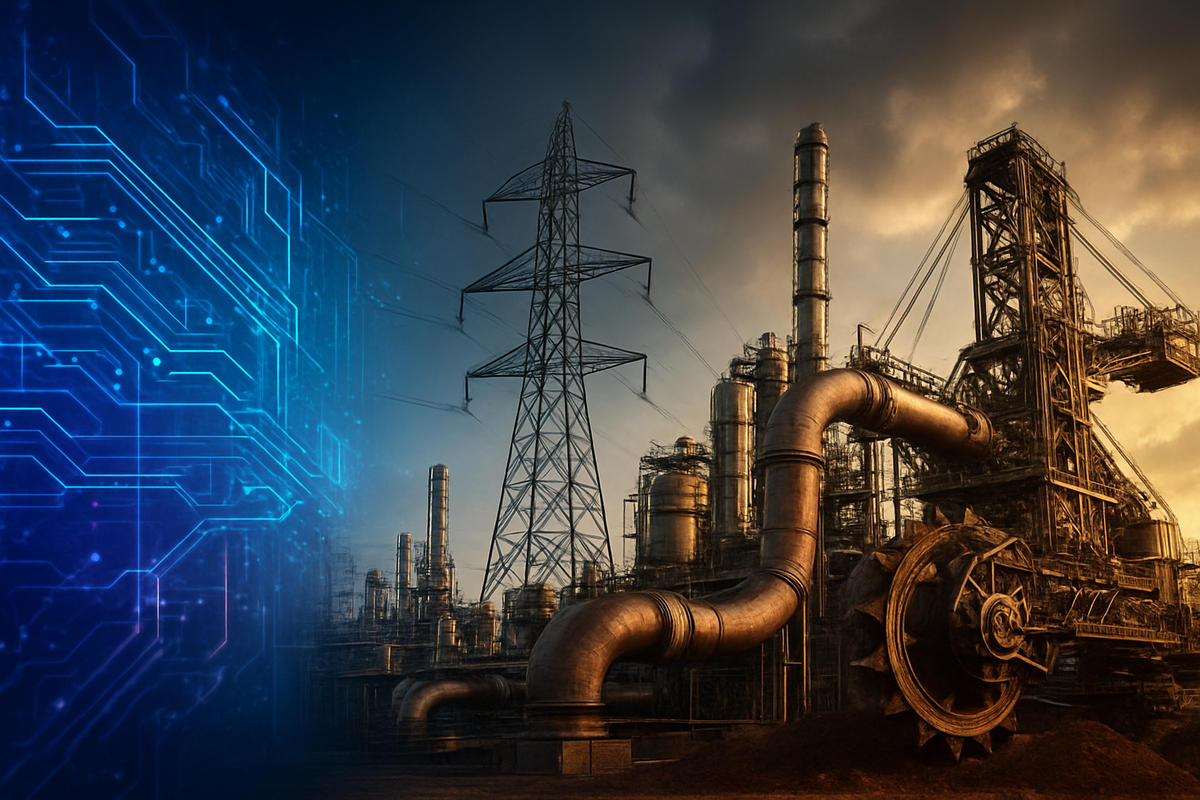
NEW YORK — As of March 11, 2026, a seismic shift is rattling the foundations of Wall Street. For nearly three years, the narrative of the "Magnificent Seven" and the unyielding dominance of artificial intelligence drove the S&P 500 to record heights. But in recent weeks, the market’s "AI mania" has hit a physical wall—quite literally. A massive rotation is underway, as investors dump high-flying software and semiconductor stocks in favor of a new asset class known as "HALO" stocks: Heavy Assets, Low Obsolescence.
The immediate implications are stark. While the tech-heavy Nasdaq has retreated into correction territory, sectors once dismissed as "boring"—Energy, Utilities, and Materials—are seeing record-breaking inflows. This "Atoms over Bits" trade represents more than just a momentary dip; it is a fundamental re-evaluation of what constitutes a "moat" in an era where generative AI can write code in seconds, but cannot build a power plant or mine copper.
The Birth of the HALO Trade and the 'Power Wall'
The term HALO (Heavy Assets, Low Obsolescence) was first popularized in early February 2026 by Josh Brown, CEO of Ritholtz Wealth Management, as a framework for navigating an increasingly volatile market. According to Brown, HALO stocks represent companies with massive, high-barrier physical infrastructure that cannot be replicated by software. By early March, institutional desks at Goldman Sachs (NYSE: GS) and Morgan Stanley (NYSE: MS) had adopted the acronym, signaling a shift in the global investment regime.
The timeline leading to this moment was accelerated by the "Power Wall" crisis of late 2025. While companies like NVIDIA (NASDAQ: NVDA) continued to produce faster and more efficient GPUs, the infrastructure required to support them reached its breaking point. Tech giants discovered that their ambitious AI roadmaps were no longer constrained by chip supply, but by a lack of electricity and grid capacity. This realization led to a cooling of the AI capex enthusiasm, as cloud providers admitted they literally could not find the power to turn on their newest data centers.
Initial market reactions have been dramatic. Since the start of the year, the Energy sector (XLE) has surged 25.3%, while the Materials sector (XLB) followed closely with an 18.1% gain. In contrast, the Software-as-a-Service (SaaS) index has plummeted 17.4%, as the release of advanced "agentic" AI tools—such as the recent suite from Anthropic—led investors to fear that proprietary code is no longer a sustainable competitive advantage.
Winners and Losers: From Silicon Valley to the Copper Mines
The primary beneficiaries of this rotation are companies that own the "physical reality" of the modern economy. ExxonMobil (NYSE: XOM) has emerged as the poster child of the HALO trade, with its stock price jumping 26% year-to-date. As Brent Crude spiked to $118 per barrel following geopolitical tensions in the Middle East, Exxon’s massive refining capacity and reliable dividends became a sanctuary for fleeing tech capital.
Similarly, NextEra Energy (NYSE: NEE) has seen its valuation swell by 24% this year. The utility giant is currently leveraging a massive 30-gigawatt project backlog specifically tailored to meet the surging electricity demands of AI data centers. In the materials space, Freeport-McMoRan (NYSE: FCX) has soared 39% over the last quarter as copper prices hit an all-time high of $6.00 per pound. Analysts note that copper is the essential "blood" of the AI expansion, required for everything from high-density power distribution to cooling systems.
On the losing side of this rotation are the software stalwarts that previously seemed invincible. Microsoft (NASDAQ: MSFT), while still a titan of industry, has seen its stock "fade" as it grapples with a staggering $80 billion backlog for its Azure cloud services—a backlog it cannot clear due to power shortages. Meanwhile, traditional software giants like Salesforce (NYSE: CRM) and IBM (NYSE: IBM) have faced double-digit declines as the market re-rates the value of their software moats in an AI-automated world.
Macro Stagnation and the Geopolitical Catalyst
The broader significance of the HALO trade is deeply intertwined with the return of "stagflation" risks. On February 28, 2026, precision strikes against Iranian manufacturing facilities led to the effective closure of the Strait of Hormuz, causing a global energy shock. This geopolitical crisis sent oil prices skyward at exactly the same time that the U.S. labor market began to cool, with February payrolls showing a surprising loss of 92,000 jobs.
This combination of rising inflation (driven by energy and commodities) and stagnating growth (driven by high interest rates and labor cooling) has created a classic stagflationary environment. In such a climate, "growth at any price" tech stocks typically underperform, while companies with tangible, inflation-protected assets thrive. The HALO framework provides investors with a "macro hedge," prioritizing essential services that people and businesses cannot do without, regardless of the economic climate.
Historically, this rotation mirrors the "Nifty Fifty" collapse of the 1970s or the post-dot-com bubble shift of the early 2000s, where investors abandoned speculative growth for value-oriented cyclicals. However, the 2026 version is unique because the "old economy" companies are actually the essential enablers of the "new economy’s" AI ambitions.
The Path Forward: Atoms, Bits, and the Barbell Strategy
In the short term, market analysts expect the HALO trade to intensify as the "Power Wall" remains the primary bottleneck for technological advancement. For tech giants to regain their footing, a massive strategic pivot toward energy independence will be required. We are already seeing the first signs of this, as major tech companies begin exploring direct investments in modular nuclear reactors and private grid infrastructure.
Long-term, the market may settle into what many are calling a "Barbell Strategy." In this scenario, investors will maintain high-conviction positions in the core infrastructure of AI—like NVIDIA (NASDAQ: NVDA)—on one end, while heavily weighting their portfolios with HALO stocks like ExxonMobil (NYSE: XOM) and NextEra Energy (NYSE: NEE) on the other. This strategy aims to capture the upside of AI innovation while protecting against the risks of software obsolescence and stagflationary shocks.
The challenge for the coming months will be the potential for "commodity overreach." If prices for copper and oil rise too fast, they could stifle the very AI revolution they are currently fueling, creating a feedback loop of slowing growth and rising costs that would test even the most resilient HALO portfolios.
Final Assessment: A Lasting Structural Change
The rotation into HALO stocks marks a definitive end to the "asset-light" era that dominated the 2010s and early 2020s. The market has sent a clear message: in a world of infinite digital content and automated code, the things that are hard to move, hard to build, and impossible to replace are the true stores of value.
Moving forward, investors should watch for a potential "stabilization" of energy prices and the progress of the U.S. labor market. If inflation begins to retreat without a deep recession, the tech sector may see a selective recovery. However, the days of tech being the only game in town are likely over. The "HALO" around materials, energy, and utilities is likely to shine bright well into the second half of the decade.
The key takeaway is simple: the "atoms" have struck back, and the physical constraints of the world have once again become the defining factor for investment success.
This content is intended for informational purposes only and is not financial advice.