
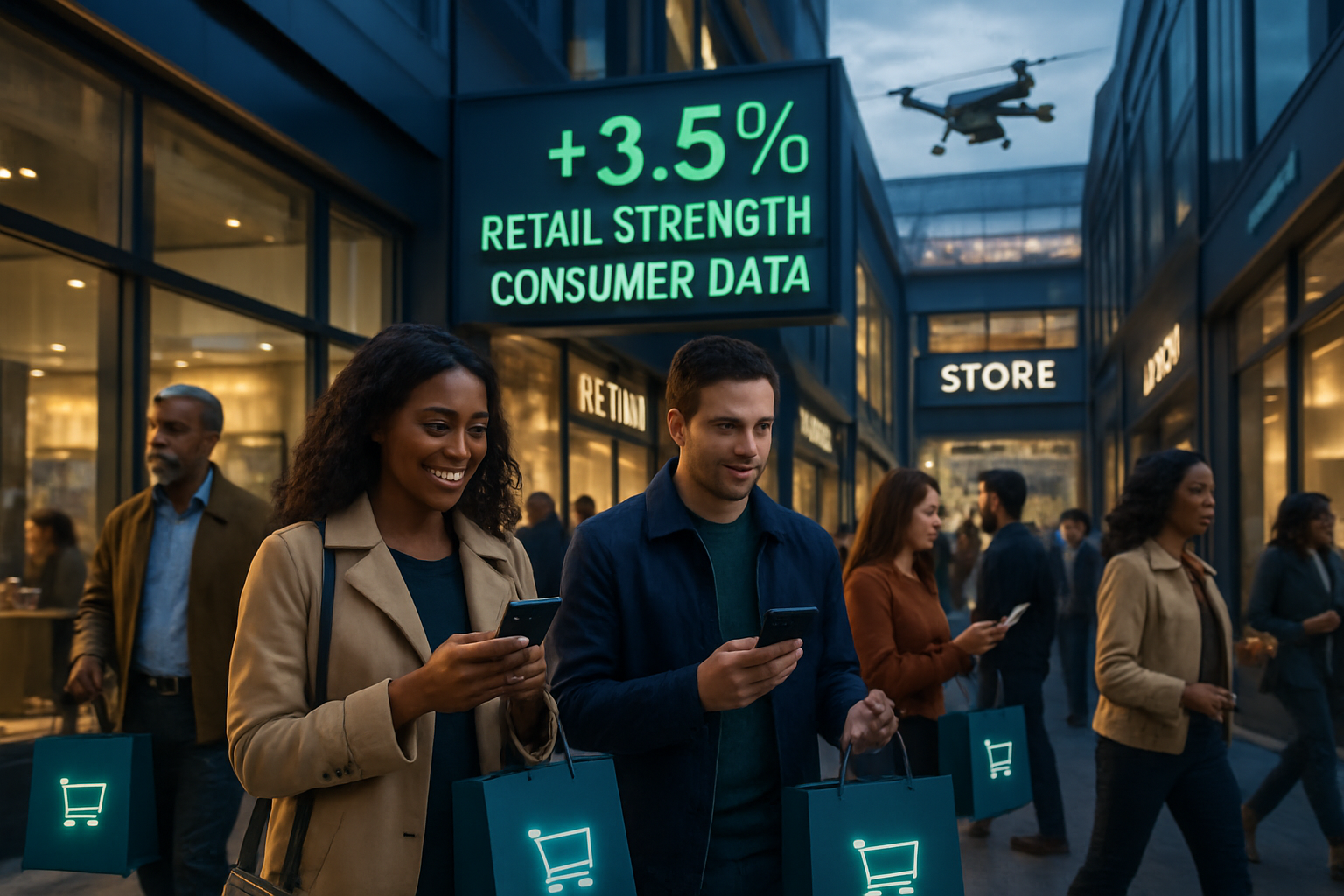
Despite a winter defined by the lingering shadows of a historic government shutdown, persistent tariff-induced inflation, and a cooling labor market, the American consumer has once again emerged as the primary engine of economic growth. New data from early 2026 confirms that retail spending has risen by a robust 3.5% year-over-year, a figure that has caught many Wall Street analysts by surprise given the formidable macroeconomic headwinds.
This unexpected surge in spending is providing a critical lifeline to the retail sector and the broader U.S. economy, which struggled through a stagnant fourth quarter in 2025. While consumer sentiment remains cautious, the "mechanical rebound" from federal backpay and the initial impact of recent tax adjustments under the "One Big Beautiful Bill Act" have injected much-needed liquidity into household budgets, signaling that the U.S. consumer is far from tapped out.
A Resilient Rebound Amidst "Stagflation-Lite"
The narrative of the early 2026 economy is one of defiance. According to the Bain & Company 2026 Global Retail Sales Outlook released on January 26, 2026, U.S. retail sales are on track to reach a record $5.3 trillion this year. This 3.5% growth rate is particularly significant when viewed against the backdrop of the 43-day government shutdown that ended late last year, which had dragged Q4 2025 GDP down to a meager 1.4%. The current spending spree represents a "catch-up" effect as federal employees receive backpay and tax refunds begin to circulate.
The timeline of this resilience began in late January, when the New York Federal Reserve's Survey of Consumer Expectations showed median expected spending growth rising to 3.4%. Shortly thereafter, Treasury Secretary Scott Bessent bolstered market confidence by projecting a full-year GDP growth of 3.5%, citing a "bullish" recovery fueled by domestic productivity gains. However, this growth isn't coming easily; consumers are navigating a "stagflation-lite" environment where inflation for essentials like food (up 5.4%) and medical care (up 5.3%) continues to outpace the Federal Reserve's 2% target.
Market reactions have been cautiously optimistic. While the Federal Reserve, currently led by a "wait-and-see" philosophy, has kept the federal funds rate steady at approximately 4.3%–4.6%, the strength in spending has reduced the immediate pressure for emergency rate cuts. Analysts at S&P Global (NYSE: SPGI) and Goldman Sachs (NYSE: GS) have noted that while the labor market is softening—with unemployment edging toward 4.5%—the consumer's willingness to spend is preventing a more severe economic contraction.
Winners and Losers in the "Flight to Value"
The 3.5% rise in spending has not been distributed equally across the retail landscape. We are witnessing a decisive "flight to value" as households pivot toward private-label brands and discount retailers to preserve their purchasing power. Walmart (NYSE: WMT) has emerged as a primary beneficiary of this trend, reporting strong early-quarter traffic as middle-income families increasingly turn to its grocery and essentials aisles. Similarly, Costco (NASDAQ: COST) continues to see high member retention and bulk-buy volume, acting as a defensive hedge for consumers against lingering tariff-related price hikes.
On the digital front, Amazon (NASDAQ: AMZN) remains a dominant force, leveraging its AI-driven logistics to maintain competitive pricing despite increased shipping costs. Amazon's ability to offer "value" through its Prime ecosystem has allowed it to capture a significant share of the early 2026 spending surge. Conversely, mid-tier department stores and specialty retailers that lack a strong value proposition are finding the environment increasingly difficult, as discretionary dollars are being diverted toward high-cost essentials and discount giants.
The "losers" in this climate are largely companies with high debt loads or those tethered to luxury markets that are seeing a cooling effect. With interest rates expected to remain above 4% until at least the second half of 2026, retailers that rely on consumer credit for big-ticket items—such as high-end furniture or electronics—are seeing slower turnover. Target (NYSE: TGT), while resilient, has had to lean heavily into its "Dealworthy" private-label line to compete with the sheer scale of Walmart's price cuts, illustrating the intense pressure on margins across the sector.
The Broader Significance: AI Productivity and Policy Shifts
This resilience fits into a broader industry trend where technology is offsetting labor market weakness. The "jobless growth" phenomenon of early 2026, where GDP rises despite lackluster hiring, is largely attributed to massive AI-driven productivity gains within the retail and logistics sectors. Companies are doing more with less, which has helped keep corporate earnings stable even as the unemployment rate ticks higher. This sets a new precedent for how the U.S. economy can function during a period of high rates and structural shifts.
The ripple effects of the consumer's strength are also being felt in the regulatory sphere. The "One Big Beautiful Bill Act," which provided the tax cuts supporting current spending, is now under intense scrutiny as lawmakers debate its long-term impact on the federal deficit. Furthermore, the Supreme Court's early 2026 decision to strike down certain import tariffs has provided a psychological boost to markets, even if the "sticker shock" of previous trade policies still lingers on store shelves.
Historically, this period draws comparisons to the post-inflationary era of the early 1980s, but with a modern twist. While the 1980s saw a sharp pivot in monetary policy to break inflation, the 2026 consumer is benefiting from a more gradual "normalization" of interest rates. The ability of the market to sustain a 3.5% spending increase in a high-rate environment suggests that the structural demand for goods and services in the U.S. is more durable than previously estimated by traditional economic models.
The Road Ahead: Strategic Pivots and Scenarios
In the short term, the retail sector must adapt to a consumer that is "spending but stressed." Retailers will likely continue to pivot their strategies toward aggressive loyalty programs and private-label expansion. The next six months will be a critical testing ground for whether the 3.5% spending growth can be sustained once the "mechanical" boost from government backpay and tax refunds fades. If inflation continues to hover near 3%, the Federal Reserve may be forced to hold rates higher for longer, potentially testing the limits of consumer endurance by late 2026.
Long-term, the market is watching for a potential "soft landing" that transitions into a more robust growth phase in 2027. If the Fed begins its projected rate cuts in September 2026, bringing the target range down toward 3.0%, we could see a resurgence in discretionary spending and a recovery in the housing market. However, the risk of a "consumption cliff" remains if the labor market softens too quickly, turning the current "low-hire" environment into a "high-fire" scenario.
Closing Thoughts for Investors
The early 2026 economic landscape is a testament to the enduring power of the American consumer. Despite the headwinds of inflation, high rates, and political volatility, the 3.5% rise in spending has provided a necessary cushion for the markets. Investors should view this as a period of consolidation where "value" and "efficiency" are the watchwords. The strength of the consumer has effectively moved the goalposts for a potential recession, pushing the timeline of any significant downturn further into the future.
As we move through the first half of 2026, investors should keep a close eye on upcoming PCE inflation data and the Federal Reserve's June meeting. Any signs of inflation dipping toward the 2.5% mark could trigger a market rally in anticipation of late-year rate cuts. For now, the "flight to value" remains the safest play, with mega-cap retailers like Walmart and Amazon leading the charge in a market that refuses to quit.
This content is intended for informational purposes only and is not financial advice.