
The Walt Disney Company (NYSE: DIS) finds itself in a paradoxical position following its February 2026 fiscal first-quarter earnings report. Despite posting revenue and earnings that exceeded analyst consensus, the entertainment giant saw its shares plummet by over 7% in a single trading session, wiping out billions in market capitalization. The disconnect between a "beat" on paper and a "slump" in the market highlights a shift in investor sentiment: in 2026, simply meeting financial targets is no longer sufficient for legacy media titans facing a high-expectation, high-cost environment.
This market reaction serves as a sobering reminder of the challenges inherent in Disney’s massive transition from a traditional linear broadcaster to a tech-integrated, experience-first global powerhouse. While the company’s parks and cruises are generating record-breaking revenue, the sheer capital intensity required to maintain that growth—coupled with a "stalling" short-term outlook—has left investors questioning the efficiency of Disney’s multi-front strategy.
The Disconnect: Record Revenue vs. Reality Check
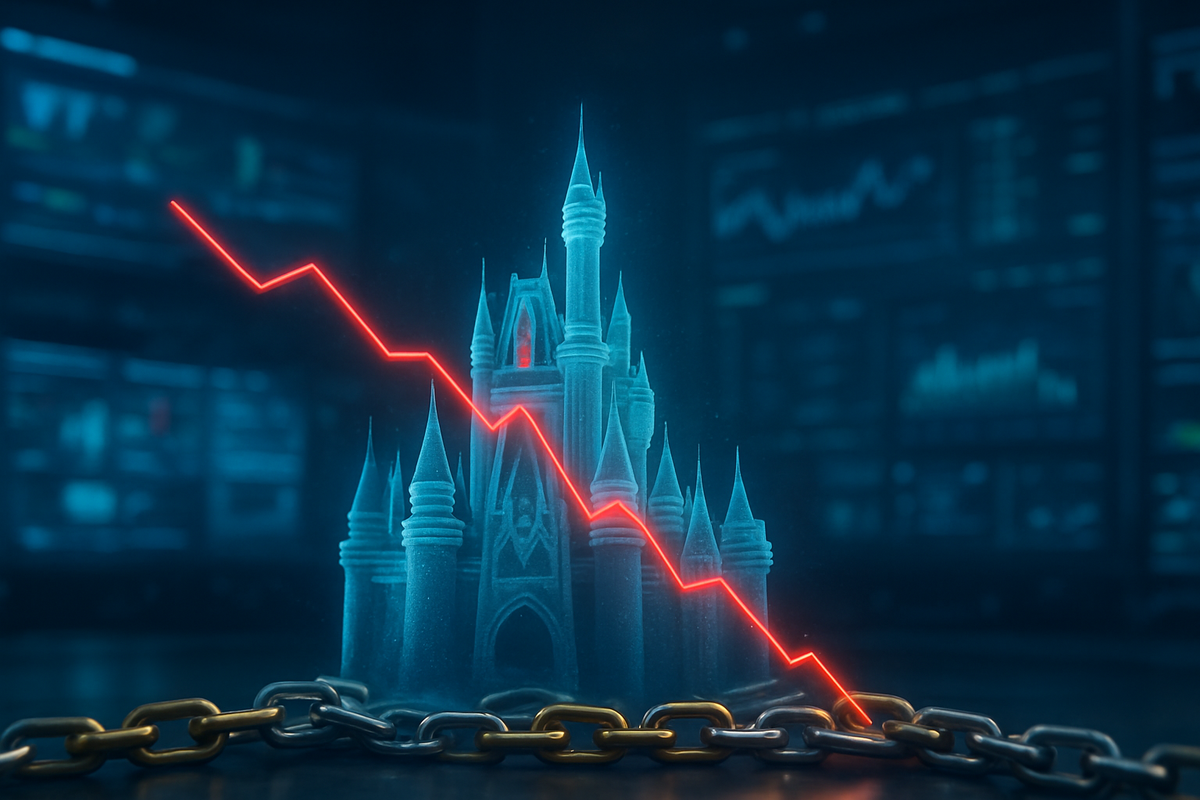
On February 2, 2026, Disney reported a top-line revenue of $25.98 billion, a 5% increase year-over-year and comfortably ahead of the $25.74 billion expected by Wall Street. Adjusted earnings per share (EPS) of $1.63 also outperformed the $1.57 forecast. However, the optimism stopped there. The stock, which had entered the day with momentum, collapsed as investors dug into the details. By the closing bell, DIS shares had dropped 7.4%, settling near $103.12—the sharpest single-day decline for the company in nearly a year.
The primary culprit for the sell-off was management's cautious guidance for the remainder of the fiscal year. CFOs and analysts pointed to a projected "stall" in growth for the upcoming second quarter, with the company admitting that much of its fiscal 2026 gains would be "back-end weighted" toward the summer and autumn months. Furthermore, this was the first quarter in which Disney ceased reporting specific subscriber counts for Disney+ and Hulu, a move that many investors interpreted as a sign that the era of rapid streaming growth has officially peaked. Instead, Disney chose to focus on a $450 million operating profit in streaming, which, while impressive, was overshadowed by a staggering $2.28 billion negative free cash flow due to heavy capital expenditures.
The quarter was also marred by the financial hangover of a 15-day carriage dispute with YouTube TV, owned by Alphabet Inc. (Nasdaq:GOOGL), in late 2025. This blackout reportedly cost Disney's sports segment—led by ESPN—roughly $110 million in operating income. Additionally, the lack of a definitive succession plan for CEO Bob Iger, despite rumors swirling around Experiences Chairman Josh D'Amaro, created a "wait-and-see" vacuum that nervous investors were quick to fill with sell orders.
Winners and Losers in the Media Landscape
While Disney grapples with its internal transitions, the broader media landscape is being reshaped by the fallout of its earnings report. The clear "winners" in this environment appear to be tech-native platforms like Netflix (Nasdaq:NFLX), which continues to benefit from a leaner overhead structure and a more established, globalized streaming footprint. As Disney pours billions into physical infrastructure like new cruise ships and park expansions, Netflix remains focused on content and algorithmic efficiency, a strategy that currently commands a higher valuation multiple from the market.
Conversely, "losers" include other legacy media peers like Warner Bros. Discovery (Nasdaq:WBD) and Paramount Global (Nasdaq:PARA). Disney’s struggle to impress the market despite a "beat" suggests that the bar for the entire sector has been raised significantly. If Disney, with its unmatched IP and world-class theme parks, cannot maintain a premium valuation amid high CapEx, the pressure on smaller, more debt-laden rivals like WBD—which is currently the subject of intense consolidation rumors—will only intensify. These companies may find it increasingly difficult to convince investors of their long-term viability without the massive physical "moat" that Disney possesses.
The Experience and IP division (Parks and Cruises) remains Disney's crown jewel, surpassing $10 billion in quarterly revenue for the first time. However, this success is a double-edged sword. To sustain this "Experiences" engine, Disney must continue to reinvest billions. For investors, the concern is that Disney is becoming a "low-margin, high-CapEx" utility company rather than the high-growth "Magic Kingdom" of decades past.
The Broader Shift: Beyond Content Libraries
The reaction to Disney's February 2026 report reflects a fundamental shift in how the market values media companies. We have entered the "Consolidation Endgame," where the mere possession of a content library is no longer a competitive advantage. The industry is pivoting toward "Experience and IP" businesses, where the value of a movie or TV show is measured by how well it translates into a physical theme park attraction, a cruise ship theme, or a persistent digital world.
This trend is further complicated by the rapid integration of Generative AI. Disney’s recent forays into using technologies like OpenAI’s Sora for short-form content creation illustrate a desperate need to lower production costs and compete with the "creator economy." However, this R&D spend adds to the short-term financial drain. Historically, when a dominant market player like Disney shifts its focus from growth (subscriber counts) to efficiency and cash flow, it signals the maturation of an industry. We saw similar transitions in the telecommunications and utility sectors in previous decades; now, "Big Media" is undergoing its own maturity crisis.
Furthermore, the YouTube TV dispute highlights the ongoing fragility of the linear television model. Even as Disney shifts toward streaming and parks, it remains tethered to the decaying revenue of cable bundles. This "linear decay" continues to act as an anchor, offsetting the gains made in newer, more dynamic divisions.
The Path Forward: Strategic Pivots and Succession
The coming months will be critical for Disney as it seeks to stabilize its share price and regain investor trust. Short-term, the company must prove that its "back-end weighted" growth projections are realistic. This will require blockbuster performance from its summer 2026 theatrical slate and a flawless launch of its newest cruise ship assets. If the second-quarter results show the "stalling" that management warned about, the stock could see further downward pressure.
Long-term, the single most important catalyst for Disney will be the formal announcement of a successor to Bob Iger. Until a new leader is named—presumably one with a deep background in the high-performing "Experiences" segment—the stock is likely to remain range-bound. Investors are looking for a visionary who can marry Disney’s creative legacy with the harsh fiscal realities of a post-streaming-growth world. Strategic pivots may also include more aggressive divestitures of non-core linear assets or a further deepening of the "Triple Play" bundle (Disney+, Hulu, ESPN+) to combat churn.
Market Wrap-Up: What to Watch
Disney's February 2026 earnings report is a classic "good news, bad reaction" story. The key takeaways for investors are clear: revenue beats are secondary to free cash flow and forward guidance. As of late February 2026, the market is signaling that it is no longer willing to fund Disney’s massive expansion projects without seeing a more immediate return on investment.
Moving forward, the market will be hyper-focused on three things: the official CEO succession timeline, the stabilization of free cash flow in the second half of 2026, and any further updates on the "Consolidation Endgame" involving Disney's peers. For investors, the "House of Mouse" remains a formidable fortress, but its walls are becoming increasingly expensive to maintain.
This content is intended for informational purposes only and is not financial advice.