
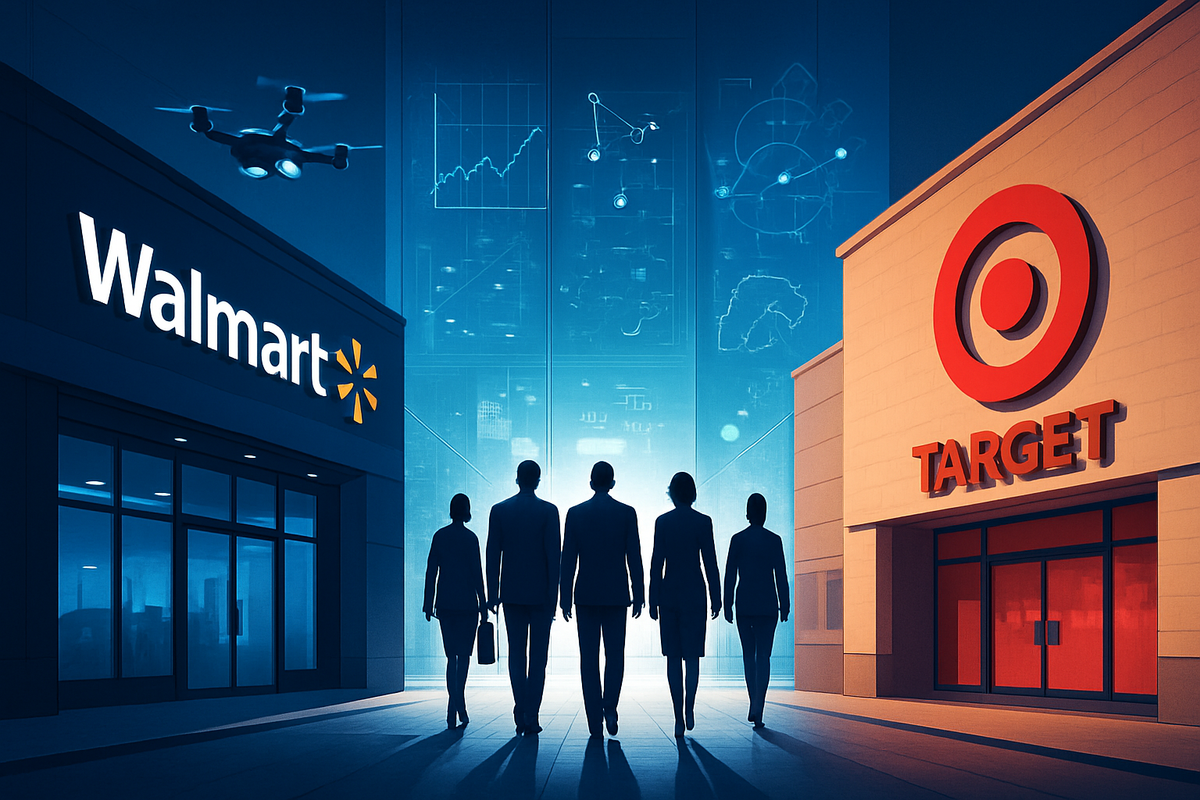
The American retail landscape reached a historic turning point this month as the nation’s two largest general merchandise retailers transitioned to new leadership. On February 1, 2026, Walmart (NYSE: WMT) and Target (NYSE: TGT) officially debuted their new Chief Executive Officers, marking the end of the decade-long tenures of Doug McMillon and Brian Cornell, respectively. These transitions come at a critical juncture for the consumer staples sector, as retailers grapple with a "K-shaped" economy and the rapid integration of artificial intelligence into the shopping experience.
While both companies have opted for internal successors to ensure continuity, the market’s initial reaction has highlighted a widening performance gap between the two giants. Walmart’s seamless handoff has reinforced investor confidence in its tech-forward trajectory, while Target’s new leadership faces immediate pressure to reverse a two-year slump in discretionary sales. As of late February 2026, the industry is closely watching how these two leaders will navigate a retail environment defined by "agentic" AI and a permanent consumer shift toward value-oriented shopping.
The Handover: A Tale of Two Successions
The leadership changes were the culmination of multi-year succession plans. At Walmart (NYSE: WMT), John Furner took the reins from Doug McMillon, who retired after 12 years as CEO and over four decades with the company. Furner, previously the CEO of Walmart U.S., is a quintessential "homegrown" talent, having started his career as an hourly associate. His appointment is seen as a vote of confidence in the strategy he helped build alongside McMillon—one that transformed Walmart from a traditional brick-and-mortar retailer into an omnichannel powerhouse. Under Furner, the focus has shifted toward "agentic retail," where AI-driven agents manage household inventory and automate purchases for consumers.
In contrast, the transition at Target (NYSE: TGT) felt more like a rescue mission. Michael Fiddelke, the former COO and CFO, succeeded Brian Cornell on February 1. While Cornell is credited with Target’s massive growth during the late 2010s and the pandemic era, the last two years were marred by inventory miscalculations and a decline in foot traffic. Fiddelke’s appointment was designed to leverage his operational expertise to streamline a bloated supply chain. However, the market reaction was lukewarm; Target’s stock saw a 4% dip in early February as some analysts expressed disappointment that the board did not look for an external "disruptor" to reignite the brand’s merchandising "swagger."
Winners, Losers, and the Battle for the "Value" Consumer
The immediate winner in this leadership shuffle appears to be Walmart. By promoting Furner, Walmart has signaled to the market that its high-margin revenue streams—specifically its retail media network, Walmart Connect, and its data integration with Vizio (NYSE: VZIO)—will remain top priorities. Analysts at major firms have maintained "Outperform" ratings on WMT, citing the company’s ability to capture high-income households who are increasingly "trading down" to save on essentials. Walmart’s Sam’s Club division, now led by Latriece Watkins, also continues to gain ground on Costco (NASDAQ: COST), further diversifying Walmart’s defensive moat.
Target, meanwhile, finds itself in a precarious "show-me" period. Fiddelke must prove that he can balance the company’s traditional strength in "cheap chic" apparel and home goods with the logistical efficiency required to compete with Amazon (NASDAQ: AMZN). The "loser" in this scenario, at least in the short term, has been the discretionary retail segment. As consumers prioritize groceries and health products—categories where Walmart excels—Target’s reliance on non-essential goods has made it vulnerable. Competitors like Dollar General (NYSE: DG) and Five Below (NASDAQ: FIVE) are also eyeing this transition period as an opportunity to snag price-sensitive shoppers who might feel alienated by Target’s shifting price points.
AI and the Structural Shift in Retail Strategy
The appointment of Furner and Fiddelke reflects a broader industry trend: the move from "E-commerce" to "Agentic Commerce." In early 2026, the conversation has moved past simple online ordering to Generative Engine Optimization (GEO). Both new CEOs are tasked with ensuring their product catalogs are "machine-readable" for the AI shopping agents that now conduct research for roughly 20% of American households. Walmart’s early lead in this space, fueled by its massive investment in proprietary LLMs (Large Language Models), has set a high bar for Fiddelke at Target, who must now accelerate Target's digital infrastructure without sacrificing the brand's aesthetic appeal.
Furthermore, these leadership changes are happening against a backdrop of intensified supply chain "nearshoring." With global trade tensions remaining a persistent threat to margins, both Furner and Fiddelke have prioritized AI-driven supply chain visibility. This mirrors historical precedents like the 2014 leadership shifts during the first major wave of the e-commerce explosion, but the stakes are higher today. The regulatory environment is also tightening, with the FTC closely monitoring how these retail giants use consumer data for targeted advertising, a key growth lever for both companies' "Connect" and "Roundel" media businesses.
The Road Ahead: 2026 and Beyond
In the short term, investors should expect a "honeymoon period" of strategic reviews. John Furner is expected to double down on Walmart’s international expansion, particularly in India and Mexico, while continuing to integrate Sam’s Club’s frictionless checkout technology into the main Walmart fleet. For Walmart, the challenge is not fixing what is broken, but maintaining the velocity of its massive machine. The risk lies in potential "big-box fatigue" if the company becomes too focused on digital services at the expense of the physical store experience.
For Michael Fiddelke at Target, the next 12 to 18 months are about survival and rebranding. He has already hinted at a return to "merchandising authority," suggesting that Target will lean back into exclusive designer collaborations to drive foot traffic. However, the long-term success of his tenure will depend on his ability to modernize Target’s back-end logistics. If Target can achieve Walmart-level efficiency in its "last-mile" delivery while retaining its "Tar-zhay" brand identity, a significant stock recovery could be in the cards by 2027.
Final Assessment: A High-Stakes Changing of the Guard
The February 2026 CEO debuts at Walmart and Target mark the end of the "Post-Pandemic" era and the beginning of the "AI-Integrated" era of retail. Doug McMillon and Brian Cornell left behind massive legacies, but the challenges of the current market—persistent inflation, fragmented consumer loyalty, and the rise of autonomous shopping—require a different set of skills. John Furner’s deep operational roots and Michael Fiddelke’s financial discipline are the tools their respective boards have chosen to navigate these turbulent waters.
Moving forward, the primary metric for investors to watch will be "share of wallet" among the top 20% of earners. As Walmart continues to successfully court more affluent shoppers, Target must find a way to make its discretionary offerings indispensable again. The retail sector remains a barometer for the broader US economy, and the performance of these two leaders over the coming months will provide the clearest signal yet of where the American consumer is headed.
This content is intended for informational purposes only and is not financial advice.