
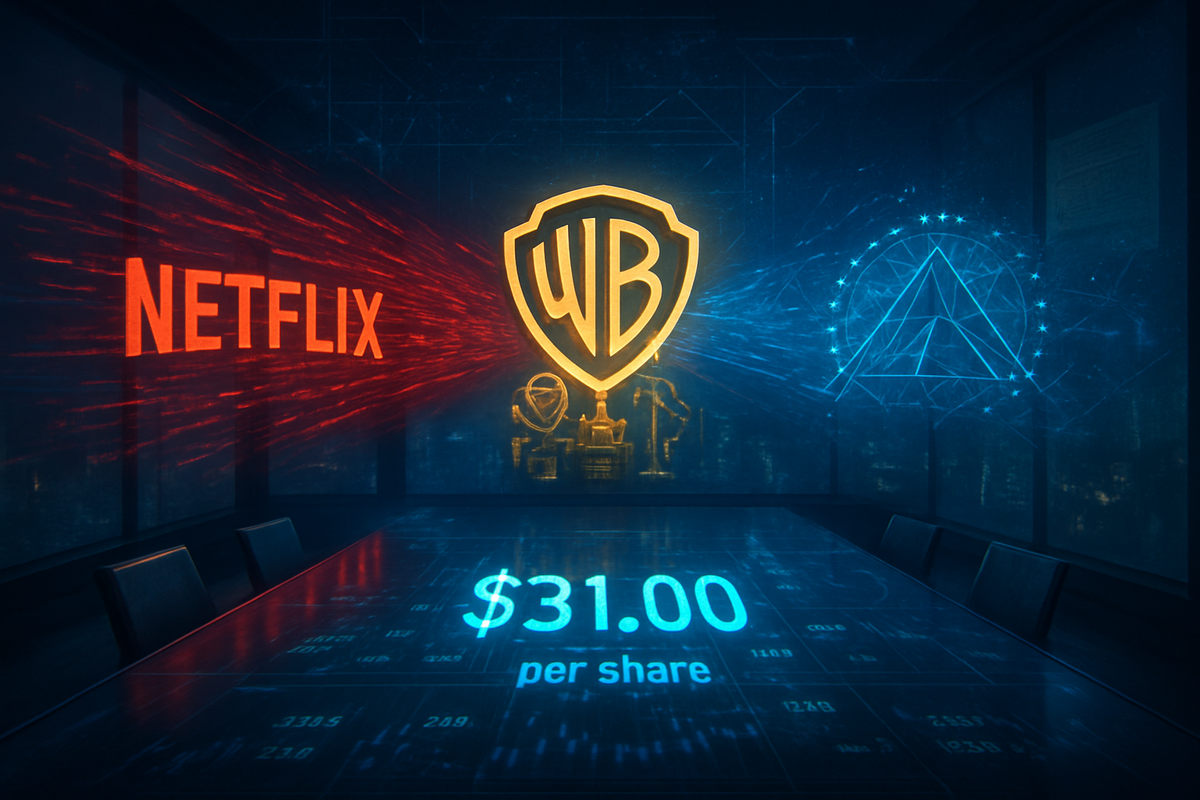
In a move that has sent shockwaves through the global media landscape, Paramount Global (NASDAQ: PARA)—now operating under the aggressive leadership of the Paramount-Skydance merger—has launched a massive, hostile $31 per share all-cash bid to acquire Warner Bros. Discovery (NASDAQ: WBD). The $110.9 billion offer is a direct challenge to a previously negotiated agreement with Netflix (NASDAQ: NFLX), signaling a desperate and high-stakes battle for control over some of Hollywood’s most storied assets, including HBO, CNN, and the DC Universe.
The escalation reached a fever pitch this week as Paramount added a staggering $7 billion regulatory breakup fee to its proposal. This "fortress" of a financial guarantee is designed to neutralize fears of a Department of Justice intervention, effectively betting the future of the Ellison-led Paramount empire on the consolidation of the "Big Three" legacy media players. As of February 25, 2026, the Warner Bros. Discovery board is under intense pressure from shareholders to abandon its "split-and-sell" strategy with Netflix in favor of Paramount’s total-company buyout.
The Path to Hostility: A Timeline of the Media Merger of the Century
The current bidding war is the culmination of a volatile 18-month period that began in late 2024 when Warner Bros. Discovery CEO David Zaslav first floated the idea of a strategic split. By December 2025, WBD had entered a definitive agreement with Netflix to sell its prestigious "Studios and Streaming" division for $27.75 per share. Under that plan, WBD's "Global Linear Networks"—including TNT Sports and HGTV—were to be spun off into a debt-laden entity called "Discovery Global."
However, Paramount Skydance, backed by the deep pockets of the Ellison family and Oracle (NYSE: ORCL) founder Larry Ellison, viewed the Netflix deal as a "carve-out" that would leave the remaining linear assets to wither. After a rejected $30 per share friendly offer in January 2026, David Ellison took the bid directly to WBD shareholders on February 24, raising the price to $31 and offering to acquire 100% of the company’s assets, including the linear networks Netflix preferred to avoid.
Market reaction has been swift and dramatic. WBD shares surged 14% on the news of the hostile bid, while Paramount shares saw a modest dip as investors weighed the massive debt load required to fund the all-cash transaction. Industry analysts note that Paramount's offer includes a "ticking fee" of $0.25 per share per quarter if the deal fails to close by late 2026, a move intended to demonstrate total commitment to the timeline.
Winners and Losers in the Battle for Content Supremacy
The clear immediate winners are Warner Bros. Discovery shareholders, who are witnessing a valuation of their company that few expected after the stock's multi-year slump. If the $31 bid is accepted, it would represent a nearly 150% premium from the company’s 2024 lows. Large institutional holders like Vanguard and BlackRock (NYSE: BLK) are reportedly leaning toward the Paramount offer, viewing it as a cleaner exit than the complex Netflix spin-off structure.
Netflix, while potentially losing out on the crown jewels of the HBO library, remains in a strong position. Under the terms of its existing agreement, Netflix would be entitled to a $2.8 billion breakup fee, which Paramount has already committed to covering as part of its hostile bid. While losing the WBD content library would be a blow to Netflix’s "prestige" growth strategy, the $2.8 billion windfall would provide a significant boost to its 2026 content budget.
The biggest "losers" or at least the most vulnerable parties, are the thousands of employees within the linear television divisions of both companies. A combined Paramount-WBD entity would likely face redundant departments across CNN, CBS News, and their respective sports divisions. The cost-cutting "synergies" required to pay down the debt from a $111 billion acquisition could lead to the most significant layoffs in the history of American media.
A Seismic Shift in Media M&A and Regulatory Strategy
This bidding war represents a fundamental shift in how media assets are valued. For years, the market focused on streaming subscriber growth above all else. However, Paramount’s bid for the entirety of WBD—linear assets included—suggests a return to the "Big Media" philosophy of the early 2000s: that scale, diversified cash flows, and a massive library are the only ways to survive the dominance of tech giants like Apple (NASDAQ: AAPL) and Amazon (NASDAQ: AMZN).
The $7 billion regulatory breakup fee is also a landmark moment in corporate law. By offering such a massive sum, Paramount is effectively "self-insuring" against the risk of antitrust blocks. It signals to the WBD board that Paramount is confident it can navigate the current regulatory climate, or that it is willing to pay a historic price if it fails. This sets a new precedent for M&A strategies, where the financial "protection" for the seller is becoming as important as the purchase price itself.
Historically, this mirrors the 2019 Disney-Fox merger, but with a crucial difference: the buyer is not a cash-rich tech firm or a legacy giant at its peak, but a newly merged entity (Paramount Skydance) taking a "bet-the-house" gamble to achieve a size that can compete with the trillion-dollar tech platforms.
The Road to September: What Happens Next?
In the short term, all eyes are on the Netflix response. The streaming giant has a seven-day window, expiring in early March 2026, to match Paramount’s $31 offer. While Netflix has the cash, its management has historically been averse to the high-overhead, low-margin business of linear cable networks. If Netflix walks away with its $2.8 billion breakup fee, the path for Paramount becomes a grueling regulatory marathon.
If the Paramount bid proceeds, the focus will shift to the "ticking fee" deadline of September 30, 2026. This creates a high-pressure environment for federal regulators to either approve the deal or face accusations of destroying shareholder value. There is also the possibility of a "white knight" bidder emerging from the tech sector—though names like Google (NASDAQ: GOOGL) have remained silent thus far.
Market Outlook and Final Takeaways
The war for Warner Bros. Discovery is more than just a corporate takeover; it is the final act of the "Streaming Wars" and the beginning of the "Consolidation Era." For investors, the takeaway is clear: content remains king, but only if that content is backed by a platform with enough scale to withstand the volatility of the advertising and subscription markets.
Moving forward, the market will be hyper-focused on Paramount’s ability to secure the necessary financing for the $110.9 billion cash payout. Any sign of a credit rating downgrade for Paramount or a hitch in the regulatory filing could cause WBD’s stock price to fluctuate wildly. Investors should watch for the Netflix "match" decision in the coming days, as it will determine whether this remains a two-way fight or a total market upheaval.
Ultimately, the winner of this battle will control a media empire unrivaled in history, but they will also inherit a mountain of debt and the challenge of managing a legacy business in a digital world. The stakes for the American entertainment industry have never been higher.
This content is intended for informational purposes only and is not financial advice.