

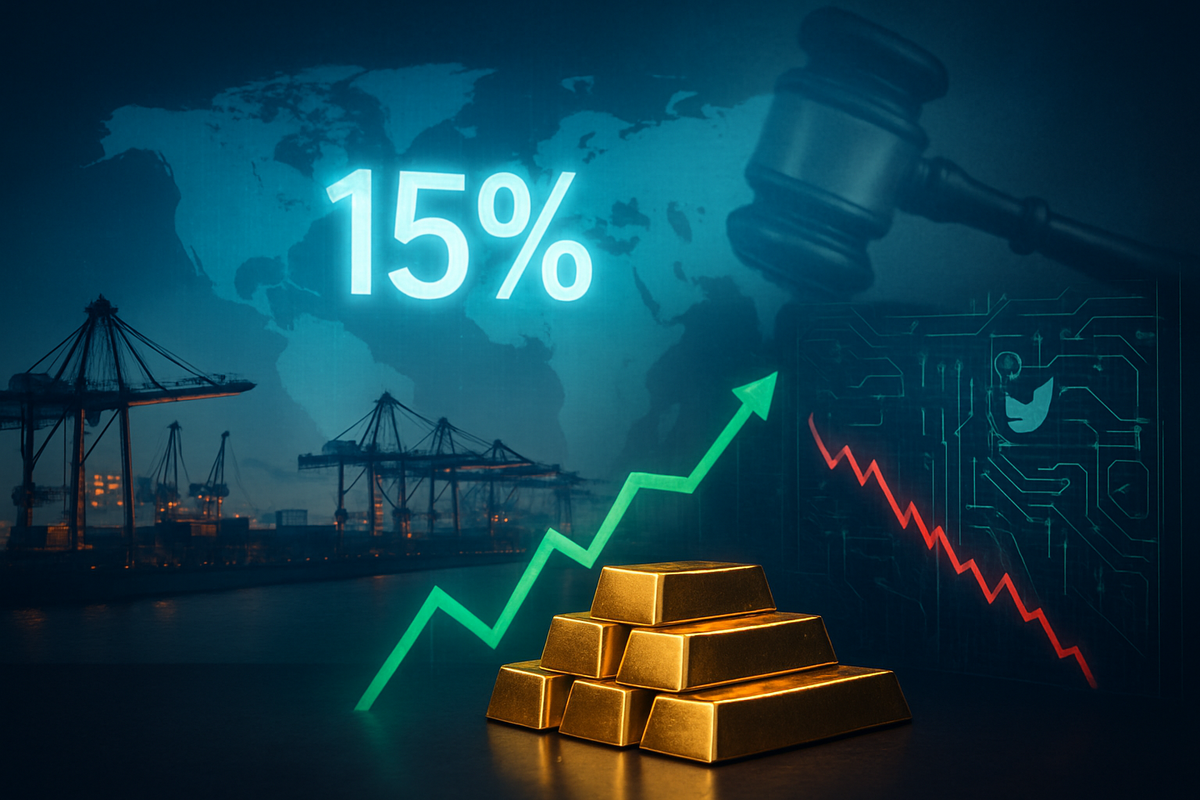
The global financial landscape was thrust into a state of high-octane volatility this week as President Trump announced a transition to a 15% blanket global tariff, effectively circumventing a landmark Supreme Court ruling that had briefly threatened his "America First" trade agenda. The move, characterized by the administration as a necessary measure to protect the U.S. balance of payments, has sent shockwaves through international markets, triggering a 2.1% spike in gold prices and a fractured, defensive reaction across the technology sector.
As of February 24, 2026, the shift from targeted executive orders to broad statutory surcharges has rewritten the rules of engagement for global trade. While the Supreme Court's decision initially sparked a brief rally in equities on hopes of a trade de-escalation, the President’s swift pivot to Section 122 of the Trade Act of 1974 has reintroduced a premium on uncertainty. Investors are now grappling with the dual reality of a potential $200 billion refund for past duties and the immediate imposition of a new, more aggressive 15% levy on nearly all imported goods.
The Pivot to Section 122: Defying Judicial Constraints
The current crisis traces its roots to February 20, 2026, when the Supreme Court issued its ruling in Learning Resources, Inc. v. Trump. In a 6-3 decision, the Court applied the "Major Questions Doctrine," ruling that the International Emergency Economic Powers Act (IEEPA) did not grant the President the authority to impose broad, across-the-board tariffs without specific congressional consent. This ruling effectively invalidated the "Liberation Day" tariffs that had defined the administration's second-term trade policy, potentially forcing the government to refund up to $211 billion in collected duties.
However, the administration’s response was nearly instantaneous. By the morning of February 21, the White House invoked Section 122 of the Trade Act of 1974, a rarely used provision that allows for a temporary import surcharge of up to 15% for a period of 150 days to address serious balance-of-payments deficits. By February 23, the rate was officially set at the statutory maximum of 15% for most nations, though the administration pivoted on February 24 to maintain a 10% rate for the European Union and the United Kingdom to prevent the collapse of ongoing trade negotiations.
The market's initial reaction was one of "safe-haven" flight. On February 23, spot gold prices surged 2.1%, breaking past the psychological barrier of $5,200 to reach $5,211 per ounce. The move was further exacerbated by a weakening U.S. dollar, which fell as traders initially priced in a reduction in trade barriers before the Section 122 announcement restored the trade-war premium. This volatility has left the S&P 500 and the Nasdaq 100 trading down 1.2% and 1.1%, respectively, as investors recalibrate for a 150-day window of intense trade friction.
Winners and Losers: Tech Resilience vs. Retail Pain
The reaction in the equity markets has been sharply divided, with a handful of technology giants showing surprising resilience while broader software and retail stocks bore the brunt of the sell-off. NVIDIA (NASDAQ: NVDA) emerged as a notable outlier, rising 1.02% to 1.3% on February 23. This strength was attributed to institutional optimism ahead of its Q4 FY2026 earnings report and the "structural" necessity of its AI chips, which are increasingly viewed as indispensable assets that transcend trade policy.
Similarly, Apple (NASDAQ: AAPL) saw a modest gain of 0.5% in early trading. While Apple remains highly sensitive to global supply chain costs, the stock benefited from the SCOTUS-driven removal of specific IEEPA-based country tariffs that had previously targeted its core manufacturing hubs. Conversely, companies with high overhead and thin margins, such as Amazon (NASDAQ: AMZN) and Salesforce (NYSE: CRM), saw declines of 3% and 5%, respectively, as markets factored in higher operating costs and the threat of retaliatory digital services taxes from abroad.
In the commodities space, gold miners were the primary beneficiaries of the flight to quality. Newmont (NYSE: NEM) shares rose 1.74% to $124.25, buoyed by the 2% jump in bullion prices. Barrick Mining (NYSE: B), formerly Barrick Gold, rose 2.63% to $49.22. Both companies have been shielded from the direct impact of the new 15% surcharge, as the Section 122 proclamation includes specific exemptions for metals used in currency and bullion to maintain financial system stability. However, an ongoing legal rift between the two over their Nevada Gold Mines joint venture continues to linger as a background risk for investors in the mining sector.
Broader Significance: The New Legal Frontier of Trade
The invocation of Section 122 represents a significant escalation in the use of executive trade authority and a direct challenge to the Supreme Court's recent attempts to curb administrative power. By moving the legal basis for tariffs from IEEPA to the Trade Act of 1974, the administration is betting that the 150-day statutory clock will provide enough leverage to force trade concessions before a new round of legal challenges can reach the high court.
This event fits into a broader trend of "protectionist agility," where the executive branch utilizes older, more specific statutes to bypass modern judicial scrutiny. The ripple effects are already being felt globally; the European Union has paused several trade ratifications in response to the 15% threat, and China has signaled potential retaliatory measures targeting U.S. agricultural exports. Historically, this level of trade friction has not been seen since the Nixon era, which also saw the use of temporary import surcharges to manage currency and trade imbalances.
Furthermore, the "Major Questions Doctrine" applied by the Supreme Court suggests that the legal battle is far from over. Future litigation will likely focus on whether a 15% blanket tariff truly addresses a "balance-of-payments" crisis as defined by the 1974 Act, or if it is a veiled attempt to reinstate the broader economic controls that the Court just struck down. This creates a high-stakes environment for multinational corporations, which must now plan for a world where trade policy can be overturned and reinstated in the span of a single weekend.
The Path Ahead: A 150-Day Pressure Cooker
The short-term horizon is dominated by the 150-day countdown built into Section 122. This fixed duration creates a "pressure cooker" environment for trade negotiations. If the administration cannot secure significant concessions from trading partners or congressional backing by mid-summer 2026, the 15% surcharge will expire automatically, potentially creating another massive policy vacuum and another round of market volatility.
For public companies, the immediate priority is a strategic pivot in supply chain management. We may see a surge in "pre-emptive importing" as businesses rush to bring goods into the country before any further rate hikes or before the 150-day window expires. Market opportunities may emerge in domestic manufacturing and logistics providers who can help firms navigate these temporary surcharges. However, the risk of a retaliatory "tit-for-tat" cycle remains high, particularly as the U.S. moves closer to the 2026 midterm elections, where trade policy is expected to be a central campaign issue.
Summary and Investor Outlook
The transition to a 15% global tariff under Section 122 has effectively countered the Supreme Court’s attempt to limit executive trade power, at least in the near term. The primary takeaways for investors are the continued strength of gold as a hedge against policy instability and the surprising resilience of high-moat tech leaders like NVIDIA (NASDAQ: NVDA) and Apple (NASDAQ: AAPL) in the face of macro headwinds.
Moving forward, the market will be hyper-sensitive to any signs of congressional intervention or further legal challenges to the 1974 Act’s authority. Investors should watch for the expiration of the 150-day window in late July 2026 and keep a close eye on gold price benchmarks as a barometer for trade-related fear. While the 15% tariff provides a temporary tactical advantage for the administration, the long-term impact on global inflation and supply chain integrity remains the most significant risk for the remainder of the year.
This content is intended for informational purposes only and is not financial advice.