

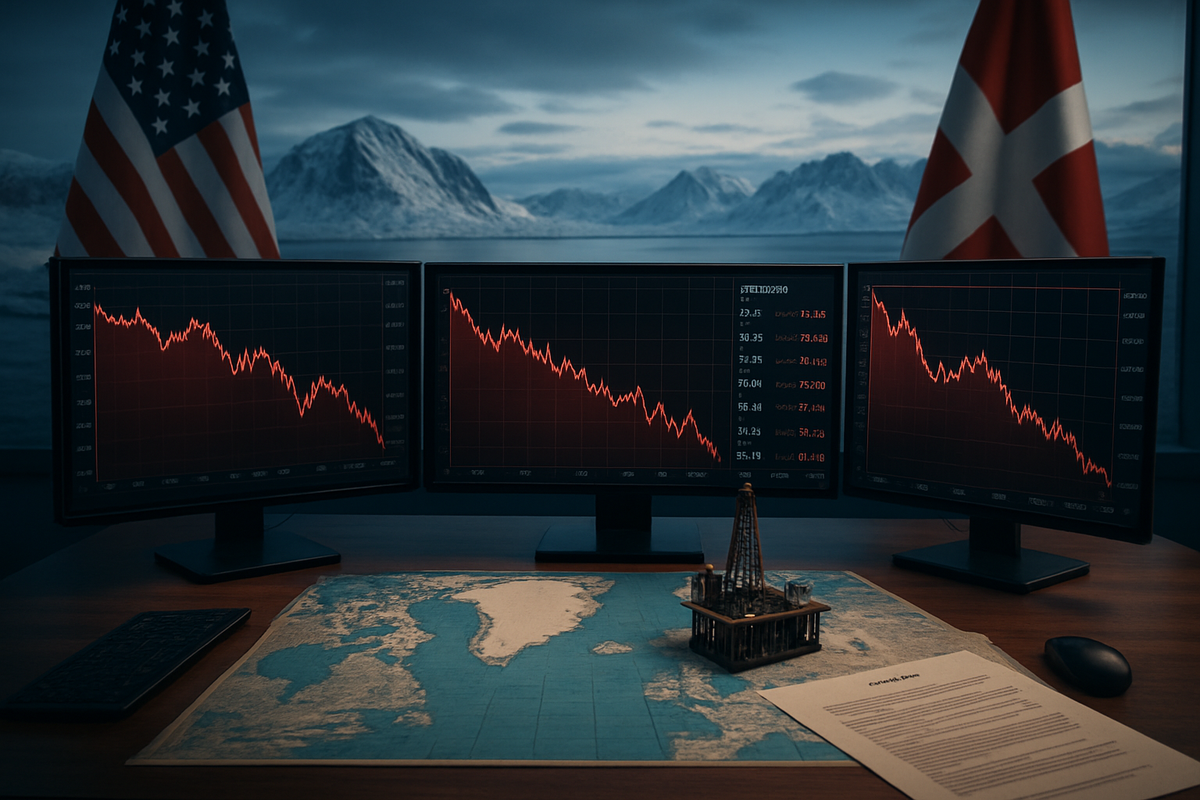
The global financial markets are still reeling after a tumultuous January that saw the return of "Twitter-diplomacy" and high-stakes protectionism. Following President Donald Trump’s aggressive mid-month demand for the United States to purchase Greenland, a move punctuated by threats of sweeping tariffs against European allies, the Dow Jones Industrial Average (INDEXDJX:.DJI) and the U.S. bond market have undergone a period of intense dislocation. While a fragile "Davos Framework" has temporarily paused the immediate threat of a 10% levy on European goods, the specter of a 25% tariff scheduled for June 1 continues to cast a long shadow over trans-Atlantic trade.
The immediate implications of this "Greenland Crisis" have been felt most acutely in the fixed-income markets, where yields surged to levels not seen since the summer of 2025. Investors, caught off guard by the administration's willingness to use broad-based tariffs as a geopolitical bargaining chip for territorial acquisition, have scrambled to price in both inflationary pressures and the risk of a fractured NATO alliance. As of February 2, 2026, the markets remain in a state of hyper-vigilance, balancing the hope of a resource-rich Arctic expansion against the reality of a potentially paralyzed global supply chain.
The January Shockwave
The crisis began in earnest on Saturday, January 17, 2026, when President Trump declared that his administration would no longer tolerate what he termed "European obstructionism" regarding the strategic future of the Arctic. Building on his 2019 interest in the territory, the President formalised a demand to purchase Greenland from the Kingdom of Denmark. When Danish officials and their European counterparts flatly rejected the proposal, the administration announced a 10% tariff on all imports from eight key nations: Denmark, the United Kingdom, France, Germany, the Netherlands, Norway, Sweden, and Finland.
When markets opened following the Martin Luther King Jr. holiday on January 20, the reaction was swift and violent. The Dow Jones Industrial Average fell 877 points, or 1.8%, in a single session, while the tech-heavy Nasdaq Composite saw even steeper declines. The volatility was fueled by fears that a trade war with Europe would derail the fragile global recovery and disrupt the flow of critical components for the automotive and aerospace industries. This was not merely a repeat of the 2019 diplomatic spat; it was a calibrated economic assault intended to force a real estate deal of continental proportions.
By the middle of that week, the U.S. Treasury market became the epicenter of the panic. The 30-year Treasury yield, a benchmark for long-term borrowing costs, briefly touched 4.92% as investors ditched bonds in anticipation of higher costs for imported goods. The 10-year Treasury yield rose to 4.3%, reflecting a rare "Sell America" sentiment as international capital sought safety in hard assets rather than U.S. debt. The Cboe Volatility Index (INDEXCBOE:VIX), often called the market's "fear gauge," spiked above the 28 level, signaling that the era of market calm had come to a definitive end.
Winners and Losers in the Arctic Standoff
The fallout from the Greenland tariff threats has created a stark divide between potential market winners and losers. Among the hardest hit are European exporters who rely heavily on the American consumer. Luxury conglomerate LVMH (OTC:LVMUY) and automotive giants like BMW (OTC:BMWYY) and Mercedes-Benz Group (OTC:MBGYY) saw their stock prices tumble by more than 5% during the initial announcement week. These companies face the double-edged sword of direct tariffs and the potential for retaliatory measures from the European Union, which could further stifle trans-Atlantic commerce.
Conversely, the crisis has breathed new life into the domestic rare earth mining sector. As the administration emphasized Greenland’s 1.5 trillion USD worth of neodymium and praseodymium reserves, companies like MP Materials Corp (NYSE: MP) saw a surge in investor interest. If the U.S. successfully secures Greenland, or even forces a joint-operating agreement for its mines, domestic players involved in the processing of these critical minerals stand to gain a strategic moat against Chinese dominance. Similarly, defense contractors such as Lockheed Martin (NYSE: LMT) and Raytheon Technologies (NYSE: RTX) have remained resilient, buoyed by the prospect of increased military spending in the Arctic circle to secure newly contested territories.
The bond market, however, remains a primary "loser" in this scenario. The iShares 20+ Year Treasury Bond ETF (NASDAQ: TLT) has seen significant capital outflows as the inflationary nature of tariffs erodes the real value of fixed-income returns. For institutional investors holding long-duration debt, the "Greenland Gambit" represents a fundamental shift in risk assessment, where geopolitical land-grabs are now a variable that can trigger a massive sell-off in sovereign bonds.
Resource Nationalism and Global Ripple Effects
This event is more than a simple trade dispute; it represents a pivot toward "resource nationalism" that could redefine industry trends for the next decade. By linking trade tariffs to territorial acquisition, the Trump administration has introduced a new level of unpredictability into global markets. This fits into a broader trend of deglobalization, where major powers are increasingly willing to sacrifice trade efficiency for the sake of securing critical supply chains—specifically the rare earth minerals required for the green energy transition and advanced defense systems.
The ripple effects are already being felt by U.S. partners. The inclusion of the United Kingdom and Norway in the tariff threat—both non-EU members but key NATO allies—suggests that the administration is prioritizing "America First" expansionism over traditional security structures. This has historical precedents in the 19th-century doctrine of Manifest Destiny, but applying such a philosophy to a 21st-century globalized economy is unprecedented. The regulatory implications are vast, as any movement toward an "Arctic Deal" would require a complete overhaul of maritime law and environmental regulations governing the sensitive Greenlandic ecosystem.
Furthermore, the comparison to the 2018-2019 China trade war is inevitable, but the stakes here are arguably higher. While the China conflict was about intellectual property and trade deficits, the Greenland crisis is about physical territory and the fundamental building blocks of future technology. Market analysts are now forced to consider if other resource-rich regions could become the next targets of "tariff-based acquisitions," a prospect that could lead to a permanent "geopolitical premium" being baked into equity prices.
The Path to June 1st: Scenarios and Strategic Pivots
Looking ahead to the remainder of 2026, the market faces two distinct paths. In the short term, the "Davos Framework" provides a cooling-off period, but the June 1 deadline for the 25% tariff hike acts as a ticking time bomb. Strategic pivots are already underway; many multi-national corporations are reportedly exploring "friend-shoring" initiatives, moving production away from the threatened European nations toward more "neutral" jurisdictions like Mexico or Southeast Asia. However, such a transition is costly and cannot be achieved before the summer deadline.
The long-term scenario involves a potential "Greenland Settlement" where the U.S. might not buy the island outright but could secure exclusive mining and military rights in exchange for dropping the tariffs. Such an outcome would likely trigger a massive relief rally in the Dow and a stabilization of bond yields. However, if negotiations fail and the 25% tariffs are enacted, economists warn of a "stagflationary" shock—high inflation coupled with stagnant growth—that could push the U.S. and Europe into a synchronized recession. Market opportunities may emerge in Arctic exploration tech and specialized logistics, but these will be overshadowed by the broader systemic risks.
A New Geopolitical Premium
The "Greenland Crisis" of January 2026 has fundamentally altered the relationship between trade policy and national sovereignty. The key takeaway for investors is that the "Trump Put"—the idea that the administration would avoid actions that significantly damage the stock market—has been tested and found to have its limits when it conflicts with the President's long-term territorial and resource ambitions. The market is no longer just reacting to earnings reports; it is reacting to a new form of "territorial arbitrage."
Moving forward, the market will likely remain volatile as every diplomatic statement from Copenhagen or Washington is parsed for clues about the June deadline. Investors should keep a close watch on the 10-year Treasury yield and the VIX; a sustained move above 5% on the 10-year or 30 on the VIX would signal that the market is bracing for a full-scale trade war. While the prospect of securing Greenland's mineral wealth is a tantalizing long-term play for the U.S. economy, the path to getting there is proving to be a minefield for the average investor.
This content is intended for informational purposes only and is not financial advice