

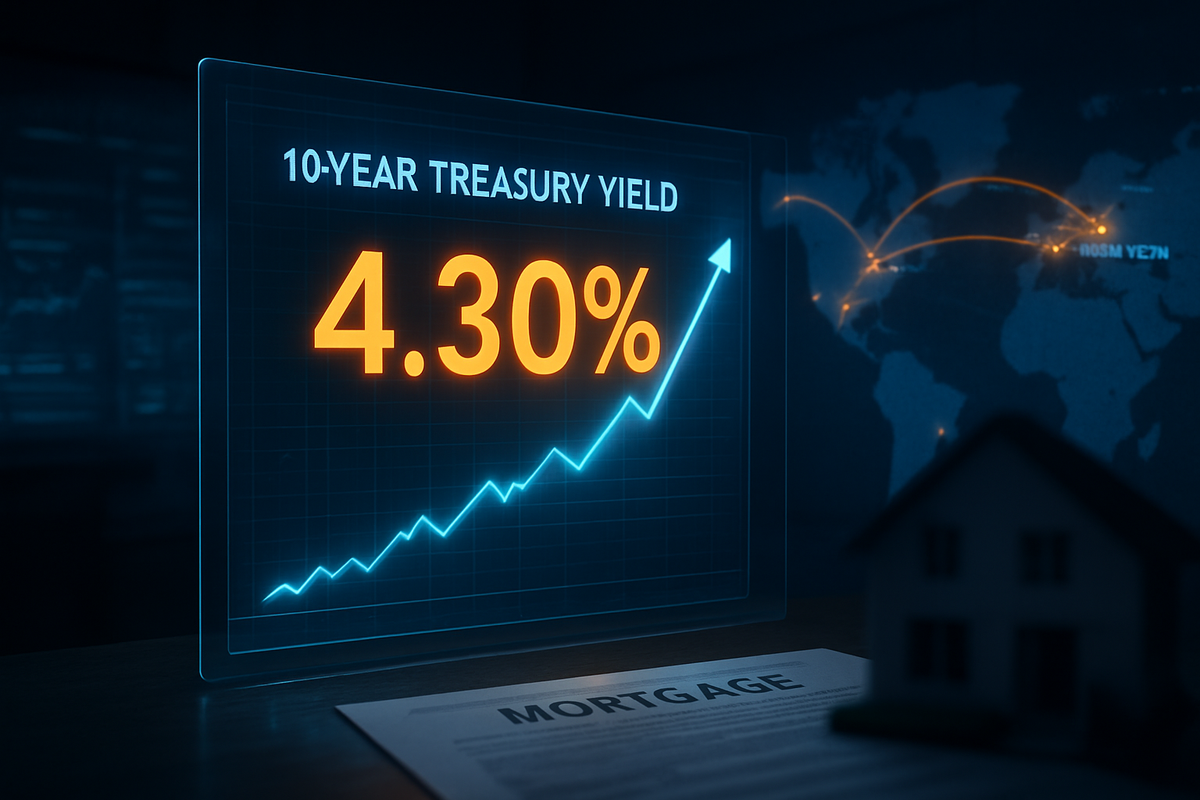
As of January 22, 2026, the global fixed-income landscape is undergoing a period of intense recalibration. The benchmark U.S. 10-year Treasury yield surged this week, climbing to a peak of 4.30% on Tuesday before stabilizing at 4.26% today. This mark represents the highest level for the sovereign debt instrument since August 2025, signaling a sharp reversal from the relative stability seen during the fourth quarter of last year. The rapid ascent is being fueled by a volatile combination of persistent domestic inflation expectations and an unprecedented sell-off in the Japanese Government Bond (JGB) market, which has sent shockwaves through international capital flows.
The implications for the broader economy are immediate and significant. As the 10-year yield serves as the "north star" for consumer credit pricing, the recent spike has already begun to ripple through the lending market. Most notably, 30-year fixed mortgage rates have adjusted upward toward 6.22%, effectively stalling a nascent recovery in the housing sector that many analysts had predicted for early 2026. For investors, this move underscores a "higher-for-longer" reality that persists despite years of Federal Reserve efforts to anchor inflation at its 2% target.
A Tectonic Shift in Global Debt Markets
The journey to 4.30% was catalyzed by a dramatic turn of events in Tokyo earlier this month. On January 20, the 10-year JGB yield hit a 27-year high of 2.33% following an announcement from Japanese Prime Minister Sanae Takaichi regarding a snap election scheduled for February 8, 2026. Takaichi’s platform, centered on aggressive fiscal expansion and sales tax cuts, spooked global "bond vigilantes" who fear the sustainability of Japan’s debt, which currently sits at roughly 260% of its GDP.
This "Truss-esque" market reaction in Japan has direct consequences for the United States. Japanese institutional investors are the largest foreign holders of U.S. Treasuries, and as domestic JGB yields skyrocket, these investors are increasingly incentivized to liquidate their U.S. holdings to bring capital home or to demand significantly higher yields on American debt to compensate for the shifting global risk profile. This selling pressure effectively exported volatility from the Japanese market to the U.S. Treasury Department, pushing the 10-year yield from 4.12% in late December 2025 to the 4.30% threshold in a matter of weeks.
Domestic factors have also played a role. While the Federal Reserve, led by Chair Jerome Powell, has maintained a restrictive stance, U.S. inflation (PCE) remains stubbornly lodged between 2.7% and 3.0%. The market’s refusal to see yields fall further reflects a growing "term premium"—a demand for higher compensation to hold long-term debt in an era of massive federal deficits and unpredictable price stability.
Winners and Losers in a High-Yield Environment
The sudden climb in yields has created a bifurcated landscape for public companies. Large-cap financial institutions like JPMorgan Chase & Co. (NYSE: JPM) and Bank of America Corp. (NYSE: BAC) find themselves in a complex position. While higher interest rates generally allow for wider net interest margins (the difference between what they earn on loans and pay on deposits), the rapid rise in yields also forces a painful "mark-to-market" devaluation of their existing long-term bond portfolios. Banks with high concentrations of low-yield securities purchased during the 2020-2021 era may see further pressure on their Tier 1 capital ratios.
Conversely, the housing and real estate sectors are facing renewed headwinds. Mortgage giants such as Rocket Companies, Inc. (NYSE: RKT) and homebuilders like Lennar Corporation (NYSE: LEN) have seen their stock prices soften as the 10-year yield’s climb pushes borrowing costs out of reach for many prospective buyers. The 6.22% mortgage rate environment is a far cry from the sub-5% levels that the industry had hoped would materialize by early 2026.
In the international sphere, Japanese financial heavyweights such as Mitsubishi UFJ Financial Group, Inc. (NYSE: MUFG) are at the epicenter of the JGB volatility. While the rise in domestic Japanese yields provides long-awaited returns for Japanese banks after decades of near-zero rates, the speed of the ascent threatens to destabilize the broader financial system, potentially leading to forced liquidations of global assets to cover margin requirements or rebalance portfolios.
Historical Echoes and the Death of the "Widowmaker"
This current market environment draws striking parallels to the "Bond Rout" of October 2023, when the 10-year yield briefly touched 5.0%. However, the 2026 version of this crisis is arguably more systemic. In 2023, the Bank of Japan was still cautiously managing its "Yield Curve Control" (YCC) policy. In 2026, that anchor has vanished. The legendary "widowmaker" trade—shorting Japanese bonds—has finally become profitable, signaling a fundamental end to the era of ultra-cheap global liquidity.
The wider significance lies in the realization that central banks may no longer have the tools to suppress yields in the face of massive fiscal spending. The "fiscal dominance" narrative, where government borrowing needs dictate market rates more than central bank policy, is gaining traction among institutional investors. This shift suggests that the global economy is entering a period where the cost of capital will remain structurally higher than it was in the 2010s, fundamentally altering how corporations approach debt-financed growth and how governments fund their social and military obligations.
The Road Ahead: Potential Pivots and Volatility
In the short term, market participants are looking toward the February 8 election in Japan as the next major volatility catalyst. If Takaichi’s fiscal plans are ratified by voters, we could see the 10-year JGB yield push toward 3.0%, which would likely drag the U.S. 10-year yield toward the 4.50% - 4.75% range. Such a move would necessitate a strategic pivot from the Federal Reserve, which might be forced to consider renewed "Quantitative Easing" (QE) or other liquidity injections to prevent a "flash freeze" in the mortgage and corporate credit markets.
Longer-term, the market may see a "flight to quality" if the yield spike triggers a significant slowdown in consumer spending. If the housing market remains frozen through the spring 2026 buying season, the resulting economic drag could eventually cap yields as investors bet on a future recession. However, until inflation shows a clear path back to 2.0%, the "bond vigilantes" appear to be firmly in control of the narrative.
Summary and Investor Outlook
The climb of the 10-year Treasury yield to 4.30% in January 2026 is a stark reminder that the global financial system remains interconnected and fragile. The combination of Japanese fiscal instability and persistent U.S. inflation has created a "perfect storm" for fixed-income assets, driving consumer loan rates higher and pressuring the balance sheets of major financial institutions.
Key Takeaways for Investors:
- Watch the JGBs: The Japanese bond market is no longer a localized issue; it is currently a primary driver of U.S. Treasury volatility.
- Mortgage Pressure: Real estate and homebuilding stocks will remain under pressure as long as the 10-year yield stays above the 4.0% psychological floor.
- Fiscal Dominance: Investors should prepare for a world where government deficits play a larger role in determining interest rates than Federal Reserve rhetoric.
Moving forward, the focus will remain on the upcoming Japanese election and the Fed's response to the widening term premium. For now, the "safe haven" of U.S. Treasuries is providing more yield—but also more heartaches—than many expected as we start the new year.
This content is intended for informational purposes only and is not financial advice.