

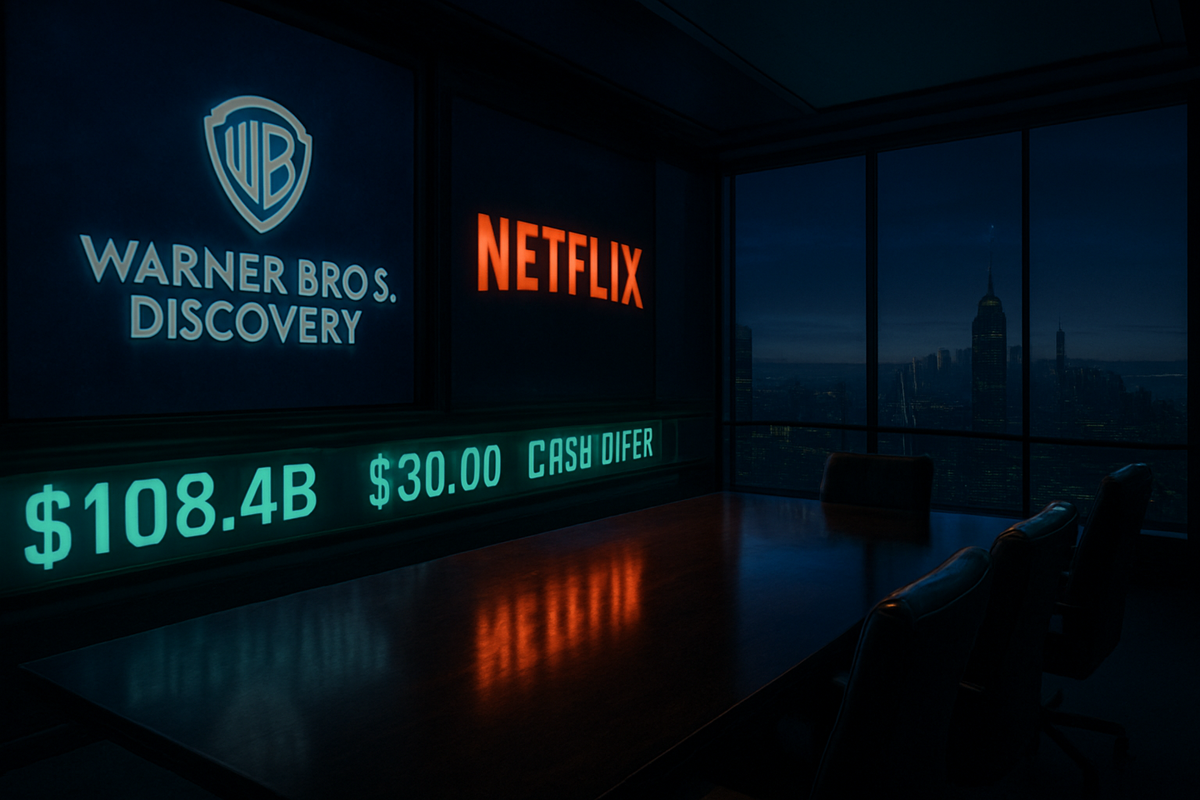
The landscape of American media has reached a fever pitch this week as Warner Bros. Discovery (Nasdaq: WBD) finds itself at the center of a monumental corporate tug-of-war. On January 22, 2026, the industry is reeling from a massive $108.4 billion hostile tender offer from Paramount Skydance (NYSE: PSKY), a move that directly challenges an existing merger agreement with streaming titan Netflix (Nasdaq: NFLX). This aggressive play by David Ellison’s newly formed media powerhouse has effectively turned a strategic consolidation into an all-out bidding war, forcing shareholders to choose between two vastly different visions for the future of entertainment.
The conflict intensified today as the WBD board of directors officially urged shareholders to reject the Paramount Skydance offer, characterizing the $30-per-share all-cash bid as "inadequate" and "insufficient in value" when compared to the long-term potential of the Netflix deal. Despite the board's resistance, the market is signaling high expectations for a deal; WBD shares rose to $28.53 in mid-day trading, creeping closer to the tender price as institutional investors begin to weigh the certainty of cash against the complexity of a spin-off.
The Battle for the Iron Throne of Content
The current standoff is the culmination of a frantic three-month period that began in late 2025. Following a year of stagnant growth and high debt levels, Warner Bros. Discovery announced in October 2025 that it was exploring "alternative options," signaling to the market that the house built by the 2022 merger was once again up for sale. By December, Netflix had emerged as the frontrunner with a "friendly" agreement to acquire WBD’s premium assets—including HBO, Warner Bros. Pictures, and the DC Studios division—for approximately $27.75 per share.
Under the Netflix proposal, WBD’s traditional linear assets, such as CNN, TBS, and HGTV, would be spun off into a separate, independent entity tentatively named "Discovery Global." However, David Ellison and Paramount Skydance disrupted this plan on December 8, 2025, by launching a rival hostile bid. Unlike the Netflix deal, the PSKY offer is a "clean" $30.00 per share all-cash acquisition of the entire company. This $108.4 billion valuation is designed to appeal directly to shareholders frustrated by the complexity and perceived risk of the "Discovery Global" spin-off, which many analysts fear would struggle as a standalone entity in a declining cable market.
The WBD board’s rejection on January 7, 2026, sparked a legal counter-offensive. Paramount Skydance has since filed a lawsuit in the Delaware Court of Chancery, alleging that the WBD board is violating its fiduciary duties by favoring the Netflix deal. The situation has devolved into a proxy fight, with PSKY nominating a rival slate of directors to the WBD board, hoping to force a vote on their $30 offer before the Netflix deal can be finalized in April.
Winners and Losers in the Merger Maelstrom
Warner Bros. Discovery shareholders appear to be the immediate winners of this escalating conflict. The bidding war has catalyzed a significant recovery in the company's stock, which had languished near $12.54 just a year ago. However, the internal stability of the company is at risk. Employees at HBO and CNN face an uncertain future as they are traded like chess pieces between tech-first Netflix and the legacy-heavy Paramount Skydance.
Paramount Skydance is taking a massive risk. While a successful acquisition of WBD would create a media behemoth with an unparalleled library of intellectual property, it would also saddle the combined entity with staggering debt. To finance the $108.4 billion price tag, Ellison has leaned heavily on his family’s fortune and a consortium of lenders including Apollo Global Management (NYSE: APO). A loss here would be a significant blow to Ellison’s ambition to become the undisputed king of Hollywood, while a win could leave the company financially overextended.
Netflix stands to lose its best chance at securing a permanent lead in the streaming wars. If the WBD deal falls through, Netflix loses access to the "Crown Jewels" of content—the DC Universe and the HBO library—which it desperately needs to maintain its subscriber lead against Disney (NYSE: DIS) and Amazon (Nasdaq: AMZN). A failed bid would force Netflix back to the drawing board, potentially seeking smaller, less impactful acquisitions at higher premiums.
A Watershed Moment for Media Consolidation
This bidding war reflects a broader industry trend where "size" has become the primary survival mechanism in a post-cable world. The era of the "Streaming Wars" has evolved into an era of "Merger Wars," where the goal is no longer just subscriber count, but total control over the production pipeline from script to screen. The intervention of Paramount Skydance illustrates the desperation of traditional media players to scale up or face obsolescence.
The regulatory implications of this deal are also unprecedented. A WBD-Netflix merger would consolidate a massive share of the streaming market, likely drawing scrutiny from the Department of Justice over concerns of a "content monopoly." Conversely, a Paramount Skydance-WBD merger would unite two of the "Big Five" movie studios, raising serious antitrust questions regarding film distribution and the future of the theatrical window. Furthermore, the fate of CNN remains a political lightning rod, with many in Washington questioning whether any of the bidders can guarantee the editorial independence of the news network.
Historically, this battle echoes the 1980s era of hostile takeovers, but with 21st-century stakes. It mirrors the 2018 fight between Disney and Comcast for 21st Century Fox, which ultimately reshaped the entertainment landscape. The current WBD fight is even more significant because it involves the intersection of Silicon Valley's tech-first approach (Netflix) and the traditional "Big Media" legacy (Paramount/Warner).
The Path Forward: Proxy Fights and Price Hikes
The coming months will be defined by strategic pivots. For Netflix to regain the upper hand, industry insiders expect it to raise its bid to at least $31 per share or offer more cash upfront to match the "cleanliness" of the PSKY offer. Netflix may also need to offer more favorable terms for the Discovery Global spin-off to satisfy the WBD board and key institutional investors like Pentwater Capital Management.
In the short term, the market will focus on the WBD shareholder meeting scheduled for April. If Paramount Skydance succeeds in its proxy battle and installs its own directors, the Netflix merger could be terminated almost immediately. However, if the board holds firm, the battle will move to the courts and regulatory chambers. Investors should expect high volatility in WBD and PSKY stock as every legal filing and public statement from David Ellison or Netflix leadership moves the needle.
Closing Thoughts on the Media Megadeal
The escalating battle for Warner Bros. Discovery is more than just a corporate transaction; it is a fight for the soul of Hollywood. The outcome will decide whether the future of storytelling is governed by a Silicon Valley algorithm or a traditional studio system revamped for the digital age. For shareholders, the $30-per-share offer from Paramount Skydance provides a lucrative exit, but the board's insistence on the Netflix deal suggests they believe there is even more value to be unlocked through a strategic partnership.
As we move toward the spring of 2026, the key takeaways are clear: the consolidation of the media industry is not over, and the premium for high-quality content libraries is higher than ever. Investors should watch for a "sweetener" from Netflix in the coming weeks and keep a close eye on regulatory signals from Washington. Whether it’s Ellison or Netflix that ultimately takes the prize, the media landscape will never be the same.
This content is intended for informational purposes only and is not financial advice.