
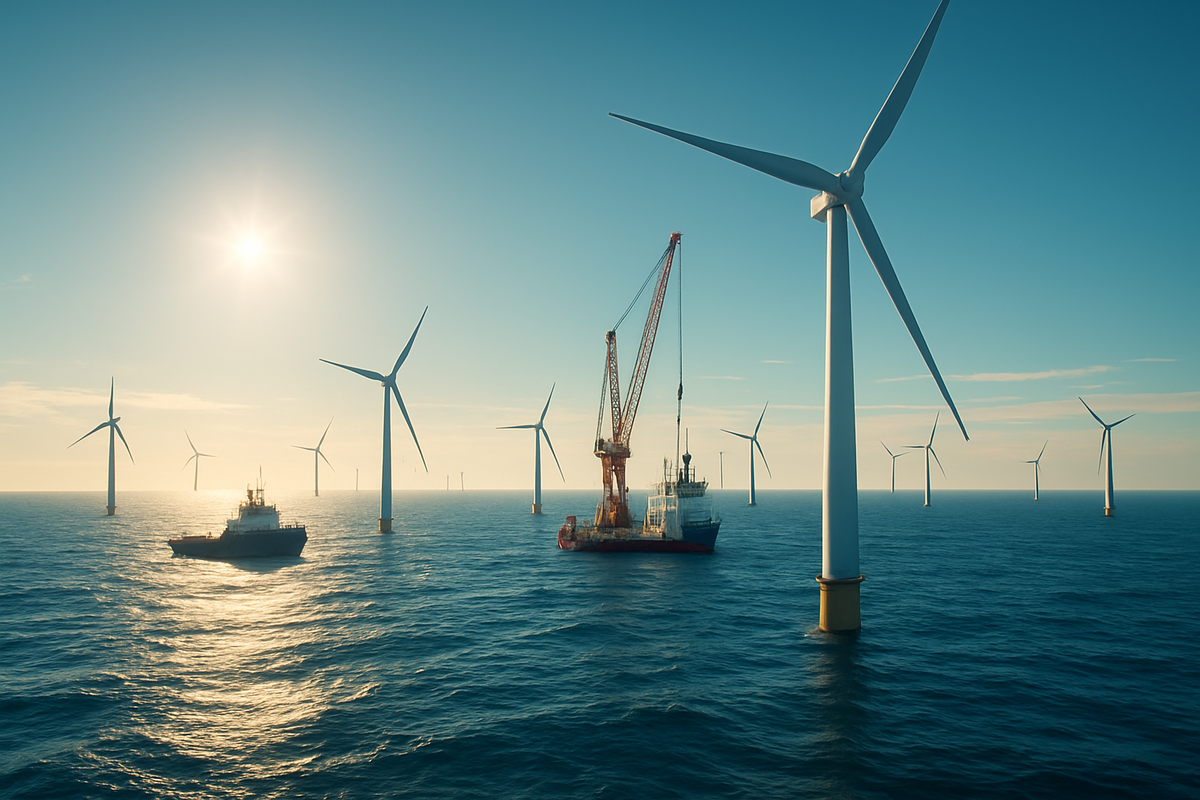
In a landmark decision for the U.S. renewable energy sector, a federal court has granted a preliminary injunction allowing Dominion Energy (NYSE: D) to immediately resume construction on the Coastal Virginia Offshore Wind (CVOW) project. The ruling, handed down today, January 16, 2026, effectively lifts a controversial stop-work order issued by the Department of the Interior just weeks ago. The decision marks a critical turning point for what is currently the largest offshore wind farm under development in the United States, signaling that judicial oversight remains a potent check on administrative interventions in the energy markets.
The resumption comes at a pivotal moment as the energy industry grapples with heightened regulatory scrutiny and shifting political winds. For Dominion Energy and its partners, the lift of the federal halt prevents what could have been a catastrophic blow to the project's timeline and financial viability. With billions of dollars in capital and thousands of jobs on the line, the market is closely watching how this legal victory will ripple across other stalled renewable projects along the Atlantic coast.
The crisis began on December 22, 2025, when the federal government issued a 90-day immediate stop-work order for CVOW and several other major East Coast offshore wind developments. The administration cited "national security risks" as the primary driver, claiming that turbine blades and reflective towers caused "radar clutter" that could interfere with military surveillance and missile defense systems. This sudden move shocked the industry, as the CVOW project had already undergone over a decade of rigorous permitting and coordination with the Department of Defense.
The timeline of the past few weeks has been a whirlwind of legal maneuvers. Following the December 22 order, Dominion Energy (NYSE: D) filed an emergency lawsuit, labeling the federal action "arbitrary and capricious." Today’s ruling by Judge Jamar K. Walker of the U.S. District Court for the Eastern District of Virginia found that the government failed to provide sufficient evidence that these purported security risks could not be mitigated by less drastic measures than a total construction halt. The court noted that Dominion’s pilot turbines had operated successfully for five years without such interference, undermining the government's sudden shift in policy.
The market reaction to the halt was swift and punishing. Dominion’s stock fell approximately 6% in the days following the December announcement, as investors feared the $11.2 billion project—already facing inflationary pressures—would become a stranded asset. However, with today’s injunction, shares have begun to stabilize, ticking up 1% in early trading as the immediate $5 million-per-day financial drain caused by idle vessels and personnel has been stemmed.
The primary winner in today's ruling is undoubtedly Dominion Energy (NYSE: D). By securing the injunction, the utility avoids further bleeding of capital and keeps its 2026 commissioning target within reach. This victory also bolsters the position of Stonepeak Partners, which holds a 50% stake in the CVOW project and shared in the daily losses during the suspension. Additionally, the ruling serves as a massive relief for the project’s supply chain partners, including turbine manufacturer Siemens Energy (OTC: SMNEY), which can now proceed with the installation of 176 massive turbines.
Other winners include major offshore wind developers like Orsted (OTC: DNNGY) and Equinor (NYSE: EQNR). Today’s ruling follows similar injunctions granted earlier this week for Orsted’s Revolution Wind and Equinor’s Empire Wind projects. This sequence of legal wins suggests a systemic judicial rejection of using "classified security risks" as a blanket tool to halt infrastructure projects. Conversely, the Department of the Interior and the Pentagon face a setback, as the court’s demand for high evidentiary standards limits their ability to unilaterally stall energy developments on security grounds without transparent justification.
While utility stocks like Eversource (NYSE: ES) have seen a slight reprieve from the news, the sector as a whole remains under pressure. The "losers" in this scenario may ultimately be the ratepayers, as the cost of the project has climbed from $9.8 billion to $11.2 billion due to the combination of the halt, legal fees, and new federal tariffs on imported steel. The increased capital expenditure (CAPEX) is expected to squeeze margins for these utility giants even as construction resumes.
The CVOW saga is a microcosm of the broader struggle within the U.S. energy transition. For years, the offshore wind sector has been viewed as the crown jewel of the green energy movement, but it is now being used as a primary battleground for competing political and regulatory philosophies. The attempt to use "radar interference" as a justification for a halt reflects a new era of regulatory risk, where "national security" is increasingly invoked in domestic industrial policy.
This event sets a powerful legal precedent: fully permitted projects that have reached the construction phase possess significant legal protections against mid-stream policy shifts. Historically, major infrastructure projects like the Keystone XL pipeline have been killed by administrative action, but the CVOW injunction suggests that once a project is "in the water" and billions are spent, the bar for halting it is significantly higher. This provides a glimmer of hope for other renewable sectors—such as solar and green hydrogen—that are also facing potential regulatory headwinds in the current political climate.
Furthermore, the ripple effects are being felt in the supply chain. The uncertainty of the past month has highlighted the fragility of the specialized maritime fleet required for offshore wind. As Dominion resumes work, the competition for specialized installation vessels—already in short supply globally—will likely intensify, potentially driving up costs for smaller developers who lack the scale and contractual leverage of a major utility like Dominion.
Looking ahead, Dominion Energy is racing against the clock to meet its late-2026 commissioning target. The first flow of power to the Virginia grid is expected within weeks, a milestone that will be critical for restoring full investor confidence. However, the legal battle is far from over. Today’s injunction is preliminary; the broader lawsuit regarding the federal government’s authority to issue such stop-work orders will proceed through the courts, likely taking months if not years to reach a final resolution.
Strategically, the industry may need to pivot toward even deeper integration with military and defense agencies during the early planning stages to "de-risk" projects from future security-based interventions. We may see a trend where offshore wind developers proactively fund radar upgrades for the military to ensure their projects are viewed as assets rather than liabilities. Market opportunities may emerge for technology firms that specialize in "stealth" turbine coatings or advanced radar mitigation software, as these technologies become essential for project approval.
The long-term outcome for the U.S. renewable sector will depend on whether this court victory leads to a more stable regulatory environment or if it merely marks the first shot in a protracted war between federal agencies and private energy developers. Investors should prepare for continued volatility as each new project faces its own set of unique geographical and political challenges.
The lifting of the federal halt on the Coastal Virginia Offshore Wind project is a monumental "tactical win" for Dominion Energy (NYSE: D) and the broader U.S. wind industry. By successfully challenging the government in court, Dominion has not only saved its flagship project from a potentially indefinite delay but has also established a legal shield for the industry against arbitrary regulatory shifts. However, the increased project costs and the ongoing legal uncertainty serve as a sobering reminder of the complexities inherent in large-scale energy transitions.
Moving forward, the market will likely remain cautious. While the immediate threat of project cancellation has dissipated, the "valuation overhang" remains. Investors should watch for Dominion’s upcoming quarterly earnings reports for a more detailed accounting of the financial impact of the 25-day halt and the rising costs of raw materials. Additionally, any further rulings in the lawsuits involving Orsted and Equinor will provide a clearer picture of whether the judicial system will continue to favor developers over administrative security claims.
In the coming months, the successful installation of the first few rows of turbines at CVOW will be the most significant indicator of the project's health. For the US renewable energy sector, the message is clear: the path to a green future is not just a feat of engineering, but a relentless marathon through the federal court system.
This content is intended for informational purposes only and is not financial advice