
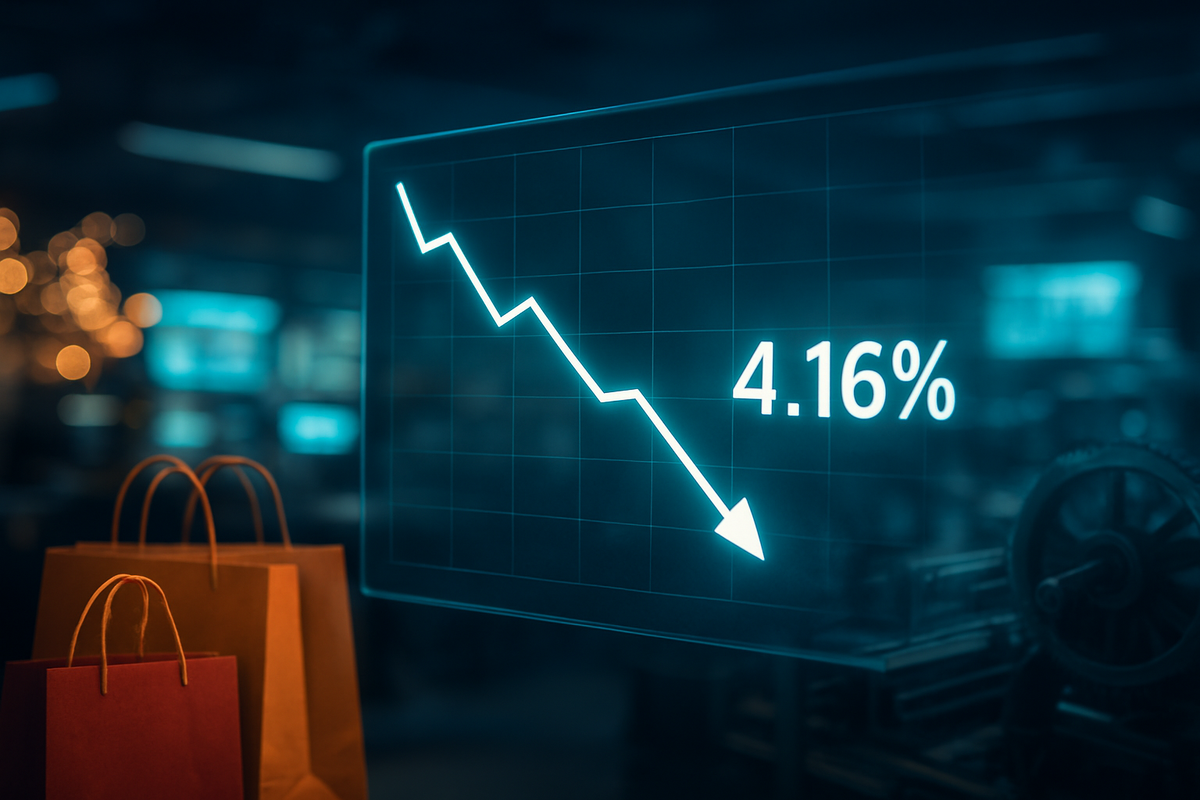
In a week defined by economic cross-currents, the 10-year U.S. Treasury yield has retreated to 4.16%, a significant pivot from the 4.21% highs seen late last year. This downward shift comes as investors digest a complex cocktail of data: a surprisingly robust holiday shopping season juxtaposed against a cooling industrial sector and the lowest core inflation readings in nearly four years. The decline in yields suggests that while the broader economy remains resilient, fixed-income traders are increasingly betting that the "inflation dragon" has been slain, even as the path forward for monetary policy remains clouded by political friction.
The movement in the bond market underscores a delicate balancing act for the Federal Reserve. With the 10-year yield stabilizing at this level, the market is effectively pricing in a "Goldilocks" transition—one where growth persists at a modest pace without reigniting price pressures. However, this optimism is tempered by the reality of a divided Federal Open Market Committee (FOMC) and a geopolitical landscape that includes a recently resolved government shutdown and ongoing trade tensions. For the first half of 2026, the signal from the bond market is clear: the era of aggressive tightening is over, but the "higher for longer" mantra has evolved into "lower, but slower."
A Tale of Two Economies: Retail Strength vs. Industrial Cooling
The drop to 4.16% was precipitated by a series of data releases that painted a picture of a bifurcated economy. On one hand, the December 2025 retail sales figures, released in early January 2026, showed a resilient American consumer. Sales surged 1.2% month-over-month, driven by a record-breaking holiday season. This consumer strength initially threatened to push yields higher, as it suggested the economy might be running too hot. However, this was quickly countered by a December manufacturing report that showed the sharpest contraction in industrial activity since 2024, signaling that the "engine room" of the economy is beginning to sputter under the weight of previous rate hikes.
The timeline leading to this 4.16% milestone began in late 2025, following a 25-basis-point rate cut by the Federal Reserve in December, which brought the federal funds rate to a range of 3.50%–3.75%. Markets initially expected this to be the start of a rapid easing cycle. However, the release of the January 13 Consumer Price Index (CPI) report provided a reality check. Headline inflation held steady at 2.7% year-over-year, while Core CPI—the Fed's preferred measure that excludes volatile food and energy costs—fell to 2.6%. While these are the lowest core levels in four years, they remain stubbornly above the Fed's 2% target, leading to a "strategic pause" in the rate-cut narrative for early 2026.
Stakeholders, including major institutional desks at firms like Goldman Sachs and Morgan Stanley, have had to recalibrate their models. The market's reaction has been one of cautious recalibration rather than panic. The initial response to the 4.16% yield was a rally in the housing sector and a stabilization in growth-oriented equities, as investors sought safety in the idea that long-term borrowing costs have likely peaked. This equilibrium, however, remains fragile, as traders keep a close eye on the Department of Justice’s reported investigation into Fed Chair Jerome Powell and its potential implications for the central bank’s independence.
Winners and Losers in the 4.16% Yield Environment
The housing sector has emerged as the most visible beneficiary of the yield retreat. Companies like D.R. Horton (NYSE: DHI) and Lennar (NYSE: LEN) saw their shares climb by nearly 8% and 9%, respectively, as the 10-year yield's decline translated into a stabilization of mortgage rates near 6.16%. For homebuilders, the retreat in yields provides much-needed relief to potential buyers who were sidelined by the 7% rates seen in 2024. This trend suggests that the residential real estate market could see a significant rebound in the first half of 2026 if yields remain at or below current levels.
Conversely, the banking sector is facing a more difficult road. JPMorgan Chase (NYSE: JPM) recently reported a 9% rise in quarterly profits, yet its stock dipped as the market focused on narrowing net interest margins. With the yield curve remaining somewhat flat and the administration proposing a 10% cap on credit card interest rates, the profitability of traditional lending is under pressure. Citigroup (NYSE: C) similarly felt the heat, with its shares falling 3% as investors fretted over regulatory headwinds and the possibility that the Fed might not cut rates fast enough to stimulate loan demand.
In the technology space, the impact is mixed. While lower yields typically favor growth stocks by lowering the discount rate on future earnings, megacaps like Apple (NASDAQ: AAPL) have struggled. Apple shares fell 1.8% in the wake of the yield move, as investors focused more on idiosyncratic risks, such as increased competition in China and the slow monetization of its "Apple Intelligence" platform. Meanwhile, the automotive sector, led by General Motors (NYSE: GM), continues to struggle with the transition to electric vehicles (EVs). GM took a substantial $6 billion hit in its recent results, as the combination of high borrowing costs for consumers and the removal of federal tax incentives outweighed any benefit from the slight dip in Treasury yields.
Broader Trends and the Shadow of Fed Independence
The current yield environment is reflective of a broader shift in global capital flows. As the U.S. Treasury yield settles at 4.16%, it remains significantly higher than its counterparts in Europe and Japan, maintaining the dollar's status as a dominant currency but also creating "ripple effects" for international trade. This yield level is consistent with a market that expects the Fed to maintain its "wait-and-see" approach through the first two quarters of 2026. This trend mirrors the historical precedent of the mid-1990s "soft landing," where the Fed successfully navigated a cooling economy without triggering a deep recession.
However, a new and volatile variable has entered the equation: the perceived threat to Federal Reserve independence. With reports of political pressure from the White House and potential legal challenges against Fed leadership, the bond market is pricing in a "political risk premium." Historically, any sign of executive interference in monetary policy has led to higher long-term inflation expectations. If investors begin to believe the Fed will cut rates prematurely to satisfy political demands, the 10-year yield could quickly reverse its downward trend and spike back toward 5%, regardless of what the inflation data says.
This situation also highlights a shift in the "inflation-growth" trade-off. For much of 2024 and 2025, the market was obsessed with CPI prints. In 2026, the focus has shifted toward the labor market and industrial output. The fact that the 10-year yield fell to 4.16% despite strong retail sales suggests that the market is now more concerned about a potential industrial recession than a resurgence of consumer-led inflation. This is a critical pivot for investors who have spent the last three years trading on every inflation headline.
The Road Ahead: H1 2026 and Strategic Pivots
Looking ahead to the remainder of the first half of 2026, the primary question for the market is when the "strategic pause" will end. Current market odds for a rate cut at the January 28 FOMC meeting are near zero, with most analysts projecting that the Fed will remain immobile until at least June. This period of immobility will require strategic pivots from both corporations and investors. Companies that have relied on cheap debt will need to adapt to a reality where the 4% range for the 10-year yield is the new "low," a far cry from the near-zero rates of the previous decade.
For investors, the current environment presents a unique opportunity in mid-cap and cyclical stocks that have been overshadowed by the "Magnificent Seven" for years. If the 10-year yield remains stable at 4.16%, it provides a predictable backdrop for businesses to resume capital expenditures. However, the risks are tilted toward the downside if the labor market—currently in a "low-hire, low-fire" state—begins to show more definitive signs of stress. A jump in the unemployment rate above 4.5% would likely force the Fed's hand, leading to more aggressive cuts than the market currently anticipates.
Summary and Investor Outlook
The decline in the 10-year Treasury yield to 4.16% is a signal of a market in transition. It reflects a hard-won victory over inflation but also a growing wariness of the cooling industrial sector and the complexities of central bank politics. While the consumer remains a pillar of strength, as evidenced by the robust retail sales, the headwinds facing manufacturing and the banking sector cannot be ignored. The "wait-and-see" approach from the Federal Reserve suggests that volatility may remain low in the short term, but the underlying tensions in the economy are far from resolved.
As we move deeper into 2026, investors should keep a close eye on two key indicators: the health of the labor market and any developments regarding the Fed’s autonomy. If employment holds steady and the Fed maintains its independence, the 4.16% yield could serve as a floor for a sustainable, if modest, market expansion. However, any erosion in these pillars could lead to a rapid repricing of risk. For now, the bond market is offering a rare moment of relative calm—one that savvy investors should use to rebalance portfolios away from high-valuation tech and toward sectors like housing and mid-cap cyclicals that stand to benefit from a stabilizing interest rate environment.
This content is intended for informational purposes only and is not financial advice.