
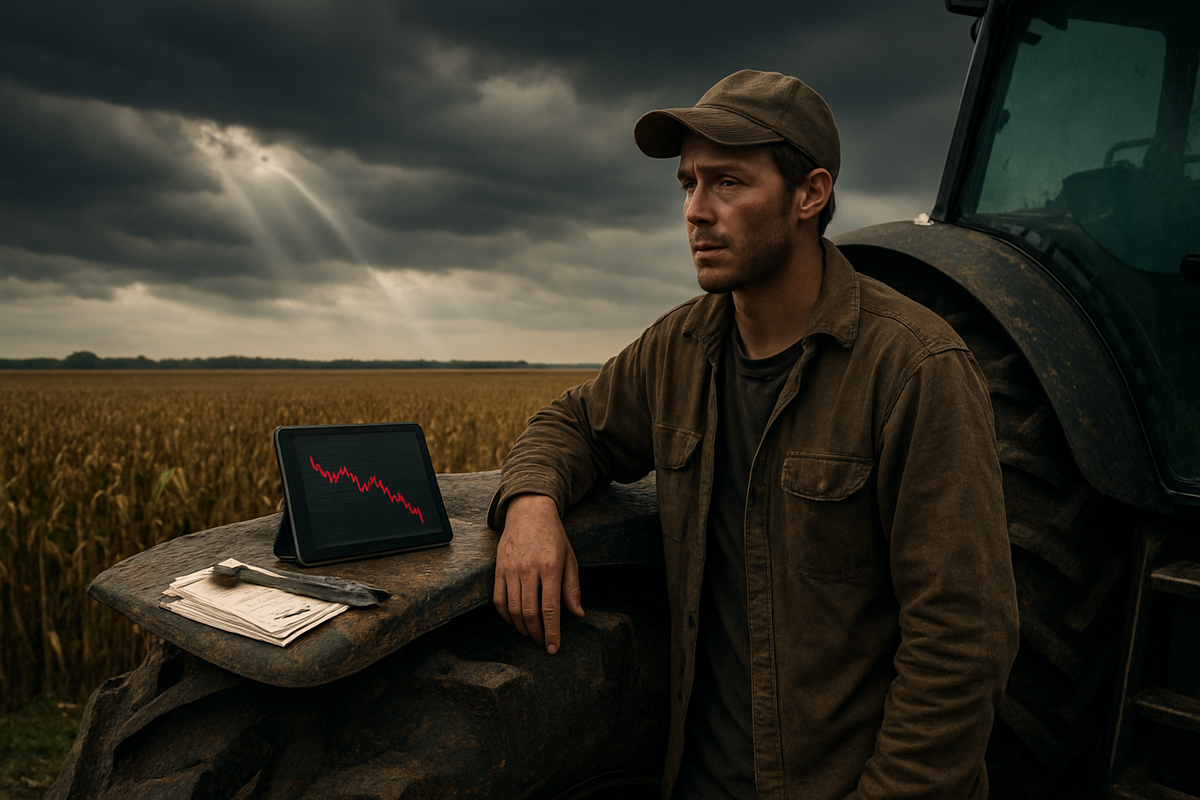
CHICAGO — As the 2026 planting season approaches, the American heartland is facing a fiscal reckoning that threatens to hollow out the next generation of agricultural producers. After a brief, policy-induced reprieve in 2025, a brutal "margin trap" has snapped shut, characterized by a volatile combination of stagnant commodity prices, "sticky" input costs, and record-high cash rents. For young farmers—those often defined as being under 40 or having less than a decade of experience—the dream of independent operation is increasingly being replaced by the reality of insolvency or corporate absorption.
The immediate implications are stark: Net farm income is projected to plummet by 23% this year to roughly $139 billion, marking one of the steepest three-year declines in U.S. history. While established landowners with "paid-for" dirt can weather the storm, the next generation is operating on razor-thin margins, often paying upwards of $160 per acre in cash rent while corn prices hover precariously near the $4.00 per bushel mark. This economic "squeeze" is not just a temporary downturn; it is an existential threat to the traditional family farm structure.
The Anatomy of the 2026 Margin Trap
The current crisis is the culmination of a three-year cycle that began with the post-COVID commodity boom of 2022-2023. As prices for corn and soybeans hit decade highs, land values and input costs followed suit. However, as global production caught up and inventories swelled, commodity prices corrected sharply. By early 2026, corn is trading between $3.90 and $4.10 per bushel, and soybeans are struggling to stay above $10.00. Meanwhile, the costs of the "Big Three"—fertilizer, seed, and fuel—have refused to retreat. Nitrogen and phosphate costs have surged 20% year-over-year due to supply chain tightening, and seed prices continue their relentless 5-7% annual climb.
The timeline leading to this moment was masked by the American Relief Act of 2025, which injected over $40 billion in ad hoc government payments into the sector. This "artificial floor" kept many operations afloat through 2025, but as those one-time payments expire in 2026, the underlying market reality has been exposed. Key stakeholders, from local ag-lenders to the USDA, are now sounding the alarm. Interest expenses for highly leveraged young farmers have nearly doubled since 2023, rising from $33 to over $60 per tillable acre, leaving little room for error as the first seeds hit the ground this spring.
The primary players in this unfolding drama are not just the farmers themselves, but the massive institutions that provide their lifelines. The USDA Farm Service Agency (FSA) is currently seeing record demand for operating loans, while commercial banks are tightening credit standards. Lenders are now "shock testing" balance sheets against a potential 25% drop in land values—a move that could disqualify thousands of young producers from the credit they need to buy fertilizer and diesel for the 2026 crop.
Corporate Winners and Losers in a Tightening Market
The economic squeeze is reverberating through the boardroom of every major agricultural firm. Deere & Company (NYSE: DE), the bellwether for farm machinery, has issued a cautious outlook for 2026, forecasting a 15-20% decline in large equipment sales in North America. As farm income drops, the "shiny green paint" in the machine shed is the first luxury to go. Similarly, CNH Industrial (NYSE: CNHI) and AGCO Corporation (NYSE: AGCO) are bracing for a year of "alignment," focusing on reducing dealer inventories as farmers pivot from buying new tractors to repairing old ones.
On the input side, the story is more complex. Nutrien (NYSE: NTR) and The Mosaic Company (NYSE: MOS) may see stable revenues as tight global supplies keep fertilizer prices high, but they face the risk of "demand destruction" if farmers decide to cut back on application rates to save cash. Corteva (NYSE: CTVA) is responding to this environment with a radical restructuring, planning to split into two separate entities by the second half of 2026: one focused on crop protection and biologicals, and the other on genetics and seeds. This move is designed to unlock value as farmers increasingly look for high-tech, high-yield seeds that can offset lower market prices.
Conversely, Archer-Daniels-Midland (NYSE: ADM) and Bunge Global SA (NYSE: BG) are finding a silver lining in the biofuel sector. The extension of the 45Z Clean Fuel Production Credit under the One Big Beautiful Bill Act (OBBBA) of 2025 has provided a much-needed boost to soybean crush margins. As the demand for renewable diesel grows, these processors are becoming a critical "demand sink" for a crop that might otherwise be rotting in silos due to cooling export demand from China.
Wider Significance and Historical Echoes
The 2026 crisis fits into a broader trend of agricultural consolidation that has been accelerating for decades. With national farmland values at a record $4,350 per acre, the barrier to entry has become a "paywall" that only institutional investors or generational wealth can bypass. This is leading to a "landlord-tenant" model of farming, where the next generation manages the land but owns none of it. The ripple effect extends to rural communities, where the loss of independent family farms often leads to the decline of local businesses and schools.
Comparisons to the 1980s farm crisis are inevitable, but the 2026 situation has distinct characteristics. Unlike the 80s, the overall sector-wide debt-to-asset ratio remains a relatively healthy 13.4%. However, this average is deceptive; it is skewed by older, debt-free landowners. For the "Next-Gen" cohort, debt-to-asset ratios are often double the national average. This has prompted new regulatory discussions, including the proposed New Producer Economic Security Act, which aims to provide low-interest "startup" loans and debt forgiveness for regenerative practices.
Policy-wise, the One Big Beautiful Bill Act (OBBBA) has replaced the traditional five-year Farm Bill cycle with a 10-year funding bridge. While this provides some stability, it also locks in reference prices that many argue are already outdated given the 2026 cost of production. The industry is watching closely to see if a "Skinny Farm Bill" will be passed later this year to address the specific credit needs of young producers who are currently being priced out of the market.
The Road Ahead: Adaptation or Absorption?
In the short term, survival for next-gen farmers will depend on "precision survival." This means the rapid adoption of "See & Spray" technology and variable-rate application to minimize every possible cent of input cost. We are likely to see a strategic pivot toward "specialty" contracts—such as non-GMO or organic crops—where premiums can offer a buffer against low commodity prices. However, these markets are thin and cannot support the entire "I-State" (Iowa, Illinois, Indiana) production base.
Longer term, the 2026 squeeze may force a fundamental shift in how farm equity is built. We may see the rise of "Farm Equity Funds" where young farmers partner with outside investors to buy land, sharing the risk and the reward. While this solves the capital problem, it further erodes the independence that has long been the hallmark of the American farmer. The "bottom" of this cycle is expected in late 2026, but the landscape that emerges will likely feature fewer, larger, and more corporate-aligned operations.
Summary of the 2026 Agricultural Outlook
The "Great Squeeze" of 2026 is a stark reminder that in agriculture, production success often leads to economic hardship. Record yields have led to a price collapse that, when paired with "sticky" inflation in inputs, has created a margin trap for the most vulnerable segment of the industry: the next generation. The artificial support of 2025 has vanished, leaving young producers to face a 23% drop in income and interest rates that make land acquisition a near impossibility.
Moving forward, the market will be defined by consolidation and technological desperation. Investors should watch the performance of Deere & Company (NYSE: DE) as a proxy for farm sentiment and monitor the Corteva (NYSE: CTVA) split as a sign of how input providers are adapting to a lower-margin environment. The ultimate test for the market will be the 2026 harvest; if yields are high and prices remain low, the "squeeze" could turn into a full-scale exodus of young talent from the American farm.
This content is intended for informational purposes only and is not financial advice.