

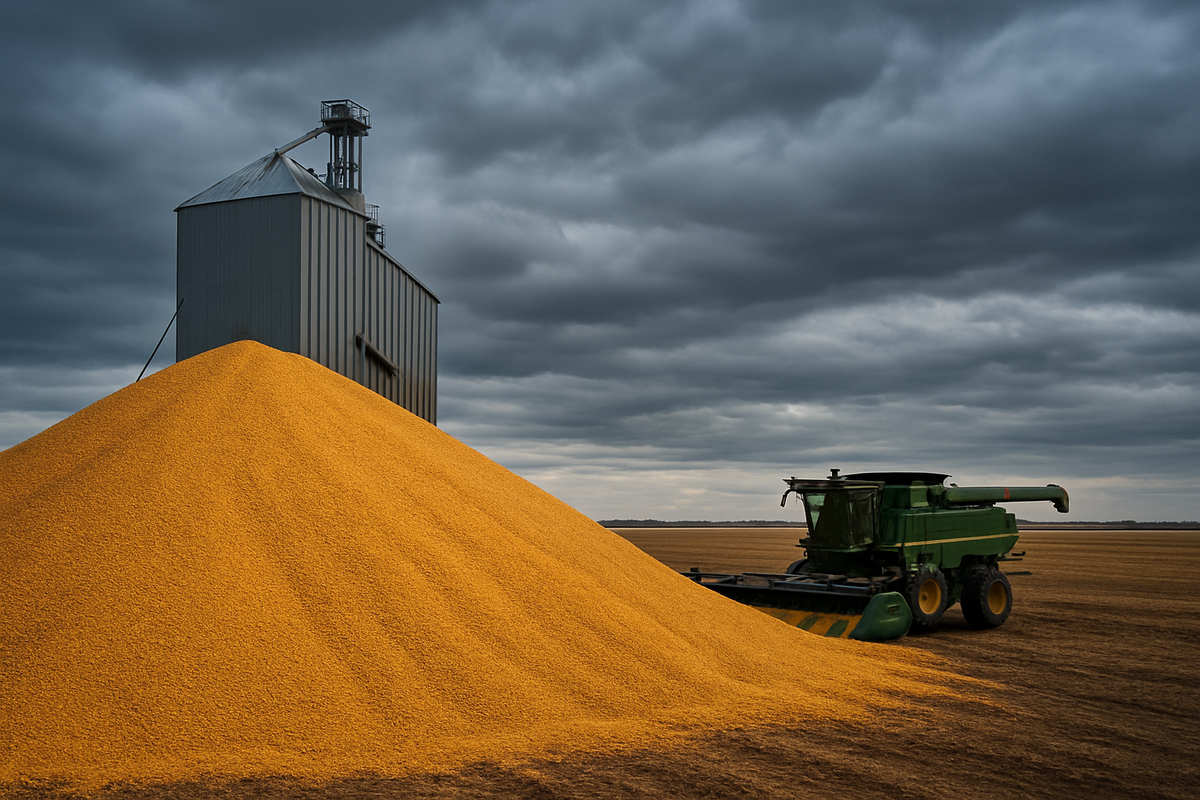
The American heartland has produced a harvest of historic proportions, with the U.S. Department of Agriculture (USDA) confirming a record-shattering 17.021 billion bushels of corn for the 2025-2026 season. This unprecedented supply, revealed in the January 12, 2026, World Agricultural Supply and Demand Estimates (WASDE) report, has immediately sent commodity prices into a tailspin, marking a significant shift in the agricultural landscape. As of January 13, 2026, the market is grappling with the reality of a massive surplus that threatens to keep prices below the cost of production for many American farmers.
While the sheer volume of the crop is a testament to technological advancement and favorable growing conditions, the immediate implications are sobering for producers. Corn futures plummeted more than 24 cents following the announcement, settling at roughly $4.21 per bushel—a level that many growers claim is unsustainable given the rising costs of fuel, fertilizer, and labor. The National Corn Growers Association (NCGA) has already voiced "alarm," warning that this "sea of yellow" could inadvertently trigger a mid-2020s farm crisis if demand-side policies do not catch up to the supply explosion.
The Road to 17 Billion: A Perfect Storm of Yield and Acreage
The path to this 17-billion-bushel milestone was paved by a combination of near-perfect weather across the I-states (Iowa, Illinois, and Indiana) and a significant expansion in harvested acreage. According to the USDA’s Annual Crop Production Summary released yesterday, the average yield hit a record-high 186.5 bushels per acre. This efficiency was coupled with a surge in harvested area to 91.3 million acres, as farmers initially bet on strong global demand that has since been tempered by rising production in competing nations like China and Brazil.
The timeline leading up to this moment began with a surprisingly mild spring in 2025, allowing for early planting and a deep root system that withstood late-summer heat. By the time the harvest concluded in late 2025, grain elevators across the Midwest were already reporting capacity issues. The January 12 report served as the final confirmation of what many analysts had feared: a supply glut of 2.227 billion bushels in ending stocks, a seven-year high. Key stakeholders, including the USDA and global trade partners, are now recalibrating their 2026 outlooks as the world corn production estimate was simultaneously raised to nearly 1.3 billion metric tons.
Winners and Losers in the Ag-Value Chain
The impact of this massive supply is deeply bifurcated across the public markets. Tyson Foods (NYSE: TSN) stands out as a primary beneficiary. As one of the world's largest processors of chicken, beef, and pork, feed represents approximately 60–65% of Tyson’s production costs. The collapse in corn prices provides a significant tailwind for their margins, potentially leading to an earnings beat in the coming quarters as lower input costs filter through the supply chain. Similarly, grain processors like Archer-Daniels-Midland (NYSE: ADM) and Bunge Global SA (NYSE: BG) are positioned to benefit from high processing volumes. While low commodity prices can sometimes squeeze trading margins, the sheer volume of grain moving through their global infrastructure—coupled with strong federal clean fuel mandates—suggests a robust year for their crushing and ethanol segments.
Conversely, the outlook is grim for equipment manufacturers and input providers. John Deere (NYSE: DE) has already warned investors that 2026 may represent the "bottom of the large ag cycle." With corn prices hovering near or below the cost of production, farmers are expected to defer major capital expenditures on tractors and combines. Deere’s net income forecast for 2026 has been adjusted downward as a result. Fertilizer giant CF Industries (NYSE: CF) is also facing a "cost-price squeeze." While nitrogen demand remains essential, the prospect of farmers shifting acreage toward less nutrient-intensive crops like soybeans in 2026 to save on costs poses a direct threat to their domestic sales volume.
Broader Significance: A Glut Without a Home
This record crop fits into a broader industry trend of "peak productivity," where advancements in seed genetics and precision agriculture have outpaced the growth of traditional demand markets. The 2025-2026 season highlights a growing disconnect: the American farmer is more efficient than ever, but the global market is increasingly saturated. This event echoes the supply gluts of the late 1980s, but with the added complexity of modern trade tensions and a more competitive South American agricultural sector.
The regulatory implications are already taking center stage. The NCGA is aggressively lobbying for the nationwide, year-round sale of E15 ethanol—a move they argue would create a reliable "home" for an additional 2 billion bushels of corn annually. Without such policy shifts or the opening of new export markets in regions like Southeast Asia and East Africa, the U.S. risks a prolonged period of suppressed prices. Furthermore, the record production in China (301.2 million tons) suggests that the U.S. can no longer rely on the world’s second-largest economy to absorb its excess supply, fundamentally changing the geopolitical leverage of American corn.
The Horizon: Storage Struggles and Strategic Pivots
In the short term, the primary challenge is physical: where to put all this corn? With quarterly grain stocks up 10% year-over-year, storage costs are expected to rise, further eating into farmer margins. We are likely to see "ground piles" of corn across the Midwest for much of the winter, increasing the risk of spoilage and quality issues. Strategically, many farmers are expected to pivot toward soybeans or alternative crops for the 2026 planting season, which could lead to a massive price correction in the soy market by this time next year.
Longer-term, this surplus may accelerate the adoption of "Sustainable Aviation Fuel" (SAF) and other industrial uses for corn starch. Companies that can innovate in the bio-materials space may find a wealth of cheap feedstock available for years to come. However, for the average producer, the immediate future is one of survival and "belt-tightening." Market opportunities will likely emerge for those with the capital to hold grain until seasonal rallies, but for many, 2026 will be a year of navigating the "profitless prosperity" of a record-breaking harvest.
Closing Thoughts: What to Watch
The 17-billion-bushel corn crop of 2025-2026 is a double-edged sword. It showcases the unparalleled capacity of American agriculture while simultaneously exposing the fragility of farm economics in an era of global oversupply. The key takeaway for the market is a shift from a supply-constrained environment to a demand-driven one. Moving forward, the "corn-to-ethanol" pipeline and export growth will be the only viable valves to release the pressure of this massive inventory.
Investors should keep a close eye on the USDA’s prospective plantings report in March 2026 to see how many farmers are actually planning to abandon corn acreage. Additionally, any movement on E15 legislation in Washington D.C. could provide a much-needed floor for prices. While the "sea of yellow" provides a feast for livestock producers and processors, it serves as a stark reminder that in the world of commodities, sometimes you can have too much of a good thing.
This content is intended for informational purposes only and is not financial advice.